Asus GeForce RTX 3050 LP BRK OC Edition 6GB specifications and in-depth review

Asus GeForce RTX 3050 LP BRK OC Edition 6GB

Manufacturer: Asus

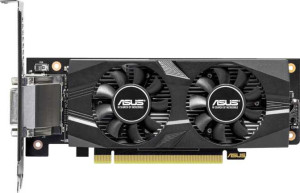
The Asus GeForce RTX 3050 LP BRK OC Edition 6GB is a factory-overclocked, low-profile graphics card designed around NVIDIA's Ampere architecture, intended for compact desktop systems where both space and power headroom are constrained. At 182 mm wide and 69 mm tall, it fits within the physical boundaries of slim and small-form-factor cases while keeping its thermal design power at 70W — a figure that places minimal strain on the power supplies commonly found in such builds. The OC Edition designation reflects a boosted clock target of 1507 MHz, slightly above the standard non-OC variant of this card family.

On the technical side, the card houses 2304 shading units, 72 texture mapping units, and 32 render output units, delivering 6.944 TFLOPS of floating-point performance alongside a pixel rate of 48.22 GPixel/s and a texture rate of 108.5 GTexels/s. Memory consists of 6GB of GDDR6 running at an effective 14000 MHz across a 96-bit bus, yielding up to 168 GB/s of bandwidth, with ECC support included. The feature set covers DirectX 12 Ultimate, OpenGL 4.6, OpenCL 3, ray tracing, DLSS, stereoscopic 3D, and Intel Resizable BAR, while XeSS and RGB lighting are absent. Display output spans three connections — one HDMI 2.1 port, one DisplayPort, and one DVI output — allowing simultaneous use of up to three monitors. The card connects via PCIe 4 and does not include an air-water hybrid cooling configuration.

Pros
  • The low-profile form factor of 182 mm × 69 mm allows installation in compact and slim desktop cases that cannot fit standard full-height graphics cards
  • A 70W TDP places very modest demands on system power supplies, making the card compatible with the smaller PSUs commonly found in small-form-factor builds
  • The factory overclock pushes the boost clock to 1507 MHz, resulting in a floating-point throughput of 6.944 TFLOPS without requiring any manual tuning
  • Ray tracing and DLSS are both supported, enabling access to hardware-accelerated rendering features within the constraints of a low-profile design
  • The presence of a DVI output alongside HDMI 2.1 and DisplayPort allows three displays to be connected simultaneously, including legacy monitors without modern digital inputs
  • ECC memory support provides hardware error correction, which is beneficial for GPU compute tasks where memory data integrity is critical
Cons
  • The 96-bit memory bus is narrow for a 6GB card, capping memory bandwidth at 168 GB/s and creating a potential bottleneck for memory-intensive workloads
  • 6GB of VRAM limits the card's usefulness in tasks that require large GPU memory allocations, such as high-resolution rendering or large-dataset compute jobs
  • XeSS (XMX) upscaling is not supported, leaving DLSS as the only available upscaling technology
  • Only one HDMI port is provided, which restricts options for users who need multiple high-bandwidth HDMI connections simultaneously
  • RGB lighting is absent, which may matter to users building systems where visual customization is a consideration
  • An air-water hybrid cooling option is not available, leaving users with only the card's default cooling configuration
Who is this for?

The Asus GeForce RTX 3050 LP BRK OC Edition 6GB is well-suited for users assembling systems in compact or slim small-form-factor cases, where its 182 mm × 69 mm footprint and 70W TDP make it one of the few graphics cards that can physically fit and operate without stressing the power supply. Users who want ray tracing and DLSS support within a low-profile card will find this OC Edition a capable option, as both features are present alongside DirectX 12 Ultimate and Intel Resizable BAR. It is also a reasonable fit for those running GPU compute workloads that benefit from ECC memory support and Double Precision Floating Point capability, provided the workloads stay within the card's memory capacity.

Who is this NOT for?

Users who work with memory-intensive applications or high-resolution rendering will find the combination of 6GB VRAM and a 96-bit memory bus a meaningful limitation, as these constraints restrict how much data can be stored and transferred efficiently under heavy load. The card is also a poor match for those who rely on XeSS upscaling or need more than one HDMI output for a high-bandwidth multi-display setup, as neither is supported in this configuration. Additionally, users expecting visual customization through RGB lighting or alternative thermal management via air-water hybrid cooling will find neither option available on this card.

Performance:

GPU clock speed 1042 MHz
GPU turbo 1507 MHz
pixel rate 48.22 GPixel/s
floating-point performance 6.944 TFLOPS
texture rate 108.5 GTexels/s
GPU memory speed 1750 MHz
shading units 2304
texture mapping units (TMUs) 72
render output units (ROPs) 32
Has Double Precision Floating Point (DPFP)

The GPU operates at a base clock of 1042 MHz and reaches a boost of 1507 MHz, with GPU memory running at 1750 MHz. Overall compute throughput comes in at 6.944 TFLOPS, accompanied by a pixel rate of 48.22 GPixel/s and a texture rate of 108.5 GTexels/s. The shader array consists of 2304 shading units, 72 texture mapping units (TMUs), and 32 render output units (ROPs), rounding out the card's compute pipeline. Double Precision Floating Point (DPFP) is supported, which allows the card to handle workloads that require higher numerical accuracy beyond standard single-precision tasks.

Memory:

effective memory speed 14000 MHz
maximum memory bandwidth 168 GB/s
VRAM 6GB
GDDR version GDDR6
memory bus width 96-bit
Supports ECC memory

Memory configuration consists of 6GB of GDDR6 VRAM running at an effective speed of 14000 MHz, with a maximum memory bandwidth of 168 GB/s delivered through a 96-bit bus. The 96-bit interface is on the narrower side for this capacity, though the high effective clock rate helps maintain usable throughput across typical workloads. ECC memory support is present, providing hardware-level error correction for tasks where data reliability in GPU memory is a priority.

Features:

DirectX version DirectX 12 Ultimate
OpenGL version 4.6
OpenCL version 3
Supports multi-display technology
supports ray tracing
Supports 3D
supports DLSS
has XeSS (XMX)
AMD SAM / Intel Resizable BAR Intel Resizable BAR
has LHR
has RGB lighting
supported displays 3

The card supports DirectX 12 Ultimate, OpenGL 4.6, and OpenCL 3, covering both modern graphics rendering and GPU compute workloads. Ray tracing and DLSS are both enabled, and stereoscopic 3D is supported as well; XeSS (XMX) is not available on this card. Multi-display technology is supported, allowing up to three screens to be connected simultaneously, and Intel Resizable BAR is included to improve memory access efficiency between the CPU and GPU. LHR is not present, and the card ships without RGB lighting.

Ports:

has an HDMI output
HDMI ports 1
HDMI version HDMI 2.1
DisplayPort outputs 1
USB-C ports 0
DVI outputs 1
mini DisplayPort outputs 0

The card provides three physical display outputs: one HDMI 2.1 port, one DisplayPort, and one DVI output, the last of which extends compatibility to older displays that do not support modern digital interfaces. No USB-C ports or mini DisplayPort connections are present, and the bracket layout remains compact in keeping with the card's low-profile design.

General info:

GPU architecture Ampere
Thermal Design Power (TDP) 70W
PCI Express (PCIe) version 4
semiconductor size 8 nm
number of transistors 8700 million
Has air-water cooling
width 182 mm
height 69 mm

Built on the Ampere architecture using an 8 nm fabrication process, the GPU integrates 8700 million transistors and connects to the system via PCIe 4. The card measures 182 mm in width and 69 mm in height, fitting within standard low-profile bracket dimensions. Its thermal design power of 70W keeps demands on system power delivery low, which aligns well with the compact and slim enclosures this card is designed for. An air-water hybrid cooling solution is not part of this card's configuration.
Final Verdict

The Asus GeForce RTX 3050 LP BRK OC Edition 6GB occupies a specific and well-defined role as a factory-overclocked, low-profile graphics card built for compact systems where full-size cards simply cannot be used. Its 182 mm × 69 mm footprint combined with a 70W TDP makes it a practical solution for slim and small-form-factor builds, while the OC Edition tuning pushes the boost clock to 1507 MHz to extract a bit more throughput without increasing power demands. Ray tracing, DLSS, ECC memory support, and Intel Resizable BAR round out a feature set that goes well beyond what the card's physical size might suggest. Users who go in with a clear understanding of the VRAM and memory bus constraints will find the Asus RTX 3050 LP BRK OC Edition 6GB a coherent, capable, and space-efficient graphics card that delivers on what it is designed to do.

Popular Comparisons

Asus GeForce RTX 3050 LP BRK OC Edition 6GB
VS
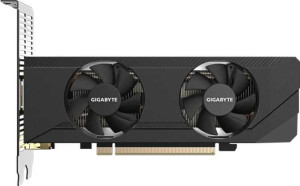
Gigabyte GeForce RTX 3050 OC Low Profile 6GB