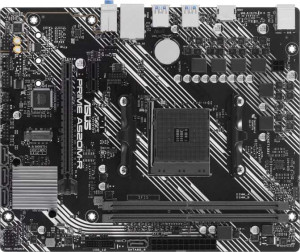
The Asus Prime A520M-R is a Micro-ATX motherboard built on the AM4 socket with an A520 chipset, measuring 236 mm wide and 193 mm tall. It carries a single CPU socket, includes an HDMI 2.1 output, and supports easy BIOS reset, though it does not offer dual BIOS, overclocking support, integrated graphics, or an integrated CPU. Wi-Fi and Bluetooth are not present, nor is RGB lighting, and the board comes with a 3-year warranty.
The board supports up to 64GB of DDR4 memory across two slots running in dual-channel configuration, with a standard maximum speed of 3200 MHz and an overclocked ceiling of 5100 MHz. ECC memory is supported, which adds a layer of data integrity for workloads where memory error correction is a requirement.
The rear I/O panel provides four USB 3.2 Gen 1 Type-A ports and two USB 2.0 ports for peripheral connectivity, alongside an HDMI output and one RJ45 port for wired networking. Two PS/2 ports are also present for legacy input devices. There are no USB Type-C, DisplayPort, DVI, VGA, or eSATA outputs, and higher-speed standards such as USB 3.2 Gen 2, USB 4, Thunderbolt 3, or Thunderbolt 4 are not available on this board.
Internal connectivity includes four SATA 3 connectors for storage drives and one M.2 socket for NVMe or SATA-based solid state drives, while SATA 2 and U.2 sockets are absent. USB expansion headers cover two USB 3.2 Gen 1 ports, two additional USB 3.0 ports, and four USB 2.0 ports for front panel or expansion use. The board also features a TPM connector for hardware security modules and two fan headers for cooling management. An mSATA connector is not included.
The board offers one PCIe 3.0 x16 slot for a dedicated graphics card or other full-length expansion card, alongside one PCIe x1 slot for smaller add-in cards. There are no PCIe 4.0, PCIe 5.0, PCIe 2.0 x16, PCIe x4, PCIe x8, or legacy PCI slots available, keeping the expansion options straightforward and focused on the essentials for a Micro-ATX build.
The board supports 7.1-channel audio through three analog audio connectors on the rear I/O. A S/PDIF output port is not included, so digital audio passthrough via that interface is not an option.
The board supports RAID 0, RAID 1, and RAID 10 configurations for multi-drive storage setups, covering the most common modes for performance striping, mirroring, and a combination of both. RAID 5 and RAID 0+1 are not supported.