Asus ProArt GeForce RTX 4070 Super OC Edition specifications and in-depth review

Asus ProArt GeForce RTX 4070 Super OC Edition

Manufacturer: Asus

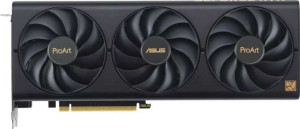
The Asus ProArt GeForce RTX 4070 Super OC Edition is a graphics card built around NVIDIA's Ada Lovelace architecture, fabricated on a 5 nm process with 35,800 million transistors. Positioned within Asus's ProArt line, it forgoes RGB lighting in favor of a more restrained aesthetic, while still delivering support for up to four simultaneous displays through three DisplayPort outputs and one HDMI 2.1a port. It connects via PCIe 4.0 and carries a rated TDP of 220W, with physical dimensions of 300 mm in width and 120 mm in height.

The card operates at a base clock of 1980 MHz with a boost frequency of 2535 MHz, producing 36.34 TFLOPS of floating-point throughput alongside a pixel rate of 202.8 GPixel/s and a texture rate of 567.8 GTexels/s. Its 7,168 shading units are supported by 224 texture mapping units and 80 render output units. On the memory side, 12GB of GDDR6X VRAM runs at an effective 21,000 MHz across a 192-bit bus, yielding a maximum bandwidth of 504.2 GB/s, with ECC memory support also included. Feature coverage extends to DirectX 12 Ultimate, OpenGL 4.6, OpenCL 3, ray tracing, DLSS, stereoscopic 3D, and Intel Resizable BAR, while Double Precision Floating Point support adds relevance for compute-oriented workloads.

Pros
  • At 300 mm wide and 120 mm tall, the card has a relatively compact form factor that fits more easily into mid-tower and smaller full-size cases
  • ECC memory support adds data integrity coverage useful for precision-sensitive or compute-oriented workloads
  • Double Precision Floating Point (DPFP) is supported, making the card relevant for tasks that require higher numerical accuracy
  • Ray tracing and DLSS are both available, enabling more advanced rendering in compatible applications
  • Support for up to four simultaneous displays via three DisplayPort and one HDMI 2.1a output suits multi-monitor workflows
  • Intel Resizable BAR support is included, allowing the CPU broader access to GPU memory during operation
Cons
  • The boost clock of 2535 MHz is lower than some other RTX 4070 Super variants, resulting in a slightly reduced floating-point throughput of 36.34 TFLOPS
  • The 192-bit memory bus width places a ceiling on memory bandwidth scaling that wider bus implementations would not face
  • RGB lighting is absent, which limits visual customization options for users who want it
  • No USB-C, DVI, or mini DisplayPort outputs are present, which may require adapters for certain display setups
  • XeSS (XMX) upscaling is not supported, ruling out that particular technology for compatible workloads
Who is this for?

The Asus ProArt GeForce RTX 4070 Super OC Edition is a solid fit for users who prioritize a compact, workstation-oriented build, as its 300 mm width and 120 mm height allow it to slot into cases where longer cards would not. Its inclusion of ECC memory and Double Precision Floating Point support makes it relevant for compute and content creation workloads where data accuracy matters, while ray tracing and DLSS availability broaden its usefulness for rendering pipelines and graphics-intensive applications. Those who need to drive up to four displays simultaneously through a mix of DisplayPort and HDMI 2.1a outputs will also find the connectivity well-suited to professional multi-monitor setups.

Who is this NOT for?

Users seeking the highest possible boost clocks or floating-point throughput within the RTX 4070 Super lineup may find this card's 2535 MHz boost frequency and 36.34 TFLOPS output less than what higher-clocked variants of the same GPU can offer. The absence of RGB lighting makes it a poor match for system builders who want visual customization as part of their setup. Additionally, those who depend on USB-C display output or XeSS upscaling will need to look elsewhere, as neither feature is present on this model.

Performance:

GPU clock speed 1980 MHz
GPU turbo 2535 MHz
pixel rate 202.8 GPixel/s
floating-point performance 36.34 TFLOPS
texture rate 567.8 GTexels/s
GPU memory speed 1313 MHz
shading units 7168
texture mapping units (TMUs) 224
render output units (ROPs) 80
Has Double Precision Floating Point (DPFP)

The card runs at a base GPU clock of 1980 MHz, boosting up to 2535 MHz, and delivers 36.34 TFLOPS of floating-point performance alongside a pixel rate of 202.8 GPixel/s and a texture rate of 567.8 GTexels/s. Its compute backbone consists of 7,168 shading units, 224 texture mapping units, and 80 render output units, with GPU memory operating at 1313 MHz. Double Precision Floating Point (DPFP) is supported, extending the card's applicability to workloads that require higher arithmetic precision.

Memory:

effective memory speed 21000 MHz
maximum memory bandwidth 504.2 GB/s
VRAM 12GB
GDDR version GDDR6X
memory bus width 192-bit
Supports ECC memory

Memory is handled by 12GB of GDDR6X VRAM running at an effective speed of 21,000 MHz over a 192-bit bus, delivering a maximum bandwidth of 504.2 GB/s. ECC memory support is also present, which provides a measure of data integrity for workloads where memory accuracy is a concern.

Features:

DirectX version DirectX 12 Ultimate
OpenGL version 4.6
OpenCL version 3
Supports multi-display technology
supports ray tracing
Supports 3D
supports DLSS
has XeSS (XMX)
AMD SAM / Intel Resizable BAR Intel Resizable BAR
has LHR
has RGB lighting
supported displays 4

The card supports DirectX 12 Ultimate, OpenGL 4.6, and OpenCL 3, providing broad compatibility across graphics and compute applications. Ray tracing and DLSS are both included, while XeSS (XMX) is not supported. Multi-display technology is available with support for up to four simultaneous outputs, and stereoscopic 3D is also enabled. Intel Resizable BAR is supported, whereas LHR is not present. The card does not feature RGB lighting, reflecting the more understated design approach of this product line.

Ports:

has an HDMI output
HDMI ports 1
HDMI version HDMI 2.1a
DisplayPort outputs 3
USB-C ports 0
DVI outputs 0
mini DisplayPort outputs 0

The card provides three DisplayPort outputs and a single HDMI 2.1a port, totaling four video outputs available simultaneously. USB-C, DVI, and mini DisplayPort connections are not present on this model.

General info:

GPU architecture Ada Lovelace
Thermal Design Power (TDP) 220W
PCI Express (PCIe) version 4
semiconductor size 5 nm
number of transistors 35800 million
Has air-water cooling
width 300 mm
height 120 mm

The card is built on the Ada Lovelace architecture using a 5 nm fabrication process, integrating 35,800 million transistors and interfacing with the system over PCIe 4.0. It has a Thermal Design Power of 220W and relies solely on air cooling, as air-water cooling is not included. At 300 mm wide and 120 mm tall, it has a relatively compact footprint for its class.
Final Verdict

The Asus ProArt GeForce RTX 4070 Super OC Edition is a graphics card that carves out a clear identity through its compact dimensions and workstation-relevant feature set, making it a considered option for users who need a capable GPU that fits within tighter physical constraints without sacrificing multi-display support or compute-oriented capabilities like ECC memory and DPFP. Its 12GB of GDDR6X VRAM with 504.2 GB/s bandwidth, combined with ray tracing and DLSS support, gives it enough technical breadth to serve both creative and compute workloads effectively. Users who require RGB customization, USB-C output, or the absolute highest boost clocks available in this GPU tier may find it falls short in those specific areas, but for those whose priorities align with its strengths — namely a compact, professional-leaning build with solid memory and display capabilities — the ProArt RTX 4070 Super OC Edition delivers a well-rounded and purpose-driven package.