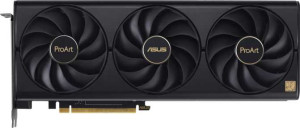
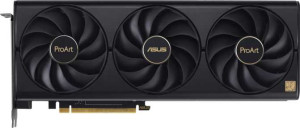
Asus ProArt GeForce RTX 4080 Super OC Edition specifications and in-depth review

Asus ProArt GeForce RTX 4080 Super OC Edition

Manufacturer: Asus

The Asus ProArt GeForce RTX 4080 Super OC Edition is a graphics card from Asus designed around Nvidia's Ada Lovelace architecture, fabricated on a 5 nm process node with 45,900 million transistors. It runs at a base clock of 2295 MHz and reaches a boost clock of 2610 MHz under load, with support for ray tracing, DLSS, DirectX 12 Ultimate, stereoscopic 3D, and RGB lighting. Up to four displays can be driven simultaneously through its four available output ports.

The card is equipped with 16GB of GDDR6X VRAM on a 256-bit memory bus running at an effective speed of 23,000 MHz, providing a peak bandwidth of 736.3 GB/s. ECC memory support and Intel Resizable BAR are both present. With 10,240 shading units, 320 texture mapping units, and 112 render output units, it delivers a texture rate of 835.2 GTexels/s and 53.45 TFLOPS of floating-point throughput. The output configuration consists of one HDMI 2.1a port and three DisplayPort outputs, with no USB-C, DVI, or mini DisplayPort connections available. The card has a 320W TDP, connects via PCIe 4.0, and measures 300 mm in width and 120 mm in height, with air cooling only.

Pros
  • 16GB of GDDR6X VRAM on a 256-bit bus supports memory-intensive rendering and compute workloads
  • A peak memory bandwidth of 736.3 GB/s enables sustained high-speed data throughput for demanding tasks
  • ECC memory support provides data integrity assurance for reliability-sensitive workloads
  • Ray tracing and DLSS are both supported alongside DirectX 12 Ultimate, covering advanced rendering use cases
  • At 300 mm wide and 120 mm tall, the card occupies a more compact footprint than many other cards at this specification tier
  • Intel Resizable BAR support is included, allowing broader CPU access to the full VRAM pool
Cons
  • A 320W TDP places significant power demands on the host system, requiring adequate power supply headroom
  • Water cooling is not supported, restricting thermal management entirely to the built-in air cooling solution
  • No USB-C output is available, limiting display compatibility for users with USB-C or Thunderbolt-based monitors
  • XeSS (XMX) is not supported, leaving DLSS as the only hardware-accelerated upscaling option
  • Only one HDMI port is provided, which may be restrictive for users who rely primarily on HDMI connections
Who is this for?

The Asus ProArt GeForce RTX 4080 Super OC Edition is a strong fit for users engaged in compute and content creation workloads that benefit from a large VRAM pool, high memory bandwidth, and ECC memory support — all of which are present on this card. Its 53.45 TFLOPS of floating-point throughput and 10,240 shading units make it well-suited for rendering-intensive tasks that can take advantage of ray tracing, DLSS, and DirectX 12 Ultimate. The card's relatively compact dimensions of 300 mm by 120 mm also make it a practical option for users who need high-tier GPU specifications in a more space-conscious build than larger cards in this class typically allow.

Who is this NOT for?

Users building in cases with strict power constraints may find the 320W TDP a limiting factor, as it demands a well-rated power supply and sufficient system cooling to operate reliably. Those who require water-cooling integration will not find support for it here, as the card is limited to air cooling only. Users who depend on USB-C display output will also be underserved, since no such port is present, and those needing more than one HDMI connection will find only a single HDMI 2.1a port available on this card.

Performance:

GPU clock speed 2295 MHz
GPU turbo 2610 MHz
pixel rate 292.3 GPixel/s
floating-point performance 53.45 TFLOPS
texture rate 835.2 GTexels/s
GPU memory speed 1438 MHz
shading units 10240
texture mapping units (TMUs) 320
render output units (ROPs) 112
Has Double Precision Floating Point (DPFP)

The card runs at a base GPU clock of 2295 MHz and reaches a boost of 2610 MHz, with a GPU memory speed of 1438 MHz. Its 10,240 shading units are paired with 320 texture mapping units and 112 render output units, producing a texture rate of 835.2 GTexels/s and a pixel rate of 292.3 GPixel/s. Overall floating-point throughput comes to 53.45 TFLOPS, and Double Precision Floating Point (DPFP) is supported.

Memory:

effective memory speed 23000 MHz
maximum memory bandwidth 736.3 GB/s
VRAM 16GB
GDDR version GDDR6X
memory bus width 256-bit
Supports ECC memory

The card is equipped with 16GB of GDDR6X VRAM running across a 256-bit memory bus at an effective speed of 23,000 MHz, delivering a maximum bandwidth of 736.3 GB/s. ECC memory support is also included, providing data reliability for workloads where memory integrity is a requirement.

Features:

DirectX version DirectX 12 Ultimate
OpenGL version 4.6
OpenCL version 3
Supports multi-display technology
supports ray tracing
Supports 3D
supports DLSS
has XeSS (XMX)
AMD SAM / Intel Resizable BAR Intel Resizable BAR
has LHR
has RGB lighting
supported displays 4

The card supports DirectX 12 Ultimate, OpenGL 4.6, and OpenCL 3, providing compatibility across a wide range of modern rendering and compute environments. Ray tracing and DLSS are both enabled, while XeSS (XMX) is not supported. Multi-display technology allows up to four screens to be connected simultaneously, and stereoscopic 3D is available. Intel Resizable BAR is supported, LHR is absent, and RGB lighting is included as part of the card's feature set.

Ports:

has an HDMI output
HDMI ports 1
HDMI version HDMI 2.1a
DisplayPort outputs 3
USB-C ports 0
DVI outputs 0
mini DisplayPort outputs 0

Output connectivity is provided through one HDMI 2.1a port and three DisplayPort outputs, giving a total of four available video connections. USB-C, DVI, and mini DisplayPort outputs are not present on this card.

General info:

GPU architecture Ada Lovelace
Thermal Design Power (TDP) 320W
PCI Express (PCIe) version 4
semiconductor size 5 nm
number of transistors 45900 million
Has air-water cooling
width 300 mm
height 120 mm

Grounded in the Ada Lovelace architecture and built on a 5 nm process, this card integrates 45,900 million transistors and connects to the host system via PCIe 4.0. Its Thermal Design Power is rated at 320W, and cooling is limited to air only, as water cooling is not supported. Physical dimensions come in at 300 mm in width and 120 mm in height, making it more compact than some other cards at this specification level.
Final Verdict

The Asus ProArt GeForce RTX 4080 Super OC Edition is a well-specified graphics card that combines high compute throughput with a generous 16GB of GDDR6X VRAM backed by ECC memory support, making it a coherent option for users whose workloads demand both raw performance and memory reliability. Its relatively compact physical footprint adds practical value for builds where space is a consideration, while the full feature set — including ray tracing, DLSS, and DirectX 12 Ultimate — ensures broad compatibility with modern rendering pipelines. The 320W TDP and absence of water-cooling support are real system requirements to account for, and users dependent on USB-C display output will need to plan accordingly. Taken as a whole, the Asus ProArt GeForce RTX 4080 Super OC Edition presents a focused and capable package for users whose needs align with its specification profile.

Popular Comparisons

Asus ProArt GeForce RTX 4080 Super OC Edition
VS
Asus ProArt GeForce RTX 4080 Super
Asus ProArt GeForce RTX 4080 Super OC Edition
VS
Asus TUF Gaming GeForce RTX 4080 Super OC Edition
Asus ProArt GeForce RTX 4080 Super OC Edition
VS
Gigabyte GeForce RTX 5080 Aero OC SFF