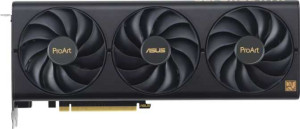
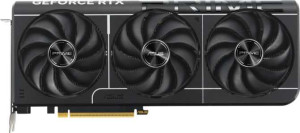
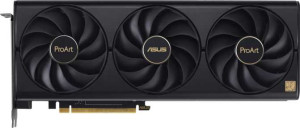
Asus ProArt GeForce RTX 4080 Super specifications and in-depth review

Asus ProArt GeForce RTX 4080 Super

Manufacturer: Asus

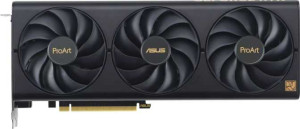
The Asus ProArt GeForce RTX 4080 Super is a graphics card built around NVIDIA's Ada Lovelace architecture, manufactured on a 5 nm process with 45,900 million transistors. Designed with workstation and creative users in mind, it features RGB lighting, support for up to four simultaneous displays, and DLSS alongside ray tracing and DirectX 12 Ultimate. Its 52.22 TFLOPS of floating-point performance reflects a compute-oriented specification that extends well beyond typical consumer gaming use cases.

The card's 10,240 shading units are paired with 320 texture mapping units and 112 render output units, yielding a texture rate of 816 GTexels/s and a pixel fill rate of 285.6 GPixel/s. On the memory side, 16GB of GDDR6X VRAM runs across a 256-bit bus at an effective speed of 23,000 MHz, delivering up to 736.3 GB/s of bandwidth. ECC memory is supported, Intel Resizable BAR is included, and LHR is absent. Output connectivity covers one HDMI 2.1a port and three DisplayPort outputs, with no USB-C, DVI, or mini DisplayPort connections present. The card carries a 320W TDP and measures 300 mm wide by 120 mm tall, with air-water cooling not included.

Pros
  • With 52.22 TFLOPS of floating-point performance and Double Precision Floating Point support, the card handles compute-intensive workloads that go well beyond standard graphics rendering
  • The 736.3 GB/s of memory bandwidth delivered via GDDR6X at 23,000 MHz effective speed provides substantial throughput for texture-heavy and data-intensive tasks
  • DLSS and ray tracing are both supported alongside DirectX 12 Ultimate, keeping the card aligned with current and near-future rendering pipelines
  • ECC memory support adds a meaningful layer of data integrity for users who run professional or scientific GPU workloads
  • Intel Resizable BAR is included, enabling compatible systems to access the full 16GB VRAM pool more efficiently
  • At 300 mm wide and 120 mm tall, the card has a relatively contained physical profile for its specification tier, offering better case compatibility than many cards at this level
Cons
  • A 320W TDP places significant demands on both the power supply and system cooling, requiring a well-ventilated case and a sufficiently rated PSU
  • Air-water cooling is not supported, so users cannot pursue a liquid cooling solution for this card directly
  • XeSS (XMX) upscaling is absent, meaning users who rely on that technology will need to depend solely on DLSS for upscaling
  • The single HDMI port limits flexibility for users who need to connect multiple HDMI-only displays without adapters
  • No USB-C, DVI, or mini DisplayPort outputs are present, which may restrict connectivity options for users with older or specialized display hardware
Who is this for?

The Asus ProArt GeForce RTX 4080 Super is a strong fit for users who need both rendering capability and compute reliability in the same card. Its 52.22 TFLOPS of floating-point performance paired with ECC memory support makes it well-suited for GPU-accelerated workloads where data accuracy matters, such as scientific computation or professional content creation. The inclusion of DLSS, ray tracing, and DirectX 12 Ultimate also means it handles modern gaming and real-time rendering pipelines without compromise, while the four-display output configuration suits users who need an expansive multi-monitor workspace. Those running Intel Resizable BAR-compatible platforms will additionally benefit from more efficient VRAM access across the full 16GB pool.

Who is this NOT for?

With a 320W TDP and no air-water cooling support, this card is a poor match for compact or small form factor builds where thermal headroom is tight and power delivery is constrained. Users who need more than one HDMI connection — for example, to run multiple HDMI-only displays or devices simultaneously — will find the single HDMI port limiting without additional adapters. The card is also not suited to users who rely on XeSS (XMX) upscaling, as that technology is absent, making DLSS the only AI upscaling option available. Those looking for a straightforward, low-maintenance setup without careful attention to case sizing and airflow may also find the power and thermal profile more demanding than they can accommodate.

Performance:

GPU clock speed 2295 MHz
GPU turbo 2550 MHz
pixel rate 285.6 GPixel/s
floating-point performance 52.22 TFLOPS
texture rate 816 GTexels/s
GPU memory speed 1438 MHz
shading units 10240
texture mapping units (TMUs) 320
render output units (ROPs) 112
Has Double Precision Floating Point (DPFP)

The GPU runs at a base clock of 2295 MHz and reaches a boost of 2550 MHz, with 10,240 shading units, 320 texture mapping units, and 112 render output units working together to produce a texture rate of 816 GTexels/s and a pixel fill rate of 285.6 GPixel/s. Floating-point performance is rated at 52.22 TFLOPS, reflecting a compute-capable specification suited to demanding workloads. GPU memory operates at 1438 MHz, and Double Precision Floating Point is supported, adding utility for tasks that require higher numerical precision beyond standard single-precision compute.

Memory:

effective memory speed 23000 MHz
maximum memory bandwidth 736.3 GB/s
VRAM 16GB
GDDR version GDDR6X
memory bus width 256-bit
Supports ECC memory

The card is equipped with 16GB of GDDR6X VRAM running across a 256-bit memory bus at an effective speed of 23,000 MHz, resulting in a maximum memory bandwidth of 736.3 GB/s. ECC memory support is included, which benefits users running compute workloads where data integrity is a priority alongside standard graphics tasks.

Features:

DirectX version DirectX 12 Ultimate
OpenGL version 4.6
OpenCL version 3
Supports multi-display technology
supports ray tracing
Supports 3D
supports DLSS
has XeSS (XMX)
AMD SAM / Intel Resizable BAR Intel Resizable BAR
has LHR
has RGB lighting
supported displays 4

The card supports DirectX 12 Ultimate, OpenGL 4.6, and OpenCL 3, providing broad compatibility across modern graphics and compute workloads. Ray tracing, stereoscopic 3D, and multi-display technology are all supported, with up to four screens drivable simultaneously. DLSS is included for AI-based upscaling in compatible applications, while XeSS (XMX) is not available. Intel Resizable BAR is present, LHR is absent, and RGB lighting is integrated into the card's design.

Ports:

has an HDMI output
HDMI ports 1
HDMI version HDMI 2.1a
DisplayPort outputs 3
USB-C ports 0
DVI outputs 0
mini DisplayPort outputs 0

The card provides four video outputs in total, comprising one HDMI 2.1a port and three DisplayPort outputs. There are no USB-C, DVI, or mini DisplayPort connections on this model.

General info:

GPU architecture Ada Lovelace
Thermal Design Power (TDP) 320W
PCI Express (PCIe) version 4
semiconductor size 5 nm
number of transistors 45900 million
Has air-water cooling
width 300 mm
height 120 mm

Underpinned by the Ada Lovelace architecture, the GPU is built on a 5 nm process and integrates 45,900 million transistors, connecting to the host system via PCIe 4. The card carries a 320W TDP, which places meaningful demands on system power delivery and airflow; air-water cooling is not supported. Its physical footprint measures 300 mm in width and 120 mm in height, making case clearance an important consideration during system planning.
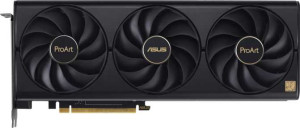
Final Verdict

The Asus ProArt GeForce RTX 4080 Super is a well-specified graphics card that bridges professional compute and high-end graphics rendering within a single unit. Its 52.22 TFLOPS of floating-point performance combined with ECC memory support and 736.3 GB/s of memory bandwidth give it genuine credibility for users whose workloads demand both throughput and data reliability. The 320W TDP and absence of liquid cooling support mean it requires a thoughtfully built system to operate at its best, and those constraints will naturally limit its audience. For users whose platform and case setup can accommodate its demands, the Asus ProArt RTX 4080 Super represents a technically coherent choice that serves creative, compute, and gaming workloads with equal conviction.

Popular Comparisons

Asus ProArt GeForce RTX 4080 Super
VS
Asus ProArt GeForce RTX 4070 Super
Asus ProArt GeForce RTX 4080 Super
VS
Asus ProArt GeForce RTX 4060 Ti 16GB
Asus ProArt GeForce RTX 4080 Super
VS
Asus Prime GeForce RTX 5080 OC Edition
Asus ProArt GeForce RTX 4080 Super
VS
Asus ProArt GeForce RTX 4080 Super OC Edition