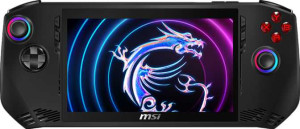
The Performance section of the Asus ROG Ally X (Z1 Extreme) centers on an eight-core CPU running at 3.3 GHz per core alongside an integrated GPU clocked at 1500 MHz, with 8.6 TFLOPS of floating-point performance delivered through 12 compute units, 768 shading units, and 32 render output units. The system supports multithreading and ray tracing, and pairs these GPU resources with 24GB of DDR5 memory operating at 7500 MHz for a memory bandwidth of 51.2 GB/s. Storage runs on an NVMe SSD with support for connecting an external drive, while the display side of performance is backed by a 120Hz refresh rate to keep visuals smooth during gameplay.
The Asus ROG Ally X (Z1 Extreme) functions as both a handheld and home console, featuring a 7″ IPS display with a native resolution of 1080p Full HD and a typical brightness of 500 nits, while also supporting 4K output when connected to an external display. It comes with 1024GB of internal storage on a replaceable drive, an internal power supply, and an 80 Wh battery, with no optical disc drive included. The device is region free and measures 280 mm wide, 111 mm tall, and 36 mm thick, with a total volume of 1118.88 cm³ and a weight of 678 g.
The ROG Ally X (Z1 Extreme) covers wireless connectivity through Wi-Fi 6E (802.11ax) — also backward compatible with Wi-Fi 6, 5, and 4 — along with Bluetooth 5.2 and DLNA certification, though it does not include a cellular module, NFC, or an RJ45 port for wired networking. Wired connections are handled by two USB 3.2 Type-C ports and an HDMI output, with an external memory slot available for storage expansion. A 3.5 mm headset jack is present, while cross-device connectivity between home and portable modes is not supported.
The ROG Ally X (Z1 Extreme) sports a 7″ touchscreen with a pixel density of 315 ppi, backed by stereo speakers with two-channel sound output, 3D audio support, and flash storage, while Dolby Vision, Blu-ray and 4K Blu-ray playback, stereoscopic 3D, an autostereoscopic display, a secondary screen, a front camera, and optical tracking are all absent. On the software and usability side, the device supports voice commands, quick resume, background downloading during gameplay, Discord voice chat, VR, and access to high scores and achievements, alongside a child lock for parental control. It does not include dual sensors for 3D capture, and sound output is limited to a standard stereo configuration.
The ROG Ally X (Z1 Extreme) supports up to 4 controllers and includes a wireless controller compatible with motion-sensing input, giving it reasonable flexibility for different play styles. The built-in control layout offers 16 buttons and 2 analog sticks, though there is no integrated touchpad, no adaptive triggers, and no dual force feedback.
The ROG Ally X (Z1 Extreme) includes support for Dolby Atmos, enabling spatial audio output through compatible headphones or speakers.