Asus ROG G700 (2025) (Ultra 7 265KF / RTX 5070 / 128GB RAM / 2TB SSD) specifications and in-depth review

Asus ROG G700 (2025) (Ultra 7 265KF / RTX 5070 / 128GB RAM / 2TB SSD)

Manufacturer: Asus

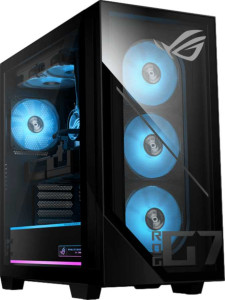
The Asus ROG G700 (2025) is a desktop gaming PC built around Intel's Ultra 7 265KF processor and NVIDIA's RTX 5070 graphics card. Configured with 128GB of DDR5 RAM and a 2TB NVMe SSD, this ATX-form-factor system is positioned toward users who need substantial memory capacity and fast storage in a single build. The chassis measures 510 mm in height, 421 mm in thickness, and 185 mm in width, resulting in a total volume of roughly 39,721 cm³.

On the graphics side, the RTX 5070 is based on NVIDIA's Blackwell architecture, delivering 30.84 TFLOPS of floating-point performance alongside a 192-bit GDDR7 memory bus running at an effective 28,000 MHz with a maximum bandwidth of 672 GB/s. The GPU supports DirectX 12 Ultimate, ray tracing, DLSS, and up to four simultaneous displays via two HDMI 2.1b outputs and four DisplayPort connections. The Intel Ultra 7 265KF CPU operates across 20 threads with a turbo frequency of 5.5 GHz, paired with 36 MB of L2 cache and 30 MB of L3 cache, and posts a PassMark multi-core score of 58,904. Connectivity includes Wi-Fi 6E, Bluetooth, one RJ45 port, and a range of USB options spanning USB 2.0, USB 3.2 Gen 1, and one USB 3.2 Gen 2 Type-C port.

Pros
  • 128GB of DDR5 RAM with support for up to 6,400 MHz and ECC memory makes the system well-suited for memory-intensive workloads
  • The RTX 5070 delivers 30.84 TFLOPS of floating-point performance with 672 GB/s memory bandwidth over a GDDR7 interface, enabling demanding rendering and compute tasks
  • Wi-Fi 6E support alongside a wired RJ45 port gives flexible networking options for both high-speed wireless and stable wired connections
  • A broad USB port selection — including USB 2.0, USB 3.2 Gen 1 Type-A, and USB 3.2 Gen 2 Type-C — accommodates a wide range of peripherals simultaneously
  • Support for up to four displays via two HDMI 2.1b outputs and four DisplayPort connections enables extensive multi-monitor setups
  • The unlocked CPU multiplier allows manual frequency adjustments beyond the default 5.5 GHz turbo clock
Cons
  • No Thunderbolt 3 or Thunderbolt 4 ports limits compatibility with high-bandwidth Thunderbolt peripherals and accessories
  • The 250W CPU TDP generates substantial heat, and the system does not include air-water cooling
  • No USB 4 ports of any speed tier restricts the use of next-generation high-bandwidth USB devices
  • The GPU is limited to 12GB of VRAM on a 192-bit bus, which may become a constraint in scenarios requiring larger memory allocations
  • No integrated graphics means the system has no display fallback if the dedicated GPU encounters an issue
Who is this for?

This system is a strong fit for users who run heavily threaded, memory-intensive workloads such as 3D rendering, video production, or large-scale simulation, thanks to its 128GB DDR5 ECC RAM, 20-thread CPU, and 30.84 TFLOPS GPU. The RTX 5070 with GDDR7 memory and full DirectX 12 Ultimate and ray tracing support also makes it well-suited for high-fidelity gaming and real-time ray-traced rendering. Users who rely on multi-monitor workflows — up to four simultaneous displays across HDMI 2.1b and DisplayPort outputs — will find the connectivity layout particularly practical for professional or creative desktop setups.

Who is this NOT for?

This machine is a poor match for anyone prioritizing compact or space-efficient desktop builds, as its ATX form factor and volume of over 39,700 cm³ require substantial desk or tower space. Users who depend on Thunderbolt connectivity for high-bandwidth external storage, displays, or docking stations will find no Thunderbolt 3 or 4 ports available. Additionally, those looking for a low-power or thermally quiet system will find the 250W CPU TDP and the absence of any air-water cooling solution a significant drawback in noise- or heat-sensitive environments.

General info:

SSD storage capacity 2000GB
form factor ATX
Is an NVMe SSD
Uses flash storage
volume 39721.35 cm³
thickness 421 mm
height 510 mm
width 185 mm

The Asus ROG G700 (2025) follows an ATX form factor and houses a 2TB NVMe SSD for primary storage, relying entirely on NVMe technology rather than flash-based storage. The chassis stands 510 mm tall, spans 185 mm in width, and extends 421 mm in depth, producing a total volume of 39,721.35 cm³.

Graphics card:

VRAM 12GB
floating-point performance 30.84 TFLOPS
effective memory speed 28000 MHz
GPU clock speed 2330 MHz
GPU memory speed 1750 MHz
GPU turbo 2510 MHz
GDDR version GDDR7
DirectX version DirectX 12 Ultimate
PCI Express (PCIe) version 5
supports ray tracing
texture rate 481.9 GTexels/s
pixel rate 200.8 GPixel/s
maximum memory bandwidth 672 GB/s
memory bus width 192-bit
supports DLSS
supported displays 4
semiconductor size 5 nm
texture mapping units (TMUs) 192
shading units 6144
render output units (ROPs) 80
OpenGL version 4.6
OpenCL version 3
has LHR
Supports multi-display technology
Has Double Precision Floating Point (DPFP)
Supports 3D
has RGB lighting
number of transistors 31100 million

The RTX 5070 graphics card carries 12GB of GDDR7 VRAM across a 192-bit memory bus, delivering a maximum memory bandwidth of 672 GB/s at an effective memory speed of 28,000 MHz. Its base clock runs at 2,330 MHz with a turbo frequency of 2,510 MHz, producing 30.84 TFLOPS of floating-point performance alongside a texture rate of 481.9 GTexels/s and a pixel rate of 200.8 GPixel/s. The GPU is built on a 5 nm process and packs 31,100 million transistors, with 6,144 shading units, 192 texture mapping units, and 80 render output units. It connects via PCIe 5 and supports DirectX 12 Ultimate, OpenGL 4.6, OpenCL 3, ray tracing, DLSS, double precision floating point, stereoscopic 3D, and multi-display output across up to four screens simultaneously. LHR and RGB lighting are not present on this card.

CPU:

CPU speed 8 x 3.9 & 12 x 3.3 GHz
Has integrated graphics
Has an unlocked multiplier
L2 cache 36 MB
L3 cache 30 MB
turbo clock speed 5.5GHz
CPU threads 20 threads
uses multithreading
Turbo Boost version 2
clock multiplier 39
Supports 64-bit
CPU temperature 105 °C

The Intel Ultra 7 265KF operates across 20 threads with a hybrid clock configuration of 8 cores at 3.9 GHz and 12 cores at 3.3 GHz, reaching a turbo clock speed of 5.5 GHz via Turbo Boost version 2 and a clock multiplier of 39. The processor features an unlocked multiplier and supports 64-bit computing, with a maximum rated temperature of 105°C. Cache consists of 36 MB of L2 and 30 MB of L3. The CPU does not include integrated graphics and does not use multithreading.

Benchmarks:

PassMark result 58904
PassMark result (single) 4912

In PassMark testing, the system achieves a multi-core score of 58,904 alongside a single-core score of 4,912.

Memory:

RAM 128GB
DDR memory version 5

The system is equipped with 128GB of DDR5 RAM, providing a substantial memory capacity for demanding workloads.

Connectivity:

Wi-Fi version Wi-Fi 6E (802.11ax), Wi-Fi 6 (802.11ax), Wi-Fi 5 (802.11ac), Wi-Fi 4 (802.11n)
supports Wi-Fi
USB 2.0 ports 4
USB 3.2 Gen 2 ports (USB-A) 0
USB 3.2 Gen 1 ports (USB-A) 5
USB 3.2 Gen 2 ports (USB-C) 1
USB 4 40Gbps ports 0
USB 4 20Gbps ports 0
USB 3.2 Gen 2x2 ports 0
USB 3.2 Gen 1 ports (USB-C) 1
RJ45 ports 1
Thunderbolt 4 ports 0
Thunderbolt 3 ports 0
DisplayPort outputs 4
HDMI version HDMI 2.1b
HDMI ports 2
Has Bluetooth
DVI outputs 0
Has S/PDIF Out port
has a socket for a 3.5 mm audio jack
has a VGA connector

Wireless connectivity covers Wi-Fi 6E, Wi-Fi 6, Wi-Fi 5, and Wi-Fi 4 alongside built-in Bluetooth, while wired networking is handled by a single RJ45 port. The USB layout includes four USB 2.0 ports, five USB 3.2 Gen 1 Type-A ports, one USB 3.2 Gen 1 Type-C port, and one USB 3.2 Gen 2 Type-C port; there are no USB 3.2 Gen 2 Type-A, USB 3.2 Gen 2x2, USB 4, or Thunderbolt ports of any kind. Display output is covered by two HDMI 2.1b ports and four DisplayPort outputs, with no DVI or VGA connectors present. Audio connectivity includes a 3.5 mm headset jack and an S/PDIF output.

Miscellaneous:

has an HDMI output
AMD SAM / Intel Resizable BAR Intel Resizable BAR
GPU architecture Blackwell
USB-C ports 0
Has air-water cooling
Thermal Design Power (TDP) 250W
mini DisplayPort outputs 0
Supports ECC memory
has XeSS (XMX)
chipset B860, Z890
CPU socket LGA 1851
Type Desktop
instruction sets MMX, F16C, FMA3, AES, AVX, AVX2, SSE 4.1, SSE 4.2
Has NX bit
memory channels 2
RAM speed (max) 6400 MHz
maximum memory amount 128GB
Uses big.LITTLE technology

The desktop CPU sits in an LGA 1851 socket and is compatible with B860 and Z890 chipsets, carrying a TDP of 250W and employing big.LITTLE technology for its core configuration. It supports the NX bit, ECC memory, and a dual-channel memory controller that accepts up to 128GB of RAM at a maximum speed of 6,400 MHz. Supported instruction sets include MMX, F16C, FMA3, AES, AVX, AVX2, SSE 4.1, and SSE 4.2. The GPU is based on the Blackwell architecture and benefits from Intel Resizable BAR, while XeSS (XMX) is not supported. The system includes an HDMI output but no mini DisplayPort outputs and no USB-C ports, and air-water cooling is not present.
Final Verdict

The Asus ROG G700 (2025) with the Intel Ultra 7 265KF and RTX 5070 is a capable ATX desktop built around a demanding workload profile, combining a high-thread-count processor, 128GB of DDR5 ECC RAM, and a GDDR7-backed GPU that together cover the needs of serious content creators, rendering professionals, and enthusiast gamers alike. Its multi-display output, Wi-Fi 6E support, and broad USB port selection round out a well-connected platform, though users should be prepared for a large physical footprint, a significant thermal envelope, and the absence of Thunderbolt connectivity. For those whose workflows genuinely demand this level of memory capacity and compute throughput in a desktop form factor, the G700 (2025) presents a coherent and well-specified option.