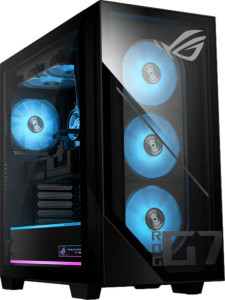
The Asus ROG G700 (2025) follows an ATX form factor and occupies a total volume of 39,721.35 cm³, with dimensions of 510 mm in height, 185 mm in width, and 421 mm in depth. Storage is handled by a 2,000GB NVMe SSD, offering fast read and write access through the NVMe interface; the system does not use flash storage as a separate storage medium. Together, these physical and storage characteristics reflect a full-sized desktop configuration built to house high-performance components.
The graphics card carries 16GB of GDDR7 VRAM across a 256-bit memory bus, with an effective memory speed of 30,000 MHz and a maximum memory bandwidth of 960 GB/s. Its base clock runs at 2,300 MHz and boosts up to 2,620 MHz, delivering 56.34 TFLOPS of floating-point performance alongside a texture rate of 880 GTexels/s and a pixel rate of 293.4 GPixel/s. The card is built on a 5 nm process node and integrates 45,600 million transistors, 10,752 shading units, 336 texture mapping units, and 112 render output units. It connects via PCIe 5.0 and supports DirectX 12 Ultimate, OpenGL 4.6, OpenCL 3, ray tracing, DLSS, stereoscopic 3D, double precision floating point, and multi-display output across up to four displays simultaneously. The card does not include LHR or RGB lighting.
The CPU runs across 20 threads with a configuration of 8 cores at 3.9 GHz and 12 cores at 3.3 GHz, reaching a turbo clock speed of 5.5 GHz via Turbo Boost version 2 and a clock multiplier of 39. It supports 64-bit processing and features an unlocked multiplier, while not including integrated graphics or multithreading. Cache is handled by 36 MB of L2 cache and 30 MB of L3 cache, and the processor has a maximum rated temperature of 105 °C.
In PassMark testing, the system achieves a multi-core score of 58,904, reflecting its capacity for parallel processing across multiple threads. The single-core result of 4,912 indicates the per-core processing capability of the CPU as measured by the same benchmark.
The system is equipped with 128GB of DDR5 RAM, providing a substantial pool of high-speed memory suited to running memory-intensive applications and multitasking workloads without constraint.
Wireless connectivity covers Wi-Fi 6E, Wi-Fi 6, Wi-Fi 5, and Wi-Fi 4 standards alongside built-in Bluetooth, while a single RJ45 port provides wired Ethernet. The USB layout includes four USB 2.0 ports, five USB 3.2 Gen 1 Type-A ports, one USB 3.2 Gen 2 Type-C port, and one USB 3.2 Gen 1 Type-C port; there are no USB 3.2 Gen 2 Type-A, USB 3.2 Gen 2x2, USB 4, Thunderbolt 3, or Thunderbolt 4 ports. Display output is handled by four DisplayPort outputs and two HDMI 2.1b ports, with no DVI or VGA connectors present. Audio connectivity includes a 3.5 mm headset jack and an S/PDIF output.
The CPU sits in an LGA 1851 socket, is classified as a desktop type, and carries a thermal design power of 360W, with compatibility extending to B860 and Z890 chipsets. It uses big.LITTLE technology, supports the NX bit, and includes instruction sets covering MMX, F16C, FMA3, AES, AVX, AVX2, SSE 4.1, and SSE 4.2. Memory runs across two channels, supports ECC, and can reach a maximum speed of 6,400 MHz with a ceiling of 128GB total capacity. The GPU is based on the Blackwell architecture and benefits from Intel Resizable BAR support, while XeSS (XMX) is not present. The system includes HDMI output but no mini DisplayPort outputs, does not feature air-water cooling, and the USB-C port count at the miscellaneous level is listed as zero.