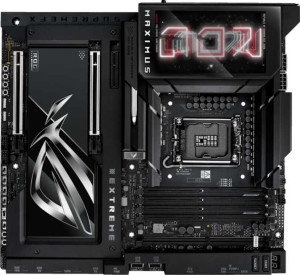
The Asus ROG Maximus Z890 Apex is a single-socket ATX motherboard measuring 305 × 244 mm, built around the LGA 1851 socket with Z890 chipset compatibility. It supports the full range of current wireless standards through Wi-Fi 7 (802.11be) down to Wi-Fi 4, and pairs that with Bluetooth 5.4, though aptX audio codec support is not included. The board does not carry an integrated CPU or onboard graphics, keeping it focused on discrete configurations. Overclocking is facilitated by a dedicated easy-overclock feature, a clear-CMOS button for quick BIOS resets, and a dual-BIOS setup that adds a layer of protection during firmware updates. RGB lighting is present, and the board comes backed by a 3-year warranty.
The board uses two DDR5 memory slots arranged in a dual-channel configuration, supporting a maximum capacity of 96 GB. Overclocked speeds can reach 9000 MHz, giving enthusiasts considerable headroom for memory tuning. ECC memory is not supported, so the platform is oriented toward consumer rather than workstation or server use cases.
The rear I/O offers a broad range of USB connectivity, including four USB 3.2 Gen 2 Type-A ports, four USB 3.2 Gen 1 Type-A ports, one USB 3.2 Gen 2x2 Type-C port, two USB 4 40Gbps ports, and two Thunderbolt 4 ports; there are no USB 2.0, USB 4 20Gbps, or Thunderbolt 3 ports present. A single RJ45 port handles wired networking, and a PS/2 port is available for legacy input devices. Video output options are absent entirely, with no HDMI, DisplayPort, DVI, or VGA connectors provided, reflecting the board's reliance on a discrete graphics card.
Storage connectivity is well provisioned, with six M.2 sockets and four SATA 3 connectors available on-board; there are no SATA 2, U.2, or mSATA connectors. For USB expansion headers, the board provides four USB 3.2 Gen 1 ports, four USB 3.0 ports, and four USB 2.0 ports through internal headers. Cooling is supported by seven fan headers, giving builders flexibility when managing airflow across larger configurations. A TPM connector is not included.
The board's expansion layout centers on two PCIe 5.0 x16 slots, making it suitable for high-bandwidth discrete graphics or other full-speed add-in cards. Two additional PCIe x4 slots round out the available expansion options. Older slot types — including PCIe 4.0 x16, PCIe 3.0 x16, PCIe 2.0 x16, PCIe x8, PCIe x1, and legacy PCI — are not present on this board.
The onboard audio section supports 7.1-channel output and delivers a signal-to-noise ratio of 120 dB from its DAC, indicating a clean audio signal with minimal background noise. Two analog audio connectors are available at the rear, and an S/PDIF Out port is included for those who prefer to route digital audio to an external receiver or DAC.
The board supports RAID 0, 1, 5, and 10, covering the most commonly used configurations for both performance-oriented and redundancy-focused storage setups. RAID 0+1 is the one mode not available on this platform.