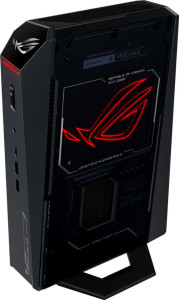
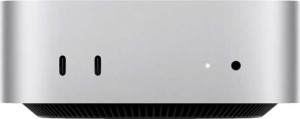
The Asus ROG NUC (2025) adopts a Micro-ATX form factor with dimensions of 282.4 mm in height, 56.5 mm in width, and 187.7 mm in thickness, resulting in a total volume of approximately 2,994.87 cm³ and a weight of 3,120 g. Storage is handled by a 2TB NVMe SSD, offering both fast sequential access and ample capacity within the machine's compact footprint.
The CPU operates with a hybrid configuration of 8 cores at 2.8 GHz and 16 cores at 2.1 GHz, totaling 24 threads, and can reach a turbo clock speed of 5.5 GHz via Turbo Boost version 2. It carries a 55W TDP and is rated to a maximum temperature of 105 °C, with an unlocked clock multiplier set at 28 for additional tuning flexibility. Cache resources include 36 MB of L3 and 40 MB of L2, and the processor supports 64-bit instructions as well as integrated graphics. The chip also includes a full set of instruction set extensions alongside ECC memory support, and its big.LITTLE architecture underpins the split core configuration described above.
The graphics card features 16GB of GDDR7 VRAM across a 256-bit memory bus, with a maximum memory bandwidth of 811.5 GB/s and an effective memory speed of 25,400 MHz. Floating-point performance is rated at 23.04 TFLOPS, backed by 7,680 shading units, 256 texture mapping units, and 96 render output units, yielding a texture rate of 384 GTexels/s and a pixel rate of 144 GPixel/s. The GPU base clock sits at 300 MHz with a turbo ceiling of 2,000 MHz, and the chip is fabricated on a 3 nm process. It supports ray tracing, DLSS, double precision floating point, and multi-display output across up to four screens simultaneously. API compatibility covers DirectX 12, OpenGL 4.5, and OpenCL 3, and the card connects via PCIe 5. LHR is not present on this GPU.
The system is equipped with 96GB of DDR5 RAM running at 6,400 MHz, providing a substantial pool of high-speed memory for demanding workloads and multitasking scenarios.
Wireless connectivity is handled by Wi-Fi 7 (802.11be) with backward compatibility down through Wi-Fi 4, alongside Bluetooth 5.4. On the wired side, the unit provides six USB 3.2 Gen 2 Type-A ports and one USB 3.2 Gen 2 Type-C port, plus a single USB 4 40Gbps port and one Thunderbolt 4 port; there are no USB 2.0, USB 3.2 Gen 1, USB 3.2 Gen 2x2, or Thunderbolt 3 ports, and no RJ45 ethernet port. Display output is available through two HDMI 2.1 ports and two DisplayPort 2.1 outputs. Audio connectivity includes both a 3.5 mm headset jack and an AUX input, while a VGA connector and S/PDIF output are not present.
In PassMark testing, the system achieved a multi-core score of 62,297 alongside a single-core result of 4,784, reflecting the CPU's overall throughput capacity and per-core processing capability respectively.
The CPU is a laptop-type processor mounted in a BGA 2114 socket and employs big.LITTLE technology, supporting instruction sets including MMX, F16C, FMA3, AES, AVX, AVX2, SSE 4.1, and SSE 4.2, along with NX bit protection. Memory is capped at 96GB across two channels at a maximum speed of 6,400 MHz, with ECC memory support included; there is no external memory slot. Storage uses flash-based media, and the system implements Intel Resizable BAR for GPU memory access optimization. The GPU is built on the Blackwell architecture with GDDR7 memory and supports stereoscopic 3D output, though XeSS (XMX) is not supported.