Asus ROG Rapture GT-BE19000AI specifications and in-depth review

Asus ROG Rapture GT-BE19000AI

Manufacturer: Asus

The Asus ROG Rapture GT-BE19000AI is a high-specification tri-band router aimed at users who need robust wireless performance and an extensive feature set under one roof. Weighing 2000 g and built around a quad-core 2.6 GHz processor, it supports Wi-Fi 7 (802.11be) alongside Wi-Fi 6, Wi-Fi 5, and Wi-Fi 4, offering broad compatibility across a range of client devices. Eight external antennas and 8GB of RAM round out a hardware profile designed for demanding network environments.

On the connectivity side, the GT-BE19000AI provides four LAN ports, one WAN port, and two USB ports, with support for an external memory slot alongside 0.048GB of onboard storage. Security is covered through a built-in firewall, WPA3 and WPA2 Wi-Fi encryption, SPI intrusion protection, MAC address filtering, URL and port filtering, and parental controls. The router also supports MU-MIMO, beamforming, mesh Wi-Fi, VLAN tagging, Inter-VLAN routing, QoS, dynamic and static routing, IPv6, UPnP, and comes paired with a dedicated smartphone app for management.

Pros
  • Supports Wi-Fi 7 alongside Wi-Fi 6, Wi-Fi 5, and Wi-Fi 4, covering a wide range of client devices across three bands
  • 8GB of RAM is substantial for a router, supporting demanding multi-device environments without memory constraints
  • Extensive security feature set including SPI intrusion protection, WPA3, MAC filtering, URL and port filtering, parental controls, and multiple VPN passthrough options
  • Mesh Wi-Fi support allows the network to be extended across multiple nodes for broader coverage
  • Routing flexibility is strong, with both static and dynamic routing, Inter-VLAN routing, and VLAN tagging all included
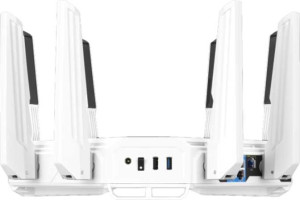
  • Eight external antennas provide a clear physical antenna layout for signal distribution
Cons
  • At 2000 g and with a volume exceeding 27000 cm³, the unit is physically large and heavy, limiting placement flexibility
  • Internal storage is minimal at 0.048GB, offering very little onboard capacity for local data needs
  • Does not support Matter, limiting direct integration with smart home ecosystems that rely on that standard
  • Not DLNA-certified, so native media sharing to compatible devices on the network is unavailable
  • Outdoor installation is not supported, restricting deployment to indoor environments only
Who is this for?

This router is well-suited to power users and home network enthusiasts who need to handle a large number of simultaneous connections, given its tri-band Wi-Fi 7 support and 8GB of RAM. Network administrators managing segmented environments will appreciate the robust routing options, including VLAN tagging, Inter-VLAN routing, and both static and dynamic routing. The extensive security suite — covering SPI intrusion protection, multiple VPN passthroughs, WPA3, and granular filtering — also makes it a practical fit for small office or home office setups where network security and traffic control are a priority. Mesh Wi-Fi support further extends its appeal to users looking to build a multi-node whole-home network.

Who is this NOT for?

Users looking for a compact, unobtrusive device will find this router difficult to accommodate, as its large physical footprint and weight of 2000 g demand dedicated space and limit placement options. Those who rely on smart home ecosystems built around the Matter standard will not find native support here, which may complicate integration with compatible devices. The router is also a poor fit for anyone needing outdoor deployment, since it lacks outdoor capability entirely. Additionally, users who intend to use the router for local media streaming via DLNA will need to look elsewhere, as that certification is absent, and the negligible 0.048GB of internal storage makes onboard file management essentially nonexistent.

General info:

LAN ports 4
WAN ports 1
has outdoor capability
USB ports 2
weight 2000 g
volume 27086.84928286 cm³
thickness 350.41 mm
width 350.41 mm
height 220.6 mm
external antennas 8
internal antennas 0

The Asus ROG Rapture GT-BE19000AI measures 350.41 mm in both width and thickness, stands 220.6 mm tall, and occupies a volume of approximately 27086.85 cm³, with a weight of 2000 g. It features eight external antennas and no internal antennas, giving a clear indication of its antenna configuration. For wired connectivity, the router includes four LAN ports, one WAN port, and two USB ports, while outdoor installation is not supported.

Performance:

Wi-Fi version Wi-Fi 6 (802.11ax), Wi-Fi 5 (802.11ac), Wi-Fi 4 (802.11n), Wi-Fi 7 (802.11be)
Wi-Fi bands Tri-band
Wi-Fi speed 11529 Mb/s
CPU speed 4 x 2.6 GHz
RAM 8GB
has an external memory slot
Has DNS relay
internal storage 0.048GB

The router supports Wi-Fi 7 (802.11be) along with Wi-Fi 6, Wi-Fi 5, and Wi-Fi 4, operating across three bands with a combined wireless speed of 11529 Mb/s. Processing is handled by a quad-core CPU running at 4 x 2.6 GHz, paired with 8GB of RAM and 0.048GB of internal storage, with an external memory slot available for additional capacity. DNS relay is supported, rounding out a performance profile built around both throughput and network management capability.

Security:

Has a built-in network firewall
Wi-Fi security protocols WPA2, WEP, WPA, WPA3
Has MAC address filtering
Has L2TP Passthrough
Has IPsec Passthrough
Has SPI intrusion protection
Has a URL filter
Has a Network Services Filter
Has port filtering
Has Network Address Translation (NAT)
Has PPTP server
Has a static IP address
Has parental control
Has PPTP Passthrough
Has automatic IP

The Asus ROG Rapture GT-BE19000AI comes with a comprehensive security setup, starting with a built-in network firewall and SPI intrusion protection to guard against unauthorized access. Wi-Fi connections are secured through WPA3, WPA2, WPA, and WEP protocols, while MAC address filtering, URL filtering, port filtering, and a Network Services Filter provide additional layers of traffic control. VPN compatibility is covered via PPTP Passthrough, L2TP Passthrough, IPsec Passthrough, and a PPTP server, and the router further supports Network Address Translation (NAT), static IP, automatic IP assignment, and parental controls for household-level access management.

Features:

IPv6 enabled
has beamforming
supports mesh Wi-Fi
supports Matter
has MU-MIMO
supports VLAN tagging
has a WPS button
Has a dedicated smartphone app
Can be used wirelessly
is DLNA-certified
Has Universal Plug n Play
Has QoS
Has dynamic routing
Has Inter-VLAN routing
Network Time Protocol enabled
Has static routing

The router includes MU-MIMO and beamforming for more efficient wireless transmission, and supports mesh Wi-Fi for extending coverage across multiple nodes. Network management is well-covered with QoS, dynamic and static routing, Inter-VLAN routing, VLAN tagging, UPnP, and Network Time Protocol, while IPv6 support keeps the router compatible with modern addressing standards. A dedicated smartphone app and a WPS button simplify setup and day-to-day management, and the device can operate wirelessly. Matter and DLNA certification are not supported.
Final Verdict

The Asus ROG Rapture GT-BE19000AI is a feature-dense tri-band router that positions itself firmly at the demanding end of the home and small office networking spectrum. Its Wi-Fi 7 support combined with 8GB of RAM and a comprehensive security and routing feature set make it a credible choice for users who need serious network control, broad device compatibility, and layered protection under one system. The physical bulk and lack of outdoor capability do narrow its practical placement options, and the absence of Matter and DLNA support will matter to certain users, but for those whose priorities center on wireless performance, network segmentation, and security depth, the GT-BE19000AI delivers a well-rounded and capable package that warrants serious consideration.

Popular Comparisons

Asus ROG Rapture GT-BE19000AI
VS
Netgear Nighthawk RS700S