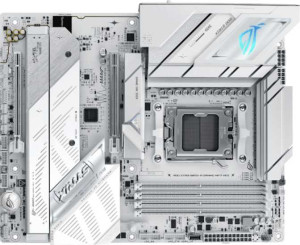
The Asus ROG Strix B850-A Gaming Wi-Fi7 Neo is built around the AM5 socket and the B850 chipset, using the standard ATX form factor with dimensions of 305 mm × 244 mm. It supports the full range of current wireless standards up to Wi-Fi 7 (802.11be), with Bluetooth 5.4 also included, though aptX audio codec support is absent. The board features HDMI 2.1 output, RGB lighting, a clear CMOS button for easy BIOS resets, and is noted as straightforward to overclock. It carries a single CPU socket, has no integrated graphics or integrated CPU, does not include a dual BIOS setup, and comes with a 3-year warranty.
This motherboard uses DDR5 memory across four slots arranged in a dual-channel configuration, supporting a maximum installed capacity of 256 GB. Overclocked RAM speeds can reach up to 9000 MHz, offering meaningful headroom for memory tuning. ECC memory is not supported.
The rear I/O panel provides a total of 12 USB ports: six USB 3.2 Gen 1 Type-A, two USB 3.2 Gen 2 Type-A, two USB 3.2 Gen 2 Type-C, and two USB 2.0 ports. There are no USB 3.2 Gen 2x2, USB 4, Thunderbolt 3, or Thunderbolt 4 ports present. Video output is handled by a single HDMI output, with no DisplayPort, DVI, or VGA connectors available. Networking is covered by one RJ45 port, and there are no eSATA or PS/2 ports included.
For internal expansion, the board includes four USB 3.2 Gen 1 headers and six USB 2.0 headers, along with one USB 3.2 Gen 2x2 header; there are no USB 3.2 Gen 2 or USB-C 3.2 Gen 2 internal connectors. Storage connectivity is provided by four M.2 sockets and two SATA 3 connectors, while SATA 2, mSATA, and U.2 are absent. Cooling is supported by six fan headers, and there is no TPM connector on the board.
The board offers two full-length PCIe slots: one PCIe 5.0 x16 and one PCIe 4.0 x16, covering the primary expansion needs of a modern desktop build. There are no PCIe 3.0, PCIe 2.0, PCIe x8, PCIe x4, PCIe x1, or legacy PCI slots present.
The onboard audio solution supports 7.1-channel output and delivers a DAC signal-to-noise ratio of 120 dB, indicating a clean audio signal. Two analog audio connectors are available on the rear panel, and an S/PDIF Out port is included for digital audio output.
The board supports RAID 0, 1, 5, and 10 (1+0), covering a practical range of configurations for both performance and redundancy needs. RAID 0+1 is not supported.