Asus ROG Strix GeForce RTX 4070 Super OC Edition specifications and in-depth review

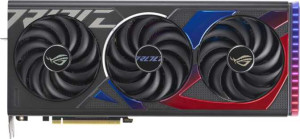
Asus ROG Strix GeForce RTX 4070 Super OC Edition

Manufacturer: Asus

The Asus ROG Strix GeForce RTX 4070 Super OC Edition is a graphics card based on NVIDIA's Ada Lovelace architecture, manufactured on a 5 nm process with 35,800 million transistors. It ships with an OC configuration that pushes the GPU turbo clock to 2640 MHz, and the card covers the expected feature set for its generation, including ray tracing, DLSS, DirectX 12 Ultimate, and support for up to four simultaneous displays. RGB lighting and Intel Resizable BAR support are also part of the package.

The card carries 12GB of GDDR6X memory on a 192-bit bus running at an effective speed of 21,000 MHz, yielding a maximum bandwidth of 504.2 GB/s. ECC memory support is included alongside Double Precision Floating Point capability. The GPU counts 7,168 shading units, 224 texture mapping units, and 80 render output units, producing a texture rate of 591.4 GTexels/s and floating-point throughput of 37.85 TFLOPS. Output connectivity consists of two HDMI 2.1a ports and three DisplayPort connections, with no USB-C, DVI, or mini DisplayPort outputs present. The card has a TDP of 225W, connects via PCIe 4.0, and measures 338.9 mm in length and 149.4 mm in height, relying on air cooling without a water-cooling option.

Pros
  • Five physical display outputs — two HDMI 2.1a and three DisplayPort — allow flexible multi-monitor configurations up to four screens
  • DLSS and ray tracing support are both included, broadening rendering options for compatible workloads
  • ECC memory support adds data reliability for users running compute tasks alongside standard graphics workloads
  • A 225W TDP is relatively modest for this class of card, placing less strain on system power delivery
  • Intel Resizable BAR support enables the CPU to access the full GPU frame buffer, improving data transfer efficiency
  • Double Precision Floating Point capability extends the card's usefulness beyond graphics to 64-bit compute tasks
Cons
  • The 192-bit memory bus width is narrower than higher-tier cards in the same generation, which constrains available memory bandwidth to 504.2 GB/s
  • No USB-C, DVI, or mini DisplayPort outputs are available, limiting connectivity for displays that rely on those interfaces
  • At 338.9 mm in length, the card may not fit in compact or smaller mid-tower cases
  • Air-water cooling is not supported, restricting thermal management to air cooling only
Who is this for?

This card is a practical fit for users who want ray tracing and DLSS support in a package with a 225W TDP, making it easier to accommodate within systems that have moderate power headroom. The five-port display output configuration — covering two HDMI 2.1a and three DisplayPort connections — suits users managing multi-monitor setups for gaming or productivity. ECC memory support and Double Precision Floating Point capability also make it a reasonable choice for users who occasionally run compute or precision-sensitive workloads alongside standard graphics tasks.

Who is this NOT for?

Users working with very large textures or memory-intensive rendering pipelines may find the 12GB VRAM on a 192-bit bus a limiting factor, as the narrower bus constrains total bandwidth relative to cards with wider memory interfaces. Those building in compact or small-form-factor cases should verify clearance carefully, given the card's 338.9 mm length. Additionally, users who require USB-C display output — whether for certain monitors, docking stations, or portable displays — will find no such port available on this model.

Performance:

GPU clock speed 1980 MHz
GPU turbo 2640 MHz
pixel rate 211.2 GPixel/s
floating-point performance 37.85 TFLOPS
texture rate 591.4 GTexels/s
GPU memory speed 1313 MHz
shading units 7168
texture mapping units (TMUs) 224
render output units (ROPs) 80
Has Double Precision Floating Point (DPFP)

The GPU runs at a base clock of 1980 MHz, climbing to a turbo frequency of 2640 MHz under load. Its 7,168 shading units are backed by 224 texture mapping units and 80 render output units, producing a texture rate of 591.4 GTexels/s and a pixel rate of 211.2 GPixel/s. Floating-point throughput is rated at 37.85 TFLOPS, while GPU memory operates at 1313 MHz. Double Precision Floating Point (DPFP) support is also present, extending the card's usability to workloads that require 64-bit arithmetic precision.

Memory:

effective memory speed 21000 MHz
maximum memory bandwidth 504.2 GB/s
VRAM 12GB
GDDR version GDDR6X
memory bus width 192-bit
Supports ECC memory

The card is fitted with 12GB of GDDR6X memory operating across a 192-bit bus at an effective speed of 21,000 MHz, resulting in a maximum memory bandwidth of 504.2 GB/s. ECC memory support is included, providing an added layer of data integrity for compute-oriented or reliability-sensitive workloads.

Features:

DirectX version DirectX 12 Ultimate
OpenGL version 4.6
OpenCL version 3
Supports multi-display technology
supports ray tracing
Supports 3D
supports DLSS
has XeSS (XMX)
AMD SAM / Intel Resizable BAR Intel Resizable BAR
has LHR
has RGB lighting
supported displays 4

The card supports DirectX 12 Ultimate, OpenGL 4.6, and OpenCL 3, providing broad API coverage for both gaming and compute workloads. Ray tracing and DLSS are both enabled, while XeSS (XMX) is not supported. Multi-display technology is present with support for up to four simultaneous outputs, alongside stereoscopic 3D and Intel Resizable BAR. LHR is not implemented, and RGB lighting is included for visual customization within a system build.

Ports:

has an HDMI output
HDMI ports 2
HDMI version HDMI 2.1a
DisplayPort outputs 3
USB-C ports 0
DVI outputs 0
mini DisplayPort outputs 0

Display connectivity is handled through two HDMI 2.1a ports and three DisplayPort outputs, totalling five physical connectors. USB-C, DVI, and mini DisplayPort outputs are absent from this model.

General info:

GPU architecture Ada Lovelace
Thermal Design Power (TDP) 225W
PCI Express (PCIe) version 4
semiconductor size 5 nm
number of transistors 35800 million
Has air-water cooling
width 338.9 mm
height 149.4 mm

Built on the Ada Lovelace architecture using a 5 nm manufacturing process, the GPU integrates 35,800 million transistors and connects to the system via PCIe 4.0. Its TDP sits at 225W, and cooling is handled exclusively through air — there is no air-water cooling option. The card measures 338.9 mm in length and 149.4 mm in height.
Final Verdict

The Asus ROG Strix GeForce RTX 4070 Super OC Edition is a well-rounded graphics card that combines Ada Lovelace architecture with a broad feature set — including ray tracing, DLSS, ECC memory support, and a five-port display output configuration — within a relatively contained 225W power envelope. Its 2640 MHz turbo clock paired with 12GB of GDDR6X memory gives it a solid footing for both gaming and occasional compute workloads, though users with very high memory bandwidth demands or compact build constraints should factor in the 192-bit bus width and 338.9 mm card length before committing. For users building in standard full-size systems who want a feature-complete Ada Lovelace card without excessive power requirements, the ROG Strix RTX 4070 Super OC Edition represents a coherent and capable option.

Popular Comparisons

Asus ROG Strix GeForce RTX 4070 Super OC Edition
VS
Asus ROG Strix GeForce RTX 5070 OC Edition