Asus ROG Strix GeForce RTX 4080 Super White Edition specifications and in-depth review

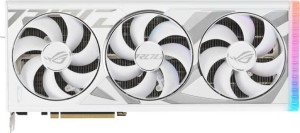
Asus ROG Strix GeForce RTX 4080 Super White Edition

Manufacturer: Asus

The Asus ROG Strix GeForce RTX 4080 Super White Edition is a graphics card built on the Ada Lovelace architecture, manufactured at 5 nm and integrating 45,900 million transistors. It runs at a base clock of 2295 MHz and reaches a turbo of 2550 MHz, with RGB lighting present and support for up to four simultaneous display outputs. At 357.6 mm wide and 149.3 mm tall, it is a physically substantial card that will require careful case clearance planning, and its 320W TDP sets clear expectations around power delivery requirements.

The card carries 16GB of GDDR6X VRAM on a 256-bit bus, with an effective memory speed of 23,000 MHz and a maximum bandwidth of 736.3 GB/s. Its 10,240 shading units, 320 texture mapping units, and 112 ROPs produce a texture rate of 816 GTexels/s and a floating-point throughput of 52.22 TFLOPS, with Double Precision Floating Point also supported. The feature set includes DirectX 12 Ultimate, OpenGL 4.6, OpenCL 3, ray tracing, DLSS, stereoscopic 3D, Intel Resizable BAR, and ECC memory, with five video outputs — two HDMI 2.1a ports and three DisplayPort connections — covering a wide range of display configurations.

Pros
  • Five video outputs — two HDMI 2.1a ports and three DisplayPort connections — give this card one of the more versatile display configurations available, supporting up to four screens simultaneously
  • The 16GB of GDDR6X memory running at 23,000 MHz effective speed delivers 736.3 GB/s of bandwidth, providing substantial headroom for texture-heavy and memory-intensive workloads
  • Ray tracing and DLSS are both supported, enabling hardware-accelerated lighting and AI-assisted upscaling in compatible titles and applications
  • ECC memory support adds error detection and correction, making the card more suitable for users running precision-sensitive compute tasks alongside standard graphics workloads
  • Intel Resizable BAR is present, allowing the CPU more efficient access to the full GPU memory pool during active workloads
  • Double Precision Floating Point support broadens the card's utility beyond graphics into numerically demanding compute scenarios
Cons
  • At 357.6 mm wide and 149.3 mm tall, the card has a large physical footprint that requires careful case compatibility checks before installation
  • The 320W TDP places considerable demands on system power delivery and airflow, making it unsuitable for builds with modest PSUs or limited ventilation
  • Air-water cooling integration is not available, so users who prefer liquid cooling solutions will need to source third-party options
  • No USB-C, DVI, or mini DisplayPort outputs are present, which may limit direct compatibility with certain display types or older hardware without adapters
Who is this for?

This card is well-matched to users running demanding rendering, compute, or multi-display workloads that can take full advantage of 16GB of GDDR6X memory, 736.3 GB/s of bandwidth, and a floating-point throughput of 52.22 TFLOPS. The five-port output configuration — two HDMI 2.1a and three DisplayPort — makes it particularly practical for users who need to drive multiple screens simultaneously, while ECC memory support and DPFP add value for those whose workflows involve numerical precision or data integrity requirements. Builds designed around full-tower or large mid-tower cases with robust power supplies will accommodate this card without constraint.

Who is this NOT for?

At 357.6 mm wide and 149.3 mm tall, the card is physically large and will not fit in compact or small form factor enclosures, making it a poor match for users working within space-constrained builds. The 320W TDP also rules it out for systems with limited power headroom or inadequate cooling infrastructure, as it demands well-provisioned airflow and a capable PSU to operate reliably. Additionally, users who require USB-C display output or built-in liquid cooling compatibility will find neither available on this model.

Performance:

GPU clock speed 2295 MHz
GPU turbo 2550 MHz
pixel rate 285.6 GPixel/s
floating-point performance 52.22 TFLOPS
texture rate 816 GTexels/s
GPU memory speed 1438 MHz
shading units 10240
texture mapping units (TMUs) 320
render output units (ROPs) 112
Has Double Precision Floating Point (DPFP)

The GPU operates at a base frequency of 2295 MHz and boosts up to 2550 MHz, with 10,240 shading units, 320 texture mapping units, and 112 render output units forming its core compute structure. This configuration yields a texture rate of 816 GTexels/s, a pixel rate of 285.6 GPixel/s, and a floating-point throughput of 52.22 TFLOPS. GPU memory runs at 1438 MHz, and Double Precision Floating Point (DPFP) support is included, extending the card's capability to workloads that require high numerical precision.

Memory:

effective memory speed 23000 MHz
maximum memory bandwidth 736.3 GB/s
VRAM 16GB
GDDR version GDDR6X
memory bus width 256-bit
Supports ECC memory

Memory comes in the form of 16GB of GDDR6X running across a 256-bit bus, with an effective speed of 23,000 MHz and a peak bandwidth of 736.3 GB/s. ECC memory support is also present, providing error detection and correction that adds a layer of reliability for users handling precision-sensitive compute or data workloads.

Features:

DirectX version DirectX 12 Ultimate
OpenGL version 4.6
OpenCL version 3
Supports multi-display technology
supports ray tracing
Supports 3D
supports DLSS
has XeSS (XMX)
AMD SAM / Intel Resizable BAR Intel Resizable BAR
has LHR
has RGB lighting
supported displays 4

The card supports DirectX 12 Ultimate, OpenGL 4.6, and OpenCL 3, providing a solid API foundation across both graphics and compute applications. Ray tracing and DLSS are both enabled, with stereoscopic 3D and multi-display technology also present, the latter allowing up to four screens to operate simultaneously. Intel Resizable BAR is included to improve CPU access to GPU memory, and RGB lighting is featured on the card itself. XeSS (XMX) and LHR are not supported on this model.

Ports:

has an HDMI output
HDMI ports 2
HDMI version HDMI 2.1a
DisplayPort outputs 3
USB-C ports 0
DVI outputs 0
mini DisplayPort outputs 0

The card provides five video outputs in total, split across two HDMI 2.1a ports and three DisplayPort outputs, offering a generous range of connection options for multi-display configurations. USB-C, DVI, and mini DisplayPort outputs are not available on this model.

General info:

GPU architecture Ada Lovelace
Thermal Design Power (TDP) 320W
PCI Express (PCIe) version 4
semiconductor size 5 nm
number of transistors 45900 million
Has air-water cooling
width 357.6 mm
height 149.3 mm

The card is built on the Ada Lovelace architecture, produced at a 5 nm node with 45,900 million transistors, and connects to the motherboard via PCIe 4. A 320W TDP defines the power overhead the system must accommodate, and the card's physical dimensions — 357.6 mm wide and 149.3 mm tall — mean that case compatibility should be verified before installation. Air-water cooling is not included with this model.
Final Verdict

The Asus ROG Strix GeForce RTX 4080 Super White Edition is a thoroughly specified graphics card that pairs a dense 10,240-shader compute configuration with 16GB of GDDR6X memory delivering 736.3 GB/s of bandwidth, alongside a five-port output layout that handles up to four simultaneous displays — a combination that suits users with demanding rendering, compute, or multi-screen workloads. Its 320W TDP and sizeable 357.6 mm footprint mean system compatibility needs to be planned carefully, and the card is firmly at home in well-provisioned, full-size builds rather than compact or power-limited setups. For users whose systems can meet those demands, the ROG Strix White Edition delivers a complete and technically capable package within the Ada Lovelace generation.