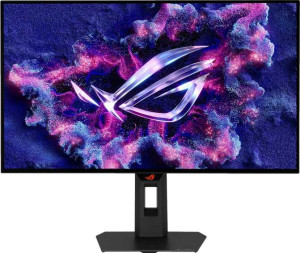
The display section of this monitor is built around an OLED/AMOLED panel measuring 26.5 inches with a resolution of 2560 x 1440 pixels and a pixel density of 110 ppi. It runs at a 240Hz refresh rate with an exceptionally low response time of 0.03ms, and supports VESA Adaptive Sync for variable refresh rate operation. The panel is glossy rather than matte and does not feature an anti-glare coating or touch screen functionality. Viewing angles reach 178 degrees both horizontally and vertically, and the display does not support touch input.
This is a gaming monitor with a physical footprint of 605 mm wide, 368 mm tall, and 63 mm thick, weighing in at 6600 g. The stand offers a solid range of ergonomic adjustments, including tilt, swivel, and portrait mode support, giving users meaningful flexibility in how they position the screen. VESA mount compatibility is also included for those who prefer a third-party arm or wall mounting solution. The total volume of the unit comes to 14026.32 cm³.
The monitor renders color at a 10-bit depth, producing up to 1,073 million colors for smooth gradients and detailed tonal representation across the image. A contrast ratio of 1,500,000:1 allows for a wide separation between the darkest and brightest parts of the image, which is characteristic of OLED panel technology. Color calibration is supported, giving users the option to fine-tune the display output to their specific accuracy requirements.
For video input, the monitor provides two HDMI 2.1 ports and one DisplayPort 1.4 output, with no mini DisplayPort, DVI, or VGA connectors included. Two USB ports and a 3.5mm headset jack round out the physical connections available on the unit. There is no USB Type-C or Thunderbolt support, and the monitor does not offer any wireless connectivity such as Wi-Fi, Ethernet, or AirPlay.
The monitor draws 26.8W during normal operation and reduces to a minimal 0.5W in standby mode, reflecting the relatively low power demands typical of OLED-based display panels.
This monitor does not include stereo speakers, Dolby Digital, Dolby Digital Plus, or DTS Surround support, making it a display-only device with no built-in audio output capabilities. It also lacks Picture-in-Picture, a remote control, an ambient light sensor, and a front camera. Additionally, there is no built-in smart TV functionality, positioning this strictly as a dedicated monitor rather than a multipurpose display unit.