Asus ROG Strix Scar 18 (2025) G835LW 18" Intel Core Ultra 9 275HX 2.7GHz / Nvidia GeForce RTX 5080 Laptop / 32GB RAM / 2TB SSD specifications and in-depth review

Asus ROG Strix Scar 18 (2025) G835LW 18" Intel Core Ultra 9 275HX 2.7GHz / Nvidia GeForce RTX 5080 Laptop / 32GB RAM / 2TB SSD

Manufacturer: Asus

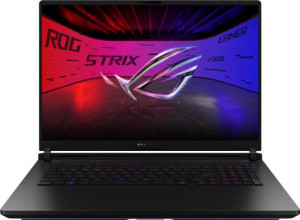
The Asus ROG Strix Scar 18 (2025) G835LW is an 18″ gaming laptop built around Intel and Nvidia's latest mobile hardware. It carries a Core Ultra 9 275HX processor paired with a GeForce RTX 5080 Laptop GPU, housed in a chassis measuring 399 × 298 × 23 mm and weighing 3,480 g. The display runs at 2560 × 1600 px across the 18″ panel, reaching a pixel density of 167 ppi, and ships with an anti-reflection coating. A backlit keyboard and 3D facial recognition round out the day-to-day usability features.

On the performance side, the RTX 5080 Laptop GPU is based on the Blackwell architecture and delivers 23.04 TFLOPS of floating-point throughput alongside 16GB of GDDR7 memory running at an effective speed of 25,400 MHz on a 256-bit bus, yielding up to 811.5 GB/s of memory bandwidth. The Core Ultra 9 275HX offers 24 threads across its hybrid core layout, a turbo frequency of 5.4 GHz, 36 MB of L3 cache, and a 4 nm semiconductor process. The system ships with 32GB of DDR5-5600 storage on an NVMe SSD of 2TB, supports up to 64GB across its two memory slots, and connects externally via two USB 4 40Gbps ports, three USB 3.2 Gen 2 Type-A ports, HDMI 2.1, Wi-Fi 7, and Bluetooth 5.4, backed by a 90 Wh battery.

Pros
  • The GPU delivers 23.04 TFLOPS of floating-point performance with 16GB of GDDR7 VRAM on a 256-bit bus, backed by a maximum memory bandwidth of 811.5 GB/s, making it well-suited for demanding graphical workloads
  • The CPU's 24-thread configuration with a hybrid core layout, unlocked multiplier, and a turbo frequency of 5.4 GHz provides substantial multi-threaded and single-threaded throughput
  • Wireless connectivity covers Wi-Fi 7 alongside four backward-compatible Wi-Fi standards, paired with Bluetooth 5.4, ensuring broad compatibility across network environments
  • The two USB 4 40Gbps Type-C ports enable high-speed peripheral and display connectivity, while three USB 3.2 Gen 2 Type-A ports add further versatility
  • Ray tracing, DLSS, and DirectX 12 Ultimate support are all present, covering the main hardware-accelerated rendering features relevant to modern gaming
  • 3D facial recognition provides a hands-free authentication option, and the system includes a front camera and dual microphones for video communication
Cons
  • At 3,480 g, the chassis is notably heavy for a portable device, which limits how practical it is to carry between locations regularly
  • The 90 Wh battery capacity is modest relative to the power demands of the high-TDP CPU and GPU combination, suggesting limited unplugged runtime
  • The display does not support touch input, which reduces interaction flexibility compared to touch-enabled laptops in the same form factor
  • There is no external memory card slot, so transferring files from cameras or other card-based devices requires an external adapter
  • RAM ships at 32GB in a configuration that supports up to 64GB, meaning users with memory-intensive workflows may need to upgrade the modules themselves
Who is this for?

This laptop is well-matched for users who regularly run demanding gaming workloads, given its Blackwell-architecture GPU with 23.04 TFLOPS of floating-point performance, 16GB of GDDR7 VRAM, and support for ray tracing, DLSS, and DirectX 12 Ultimate. The 24-thread CPU with a 5.4 GHz turbo clock and 2TB of NVMe storage also make it a capable machine for content creation and compute-intensive tasks such as 3D rendering or video processing. Users who work across multiple screens will benefit from the GPU's ability to drive up to four simultaneous displays, while Wi-Fi 7 and USB 4 40Gbps connectivity cater to those who need fast local and wireless data throughput in a desktop-replacement setup.

Who is this NOT for?

Users who prioritize portability will find the 3,480 g weight and 23 mm chassis thickness impractical for frequent travel or commuting, as the machine is clearly engineered for stationary or semi-stationary use. The 90 Wh battery, paired with a high-TDP processor and discrete GPU, is unlikely to sustain extended sessions away from a power outlet, making this a poor fit for anyone who needs reliable untethered productivity throughout the day. Additionally, the absence of a touchscreen and stylus support means it is unsuitable for users whose workflows depend on pen input or touch-based interaction, such as digital artists or note-takers who rely on direct screen annotation.

Design:

Type Gaming
weight 3480 g
Uses a fanless design
Has a backlit keyboard
volume 2734.746 cm³
width 399 mm
height 298 mm
thickness 23 mm
is weather-sealed (splashproof)

The Asus ROG Strix Scar 18 (2025) is classified as a gaming laptop with a physical footprint of 399 × 298 mm and a thickness of 23 mm, giving it a volume of 2,734.746 cm³. It weighs 3,480 g, which is typical for a large-chassis gaming machine of this screen size. The laptop features a backlit keyboard to aid visibility in low-light conditions, while active cooling is present as the design does not use a fanless configuration. It is not weather-sealed, so it offers no splash protection.

Display:

screen size 18"
resolution 2560 x 1600 px
pixel density 167 ppi
has a touch screen
has anti-reflection coating
supported displays 4

The display measures 18″ and renders at a resolution of 2560 × 1600 px, resulting in a pixel density of 167 ppi. An anti-reflection coating is applied to the panel surface to reduce glare, though the screen does not support touch input. The GPU is capable of driving up to 4 displays simultaneously, extending output well beyond the built-in panel.

Performance:

RAM 32GB
RAM speed 5600 MHz
Uses flash storage
internal storage 2048GB
CPU speed 8 x 2.7 & 16 x 2.1 GHz
CPU threads 24 threads
VRAM 16GB
floating-point performance 23.04 TFLOPS
GDDR version GDDR7
texture rate 384 GTexels/s
pixel rate 144 GPixel/s
Is an NVMe SSD
DirectX version DirectX 12 Ultimate
GPU clock speed 975 MHz
uses multithreading
maximum memory amount 64GB
DDR memory version 5
turbo clock speed 5.4GHz
GPU turbo 1500 MHz
memory slots 2
PCI Express (PCIe) version 4
semiconductor size 4 nm
has XeSS (XMX)
Supports 64-bit

The processor runs across 24 threads with a core configuration of 8 × 2.7 GHz and 16 × 2.1 GHz, reaching a turbo clock of 5.4 GHz, and is built on a 4 nm semiconductor process with multithreading and 64-bit support. System memory stands at 32GB of DDR5 running at 5600 MHz across two slots, expandable to a maximum of 64GB, while 2048GB of NVMe flash storage handles local data via a PCIe 4 interface. On the graphics side, the GPU carries 16GB of GDDR7 VRAM and delivers 23.04 TFLOPS of floating-point performance, with a base clock of 975 MHz boosting to 1500 MHz, a texture rate of 384 GTexels/s, a pixel rate of 144 GPixel/s, and full support for DirectX 12 Ultimate; XeSS is not supported.

Benchmarks:

PassMark result 56426
PassMark result (single) 4723

In CPU benchmark testing, the system achieves a PassMark multi-core score of 56,426, reflecting the processor's throughput across all available threads, while the single-core PassMark result comes in at 4,723, indicating the per-core processing capability.

Connectivity:

USB 3.2 Gen 2 ports (USB-C) 0
USB 3.2 Gen 2 ports (USB-A) 3
USB 4 20Gbps ports 0
USB 4 40Gbps ports 2
Thunderbolt 4 ports 0
USB 3.2 Gen 1 ports (USB-C) 0
USB 3.2 Gen 1 ports (USB-A) 0
Thunderbolt 3 ports 0
has an HDMI output
Has USB Type-C
supports Wi-Fi
Wi-Fi version Wi-Fi 7 (802.11be), Wi-Fi 6E (802.11ax), Wi-Fi 6 (802.11ax), Wi-Fi 5 (802.11ac), Wi-Fi 4 (802.11n)
has an external memory slot
Bluetooth version 5.4
RJ45 ports 1
HDMI ports 1
HDMI version HDMI 2.1
DisplayPort outputs 0
has AirPlay
mini DisplayPort outputs 0
has a VGA connector

Wired connectivity includes three USB 3.2 Gen 2 Type-A ports, two USB 4 40Gbps Type-C ports, and a single RJ45 Ethernet port, while video output is handled by one HDMI 2.1 port; there are no DisplayPort, mini DisplayPort, or VGA outputs, and no Thunderbolt 3 or 4 ports. Wireless options cover Wi-Fi 7 (802.11be) along with backward-compatible Wi-Fi 6E, 6, 5, and 4 standards, paired with Bluetooth 5.4, and AirPlay is also supported. An external memory card slot is not included, and no VGA connector is present.

Battery:

battery size 90 Wh
Has sleep-and-charge USB ports
Has a MagSafe power adapter

The laptop is equipped with a 90 Wh battery and supports sleep-and-charge functionality, allowing connected USB devices to be charged even when the system is powered off or in sleep mode. A MagSafe power adapter is not included or supported.

Features:

has stereo speakers
has a socket for a 3.5 mm audio jack
supports ray tracing
supports DLSS
has Dolby Atmos
Stylus included
Has a fingerprint scanner
number of microphones 2
Uses 3D facial recognition
has voice commands
has a front camera
Has S/PDIF Out port
has a gyroscope
has GPS
has an accelerometer
has a compass
Has an optical disc drive

Audio is handled by stereo speakers with Dolby Atmos support and a 3.5 mm headset jack, while two built-in microphones and a front camera facilitate video calls; the camera is accompanied by 3D facial recognition for authentication, though a fingerprint scanner is not present. On the graphics side, the GPU supports both ray tracing and DLSS, enabling hardware-accelerated lighting and AI-based upscaling in compatible titles. The laptop does not include a stylus, S/PDIF output, optical disc drive, or motion and location sensors such as a gyroscope, accelerometer, compass, or GPS, and voice commands are not supported.

Miscellaneous:

clock multiplier 27
AMD SAM / Intel Resizable BAR Intel Resizable BAR
GPU architecture Blackwell
has LHR
Thermal Design Power (TDP) 80W
Supports 3D
Supports multi-display technology
OpenCL version 3
OpenGL version 4.6
Supports ECC memory
memory bus width 256-bit
effective memory speed 25400 MHz
maximum memory bandwidth 811.5 GB/s
render output units (ROPs) 96
texture mapping units (TMUs) 256
shading units 7680
Has Double Precision Floating Point (DPFP)
GPU memory speed 2000 MHz
Type Laptop
CPU socket BGA 2114
instruction sets MMX, F16C, FMA3, AES, AVX, AVX2, SSE 4.1, SSE 4.2
Has an unlocked multiplier
L3 cache 36 MB
L2 cache 40 MB
Has NX bit
Turbo Boost version 2
CPU temperature 105 °C
Has integrated graphics
memory channels 2
RAM speed (max) 6400 MHz
Uses big.LITTLE technology

The CPU is a laptop-type processor mounted in a BGA 2114 socket with a clock multiplier of 27, an unlocked multiplier, Turbo Boost version 2, a maximum operating temperature of 105 °C, and a TDP of 80W; it uses big.LITTLE technology, includes integrated graphics, supports ECC memory across 2 memory channels with a maximum RAM speed of 6400 MHz, and carries 36 MB of L3 cache and 40 MB of L2 cache alongside instruction set support for MMX, F16C, FMA3, AES, AVX, AVX2, SSE 4.1, and SSE 4.2, plus an NX bit. The Blackwell-architecture GPU features 7,680 shading units, 256 TMUs, 96 ROPs, a 256-bit memory bus, a native memory speed of 2000 MHz reaching an effective 25,400 MHz, and a maximum memory bandwidth of 811.5 GB/s; it supports multi-display output, stereoscopic 3D, Double Precision Floating Point, OpenCL 3, OpenGL 4.6, and Intel Resizable BAR, and does not carry LHR restrictions. The system also supports Turbo Boost and big.LITTLE hybrid core scheduling on the CPU side, and the GPU's compute capabilities extend to the full Blackwell feature set without hardware-level hash-rate limiting.
Final Verdict

The Asus ROG Strix Scar 18 (2025) G835LW is a desktop-replacement gaming laptop built around a clearly defined set of priorities: raw compute throughput, graphics fidelity, and broad connectivity. Its Blackwell-architecture RTX 5080 GPU with 23.04 TFLOPS and 16GB of GDDR7 VRAM positions it firmly at the high end of mobile graphics capability, complemented by a 24-thread CPU reaching 5.4 GHz and 2TB of NVMe storage. The trade-offs — a 3,480 g chassis, modest battery capacity, and the absence of touch input — are consistent with its nature as a performance-first machine rather than a versatile portable. For users whose primary concern is sustained gaming or compute performance at a desk, the Scar 18 (2025) delivers a well-rounded and technically dense specification sheet that leaves little room for compromise on the workloads it is designed to handle.

Popular Comparisons

Asus ROG Strix Scar 18 (2025) G835LW 18" Intel Core Ultra 9 275HX 2.7GHz / Nvidia GeForce RTX 5080 Laptop / 32GB RAM / 2TB SSD
VS
Asus ROG Zephyrus G16 (2025) GU605 16"