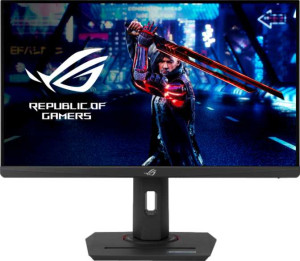
The Asus ROG Strix XG259QNS uses an LED-backlit IPS panel measuring 24.5 inches, with a resolution of 1920 x 1080 px at 89 ppi and a 380Hz refresh rate paired with a 1 ms response time for fast motion rendering. The display supports VESA Adaptive Sync and AMD FreeSync Premium to reduce tearing, and its wide viewing angles reach 178 degrees both horizontally and vertically. An anti-glare coating is present, while the panel is neither classified as matte nor glossy, and touch input is not supported.
The Asus ROG Strix XG259QNS is a gaming monitor measuring 558 mm wide, 332 mm tall, and 59 mm thick, with a total weight of 5580 g. Its stand supports both tilt and swivel adjustments, giving users flexibility in positioning, and the display is VESA mount compatible for use with third-party mounting solutions. Portrait mode is not supported, so the monitor is intended for landscape orientation only.
The display produces 16.7 million colors with a typical brightness of 400 nits and a 1000:1 contrast ratio, providing a reasonably defined tonal range for a gaming-oriented IPS panel. Its 110% sRGB coverage means the color gamut extends slightly beyond the standard sRGB space, and the monitor supports color calibration, allowing users to adjust the output to their specific accuracy requirements.
The Asus ROG Strix XG259QNS offers a straightforward video input selection, with two HDMI 2.0 ports and one DisplayPort output for connecting source devices, while mini DisplayPort, DVI, VGA, and USB Type-C video inputs are absent. Two USB ports and a 3.5 mm audio jack round out the physical connections, providing basic peripheral and headset hookup options. The monitor does not support Ethernet, Wi-Fi, or AirPlay, so all connectivity is limited to its wired ports.
The Asus ROG Strix XG259QNS draws 14.36W during normal operation and drops to a low 0.5W in standby mode, reflecting a modest power footprint for an actively driven 380Hz gaming display.
The Asus ROG Strix XG259QNS is focused purely on display output, with no built-in speakers, no audio format support such as Dolby Digital or DTS Surround, and no Picture-in-Picture functionality. It also lacks a front camera, ambient light sensor, remote control, and smart TV capabilities, making it a straightforward panel without any supplementary multimedia or smart features.