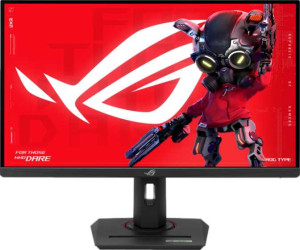
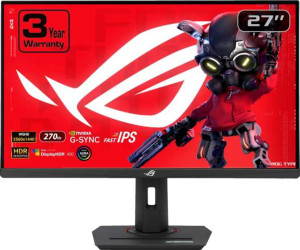
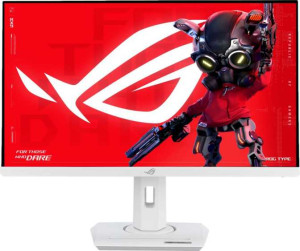
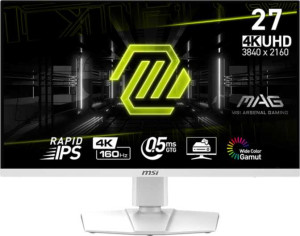
The display section of the Asus ROG Strix XG27UCG centers on a 27-inch IPS, LED-backlit LCD panel with a 3840 x 2160 pixel resolution and a pixel density of 163 ppi. It runs at a 160Hz refresh rate with a 1ms response time, and supports adaptive sync through Nvidia G-Sync, Nvidia G-Sync Compatible, and AMD FreeSync. Wide viewing angles of 178 degrees both horizontally and vertically ensure consistent image quality from off-center positions. The panel has a matte finish with an anti-glare coating, and is not glossy nor does it support touch input.
The Asus ROG Strix XG27UCG is classified as a gaming monitor and carries an EU energy label of F. It measures 614 mm wide, 367 mm tall, and 90 mm thick, with a total weight of 6600 g. The stand offers considerable flexibility, supporting tilt, swivel, and portrait mode rotation, and the monitor is also compatible with VESA mount configurations for alternative mounting setups.
The color output of the Asus ROG Strix XG27UCG is handled through a 10-bit panel capable of displaying 1073 million colors, with a typical brightness of 350 nits and a contrast ratio of 1000:1. Both Adobe RGB and sRGB color spaces are covered at 130%, and the monitor supports color calibration for users who need to fine-tune accuracy. These figures reflect a display intended to handle a wide range of color-demanding workloads alongside its gaming focus.
The Asus ROG Strix XG27UCG offers a focused set of video inputs, including one HDMI 2.1 port and one DisplayPort 1.4 output, with no mini DisplayPort, DVI, or VGA connectors present. A USB Type-C port and one additional USB port are available for peripheral connectivity, alongside a 3.5mm audio jack for headset use. The monitor does not support Thunderbolt, Ethernet, Wi-Fi, or AirPlay, positioning it as a wired-only display without any networking capabilities.
The Asus ROG Strix XG27UCG draws 30W during normal operation and drops to just 0.5W in standby mode, reflecting a modest power footprint for a 27-inch 4K gaming panel.
The Asus ROG Strix XG27UCG does not include several features commonly found on multimedia-oriented displays. There are no built-in stereo speakers, no support for Dolby Digital, Dolby Digital Plus, or DTS Surround, and no front camera or ambient light sensor. The monitor also lacks Picture-in-Picture, a remote control, and any built-in smart TV functionality, keeping its feature set focused purely on display output.