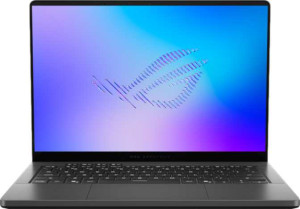
The Asus ROG Zephyrus (2026) GU405 14″ is classified as a gaming laptop and carries a weight of 1,570 g within a compact volume of 1,026.3 cm³, with dimensions of 311 mm wide, 220 mm deep, and a slim 15 mm thickness. It features a backlit keyboard for use in low-light environments, while active cooling is present as the design does not use a fanless configuration. The laptop does not include weather sealing or a rugged build, placing it squarely in the category of conventional consumer gaming hardware.
The GU405 14″ features an OLED/AMOLED panel measuring 14 inches with a resolution of 2880 x 1800 px, yielding a pixel density of 242 ppi for a detailed image. The display runs at a 120 Hz refresh rate and includes an anti-reflection coating to reduce glare in brighter environments. Touch input is not supported, but the system can drive up to four external displays simultaneously. There is no touch screen functionality on this model.
The GU405 14″ is equipped with 64 GB of DDR5 RAM running at 8,533 MHz, with the system supporting a maximum of 64 GB, and storage is handled by a 2,048 GB NVMe SSD using flash technology connected via PCIe 4. The CPU operates across 16 threads with a multi-cluster clock configuration of 4 x 2.1 GHz, 8 x 1.6 GHz, and 4 x 1.6 GHz, reaching a turbo clock speed of 4.9 GHz, and it supports multithreading and 64-bit operation within a 4 nm semiconductor process. On the graphics side, the GPU carries 16 GB of GDDR7 VRAM, a base clock of 975 MHz boosting to 1,500 MHz, and delivers 23.04 TFLOPS of floating-point performance alongside a texture rate of 384 GTexels/s and a pixel rate of 144 GPixel/s, with full DirectX 12 Ultimate support; XeSS (XMX) is not supported on this configuration.
The GU405 14″ offers a well-rounded port selection, including one USB 3.2 Gen 2 USB-C port, two USB 3.2 Gen 2 USB-A ports, one USB 4 40Gbps port, and one Thunderbolt 4 port, while USB 3.2 Gen 1, USB 2.0, and Thunderbolt 3 ports are absent. Video output is handled by a single HDMI 2.1 port, with no DisplayPort, mini DisplayPort, or VGA connector present. Wireless connectivity covers Wi-Fi 7 (802.11be) along with backward compatibility down to Wi-Fi 4, paired with Bluetooth 6. The laptop also includes an external memory slot and supports AirPlay, but there is no RJ45 Ethernet port on this model.
The GU405 14″ houses a 73 Wh battery, providing the energy capacity for this gaming configuration. The laptop does not include sleep-and-charge USB ports, meaning connected devices cannot be charged while the system is powered off, and there is no MagSafe power adapter — charging relies on a standard connection instead.
The GU405 14″ includes stereo speakers with Dolby Atmos support and a 3.5 mm headset jack, while four built-in microphones handle audio input. On the gaming side, the laptop supports both ray tracing and DLSS, enabling hardware-accelerated visual effects and upscaling. A front camera is present alongside 3D facial recognition for login, though there is no fingerprint scanner, and voice commands are not supported. Motion and location sensors — including a gyroscope, accelerometer, GPS, and compass — are all absent, as are an optical disc drive, S/PDIF output, and a stylus.
The GU405 14″ uses a Blackwell GPU architecture with 7,680 shading units, 256 texture mapping units, and 96 render output units, supported by a 256-bit memory bus running at an effective speed of 25,400 MHz and delivering a maximum bandwidth of 811.5 GB/s. The GPU operates at a base memory speed of 2,000 MHz, supports multi-display output, stereoscopic 3D, Double Precision Floating Point, and is not restricted by LHR. Graphics API support covers OpenCL 3 and OpenGL 4.6, and Intel Resizable BAR is enabled for improved CPU-to-GPU data throughput. The laptop-class CPU carries an 18 MB L3 cache, a thermal design power of 80W, a maximum operating temperature of 100 °C, and employs big.LITTLE technology for mixed-core scheduling, alongside Turbo Boost version 2 and support for instruction sets including AVX2, AES, FMA3, F16C, MMX, SSE 4.1, and SSE 4.2. The system also features integrated graphics, ECC memory support, two memory channels with a maximum RAM speed of 8,533 MHz, and an NX bit for hardware-level security.