Asus ROG Zephyrus G16 (2026) GU606 16" specifications and in-depth review

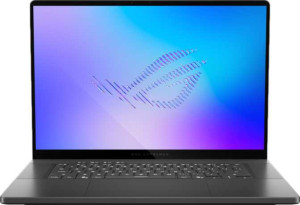
Asus ROG Zephyrus G16 (2026) GU606 16"

Manufacturer: Asus

The Asus ROG Zephyrus G16 (2026) GU606 is a 16″ gaming laptop built around a slim 14mm chassis that weighs approximately 1,950g, balancing portability with capable hardware. It features a 2560x1600 OLED/AMOLED display running at 240Hz with a pixel density of 188 ppi and an anti-reflection coating, making it well-suited for extended gaming or content work sessions.

Under the hood, the system is equipped with 64GB of DDR5 RAM running at 8,533MHz across a dual-channel configuration, paired with a 2TB NVMe SSD. The dedicated GPU is based on the Blackwell architecture, offering 24GB of GDDR7 VRAM on a 256-bit memory bus, 31.8 TFLOPS of floating-point performance, and support for ray tracing and DLSS. Connectivity options include USB 4 at 40Gbps, Thunderbolt 4, HDMI 2.1, Wi-Fi 7, and Bluetooth 6, with a 90Wh battery rounding out the specification set.

Pros
  • The 16″ OLED/AMOLED panel with a 240Hz refresh rate and 2560x1600 resolution delivers sharp, fluid visuals suited to gaming and content work
  • 64GB of DDR5 RAM running at 8,533MHz paired with a 2TB NVMe SSD provides substantial memory and fast storage capacity
  • The Blackwell GPU carries 24GB of GDDR7 VRAM with 811.5 GB/s of memory bandwidth, enabling demanding graphical workloads
  • At 14mm thick and 1,950g, the chassis is notably slim and relatively light for a gaming laptop with this level of hardware
  • Wi-Fi 7 and Bluetooth 6 ensure the laptop is equipped with the latest wireless standards
  • The port layout includes USB 4 40Gbps, Thunderbolt 4, and HDMI 2.1, covering a wide range of high-speed peripheral and display needs
Cons
  • No RJ45 port means wired Ethernet requires an external adapter
  • The absence of sleep-and-charge USB ports limits the ability to charge devices when the laptop is off or in standby
  • There is no fingerprint scanner, leaving 3D facial recognition as the only biometric login option
  • No DisplayPort output is available, reducing direct monitor connectivity options
  • The chassis is not weather-sealed, so it offers no protection against moisture or splashes
Who is this for?

This laptop is well-matched for users who need a capable gaming and content creation machine in a portable form factor. The Blackwell GPU with 24GB of GDDR7 VRAM, ray tracing, and DLSS support make it a strong fit for running graphically demanding titles and GPU-accelerated workloads. The 240Hz OLED display at 2560x1600 serves gamers and creative professionals alike who benefit from sharp, fluid visuals. With 64GB of DDR5 RAM and a 2TB NVMe SSD, the system also handles memory-intensive tasks such as video editing, 3D rendering, or large development environments without strain. The slim 14mm chassis and relatively modest weight for its class suit users who move between locations regularly but still need desktop-grade performance.

Who is this NOT for?

Users who rely on a wired network connection will find this laptop impractical without an adapter, as there is no RJ45 port. Those who frequently use multiple external monitors through diverse interfaces may find the single HDMI 2.1 output and absence of DisplayPort limiting. The lack of a fingerprint scanner could be a drawback for users who prefer fast, contact-based authentication over facial recognition. Additionally, users seeking a rugged or field-ready device will find the non-weather-sealed, non-ruggedized chassis inadequate for demanding physical environments.

Design:

Type Gaming
weight 1950 g
Uses a fanless design
Has a backlit keyboard
volume 1219.176 cm³
width 354 mm
height 246 mm
thickness 14 mm
is weather-sealed (splashproof)
has a rugged build

The Asus ROG Zephyrus G16 (2026) GU606 is classified as a gaming laptop with a slim 14mm profile and a footprint of 354mm wide by 246mm deep, resulting in a total volume of approximately 1,219cm³. It weighs 1,950g and comes equipped with a backlit keyboard, while active cooling is present as the design does not use a fanless configuration. The chassis is neither weather-sealed nor built to a rugged standard.

Display:

screen size 16"
resolution 2560 x 1600 px
pixel density 188 ppi
Display type OLED/AMOLED
has a touch screen
refresh rate 240Hz
has anti-reflection coating
supported displays 4

The laptop features a 16″ OLED/AMOLED panel with a resolution of 2560x1600px and a pixel density of 188 ppi, paired with a 240Hz refresh rate for smooth on-screen motion. An anti-reflection coating is present, though the display does not support touch input. The GPU can drive up to four displays simultaneously.

Performance:

RAM 64GB
RAM speed 8533 MHz
Uses flash storage
internal storage 2048GB
CPU speed 4 x 2.1 & 8 x 1.6 & 4 x 1.6 GHz
CPU threads 16 threads
VRAM 24GB
floating-point performance 31.8 TFLOPS
GDDR version GDDR7
texture rate 496.9 GTexels/s
pixel rate 193.9 GPixel/s
Is an NVMe SSD
DirectX version DirectX 12 Ultimate
GPU clock speed 990 MHz
uses multithreading
maximum memory amount 64GB
DDR memory version 5
turbo clock speed 4.9GHz
GPU turbo 1515 MHz
PCI Express (PCIe) version 4
semiconductor size 4 nm
has XeSS (XMX)
Supports 64-bit

The system is powered by a 16-thread CPU built on a 4nm semiconductor process, with clock speeds spanning multiple core configurations up to a turbo frequency of 4.9GHz, and it supports 64-bit operation along with multithreading. System memory consists of 64GB of DDR5 RAM running at 8,533MHz, which also represents the maximum supported memory capacity. Storage is handled by a 2,048GB NVMe SSD using flash technology over a PCIe 4 interface. On the graphics side, the GPU carries 24GB of GDDR7 VRAM with a base clock of 990MHz and a turbo of 1,515MHz, delivering 31.8 TFLOPS of floating-point performance alongside a texture rate of 496.9 GTexels/s and a pixel rate of 193.9 GPixel/s; DirectX 12 Ultimate is supported, while XeSS is not.

Benchmarks:

Connectivity:

USB 3.2 Gen 2 ports (USB-C) 1
USB 3.2 Gen 2 ports (USB-A) 2
USB 4 20Gbps ports 0
USB 4 40Gbps ports 1
Thunderbolt 4 ports 1
USB 3.2 Gen 1 ports (USB-C) 0
USB 3.2 Gen 1 ports (USB-A) 0
Thunderbolt 3 ports 0
has an HDMI output
Has USB Type-C
supports Wi-Fi
Wi-Fi version Wi-Fi 7 (802.11be), Wi-Fi 6E (802.11ax), Wi-Fi 6 (802.11ax), Wi-Fi 5 (802.11ac), Wi-Fi 4 (802.11n)
has an external memory slot
Bluetooth version 6
RJ45 ports 0
HDMI ports 1
HDMI version HDMI 2.1
DisplayPort outputs 0
USB 2.0 ports 0
has AirPlay
mini DisplayPort outputs 0
has a VGA connector

The laptop offers a well-rounded port selection, including one USB 3.2 Gen 2 Type-C port, two USB 3.2 Gen 2 Type-A ports, one USB 4 40Gbps port, and one Thunderbolt 4 port; there are no USB 2.0, Gen 1, Thunderbolt 3, DisplayPort, mini DisplayPort, or RJ45 ports. Video output is handled by a single HDMI 2.1 port, and an external memory slot is also present. Wireless connectivity covers Wi-Fi 7 (802.11be) alongside backwards-compatible Wi-Fi 6E, 6, 5, and 4 standards, paired with Bluetooth 6. AirPlay is supported, while a VGA connector is not included.

Battery:

battery size 90 Wh
Has sleep-and-charge USB ports
Has a MagSafe power adapter

The laptop is equipped with a 90Wh battery, providing a sizeable energy capacity for a gaming notebook. It does not include sleep-and-charge USB ports, nor does it use a MagSafe power adapter.

Features:

release date January 2025
has stereo speakers
has a socket for a 3.5 mm audio jack
supports ray tracing
supports DLSS
has Dolby Atmos
Stylus included
Has a fingerprint scanner
number of microphones 4
Uses 3D facial recognition
has voice commands
has a front camera
Has S/PDIF Out port
has a gyroscope
has GPS
has an accelerometer
has a compass
Has an optical disc drive

On the audio and visual side, the laptop includes stereo speakers with Dolby Atmos support, a 3.5mm headset jack, a four-microphone array, and a front-facing camera. Security and interaction features cover 3D facial recognition and voice commands, while a fingerprint scanner is not present. Gaming capabilities include ray tracing and DLSS support. The device does not include a stylus, S/PDIF output, optical disc drive, or motion sensors such as a gyroscope, accelerometer, compass, or GPS.

Miscellaneous:

AMD SAM / Intel Resizable BAR Intel Resizable BAR
GPU architecture Blackwell
has LHR
Thermal Design Power (TDP) 95W
Supports 3D
Supports multi-display technology
OpenCL version 3
OpenGL version 4.6
Supports ECC memory
memory bus width 256-bit
effective memory speed 25400 MHz
maximum memory bandwidth 811.5 GB/s
render output units (ROPs) 128
texture mapping units (TMUs) 328
shading units 10496
Has Double Precision Floating Point (DPFP)
GPU memory speed 2000 MHz
Type Laptop
instruction sets MMX, F16C, FMA3, AES, AVX, AVX2, SSE 4.1, SSE 4.2
L3 cache 18 MB
Has NX bit
Turbo Boost version 2
CPU temperature 100 °C
Has integrated graphics
memory channels 2
RAM speed (max) 8533 MHz
Uses big.LITTLE technology

The GPU is based on the Blackwell architecture and features 10,496 shading units, 328 texture mapping units, 128 ROPs, and a 256-bit memory bus with an effective memory speed of 25,400MHz and a maximum bandwidth of 811.5 GB/s; it supports multi-display output, stereoscopic 3D, ECC memory, and double precision floating point, and does not include LHR. Graphics API support covers OpenCL 3 and OpenGL 4.6, alongside Intel Resizable BAR. The laptop CPU has a TDP of 95W, a maximum operating temperature of 100°C, an 18MB L3 cache, and uses big.LITTLE technology with Turbo Boost version 2; it also features integrated graphics, NX bit support, and compatibility with instruction sets including MMX, AVX, AVX2, AES, F16C, FMA3, SSE 4.1, and SSE 4.2. RAM operates across two memory channels at a maximum speed of 8,533MHz.
Final Verdict

The Asus ROG Zephyrus G16 (2026) GU606 presents a well-considered balance between portability and high-end hardware, fitting into the category of thin gaming laptops that do not compromise on core specifications. Its Blackwell GPU with 24GB of GDDR7 VRAM, combined with a 240Hz OLED display and 64GB of DDR5 RAM, positions it as a genuinely capable machine for both serious gaming and demanding creative workloads. While the absence of wired networking and limited display output options are real practical constraints, they reflect the deliberate trade-offs of a slim, travel-oriented design. For users who prioritize raw graphical capability and display quality in a chassis that remains relatively manageable in weight and thickness, this laptop makes a compelling case for itself.