Asus TUF Gaming A18 (2025) 18" specifications and in-depth review

Asus TUF Gaming A18 (2025) 18"

Manufacturer: Asus

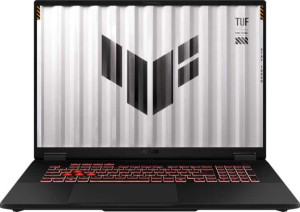
The Asus TUF Gaming A18 (2025) is an 18-inch gaming laptop built around a large-format chassis that weighs 2,600 g and measures 399 mm wide by 18 mm thin. It ships with a backlit keyboard, a 90 Wh battery with sleep-and-charge support, and a suite of connectivity options that includes Thunderbolt 4, USB 4, HDMI 2.1, and Wi-Fi 6E. The display is an 18-inch IPS LCD panel running at 2560 x 1600 px with a 240 Hz refresh rate, an anti-reflection coating, and a pixel density of 167 ppi, capable of driving up to four external screens simultaneously.

Under the hood the machine pairs an eight-core CPU clocked at 3.8 GHz base and 5.1 GHz turbo with 64 GB of DDR5-5600 RAM across two slots, backed by 2 TB of PCIe 4.0 NVMe flash storage. The discrete GPU is built on the Blackwell architecture, carries 8 GB of GDDR7 memory on a 128-bit bus with an effective speed of 25,400 MHz and a maximum bandwidth of 405.8 GB/s, and delivers 23.22 TFLOPS of floating-point throughput at a boost clock of 2,520 MHz. It supports DirectX 12 Ultimate, ray tracing, DLSS, and Intel Resizable BAR, while the CPU contributes 16 threads, a 4 nm process node, and a 50 W TDP alongside 16 MB of L3 cache.

Pros
  • The 18-inch IPS display runs at 240Hz with a 2560x1600 resolution and an anti-reflection coating, making it well-suited for extended gaming or content sessions
  • 64GB of DDR5 RAM across two slots and a 2TB NVMe SSD provide substantial memory and storage headroom for demanding workloads
  • The GPU delivers 23.22 TFLOPS of floating-point performance with GDDR7 memory, ray tracing support, and DLSS, covering a wide range of graphically intensive tasks
  • The connectivity suite includes Thunderbolt 4, USB 4 40Gbps, HDMI 2.1, Wi-Fi 6E, and a wired RJ45 port, covering both high-speed data transfer and reliable network access
  • 3D facial recognition, voice commands, and a front camera are all present, offering multiple authentication and communication options without requiring external peripherals
  • A 90Wh battery with sleep-and-charge USB ports means connected devices can be charged even when the laptop is off
Cons
  • At 2600g, the laptop is noticeably heavy for a portable device, limiting comfortable transport in daily commuting scenarios
  • The GPU uses a 128-bit memory bus, which is relatively narrow given the overall performance tier of the system
  • There is no external memory card slot, restricting quick file transfers from cameras or other card-based devices
  • The chassis is neither weather-sealed nor ruggedized, offering no protection against moisture or physical impact beyond standard use
  • No DisplayPort outputs are available, which may limit compatibility with certain professional monitors or docking setups
Who is this for?

This laptop is a strong fit for users who spend long sessions on graphically demanding games or GPU-accelerated workloads, thanks to its Blackwell-architecture GPU with 23.22 TFLOPS, DLSS and ray tracing support, and a 240Hz IPS display at 2560x1600 resolution. The 64GB of DDR5 RAM and 2TB NVMe SSD also make it well-suited for content creators and developers who need fast storage throughput and large memory capacity for video editing, 3D rendering, or compiling large codebases. Users who work across multiple screens will appreciate the ability to drive up to four displays simultaneously alongside the Thunderbolt 4 and HDMI 2.1 outputs.

Who is this NOT for?

Users who prioritize portability will find the 2600g weight and large 18-inch chassis impractical for daily commuting or travel, as the form factor is better suited to a desk than a bag. Those who need to work in unpredictable environments should also look elsewhere, since the laptop has no weather sealing or ruggedized construction, making it vulnerable to moisture and physical stress. Additionally, users who rely on a wide variety of external monitors through DisplayPort connections will face limitations, as no DisplayPort outputs are available on this machine.

Design:

Type Gaming
weight 2600 g
Uses a fanless design
Has a backlit keyboard
volume 2032.506 cm³
width 399 mm
height 283 mm
thickness 18 mm
is weather-sealed (splashproof)
has a rugged build

The Asus TUF Gaming A18 (2025) is classified as a gaming laptop and sits at 18 mm thick with a footprint of 399 mm wide by 283 mm deep, giving it a total volume of 2,032.506 cm³. It weighs 2,600 g and features a backlit keyboard, though it does not use a fanless design, nor does it carry a weather-sealed or rugged build.

Display:

screen size 18"
resolution 2560 x 1600 px
pixel density 167 ppi
Display type LCD, LED-backlit, IPS
has a touch screen
refresh rate 240Hz
has anti-reflection coating
supported displays 4

The laptop features an 18-inch IPS LCD panel with LED backlighting, delivering a resolution of 2560 x 1600 px at a pixel density of 167 ppi. It runs at a 240 Hz refresh rate and includes an anti-reflection coating, though it does not support touch input. The system can drive up to 4 displays simultaneously, making it capable of multi-monitor setups.

Performance:

RAM 64GB
RAM speed 5600 MHz
Uses flash storage
internal storage 2048GB
CPU speed 8 x 3.8 GHz
CPU threads 16 threads
VRAM 8GB
floating-point performance 23.22 TFLOPS
GDDR version GDDR7
texture rate 362.9 GTexels/s
pixel rate 121 GPixel/s
Is an NVMe SSD
DirectX version DirectX 12 Ultimate
GPU clock speed 2235 MHz
uses multithreading
maximum memory amount 64GB
DDR memory version 5
turbo clock speed 5.1GHz
GPU turbo 2520 MHz
memory slots 2
PCI Express (PCIe) version 4
semiconductor size 4 nm
has XeSS (XMX)
Supports 64-bit

The laptop is powered by an eight-core, 64-bit CPU built on a 4 nm process, running at 3.8 GHz across all cores with a turbo clock of 5.1 GHz and 16 threads via multithreading support. System memory stands at 64 GB of DDR5 RAM at 5600 MHz across two slots, with 2048 GB of NVMe flash storage connected over PCIe 4.0. On the graphics side, the GPU operates at a base clock of 2235 MHz and boosts to 2520 MHz, backed by 8 GB of GDDR7 VRAM, delivering 23.22 TFLOPS of floating-point performance alongside a texture rate of 362.9 GTexels/s and a pixel rate of 121 GPixel/s. The GPU supports DirectX 12 Ultimate but does not include XeSS acceleration, and the maximum supported memory capacity is capped at 64 GB.

Benchmarks:

PassMark (G3D) result 19987
PassMark result 29915
PassMark result (single) 3826

In benchmark testing, the laptop achieves an overall PassMark score of 29,915, reflecting its multi-threaded CPU throughput, while the single-core PassMark result comes in at 3,826. On the graphics side, it records a PassMark G3D score of 19,987, indicating its GPU rendering capability.

Connectivity:

USB 3.2 Gen 2 ports (USB-C) 1
USB 3.2 Gen 2 ports (USB-A) 2
USB 4 20Gbps ports 0
USB 4 40Gbps ports 1
Thunderbolt 4 ports 1
USB 3.2 Gen 1 ports (USB-C) 0
USB 3.2 Gen 1 ports (USB-A) 0
Thunderbolt 3 ports 0
has an HDMI output
Has USB Type-C
supports Wi-Fi
Wi-Fi version Wi-Fi 6E (802.11ax), Wi-Fi 6 (802.11ax), Wi-Fi 5 (802.11ac), Wi-Fi 4 (802.11n)
has an external memory slot
Bluetooth version 5.3
RJ45 ports 1
HDMI ports 1
HDMI version HDMI 2.1
DisplayPort outputs 0
USB 2.0 ports 1
has AirPlay
mini DisplayPort outputs 0
has a VGA connector

The laptop offers a well-rounded port selection, including one Thunderbolt 4 port that also serves as a USB 4 40Gbps connection, one USB 3.2 Gen 2 Type-C port, two USB 3.2 Gen 2 Type-A ports, and one USB 2.0 port, while there are no USB 3.2 Gen 1 or Thunderbolt 3 ports present. Video output is handled by a single HDMI 2.1 port, with no DisplayPort or mini DisplayPort outputs available, and no VGA connector. Wired networking is covered by one RJ45 port, and wireless connectivity spans Wi-Fi 6E, Wi-Fi 6, Wi-Fi 5, and Wi-Fi 4 standards alongside Bluetooth 5.3. The laptop also supports AirPlay but does not include an external memory card slot.

Battery:

battery size 90 Wh
Has sleep-and-charge USB ports
Has a MagSafe power adapter

The laptop is equipped with a 90 Wh battery and supports sleep-and-charge via its USB ports, allowing connected devices to be charged even when the laptop is powered off. It does not use a MagSafe power adapter.

Features:

has stereo speakers
has a socket for a 3.5 mm audio jack
supports ray tracing
supports DLSS
has Dolby Atmos
Stylus included
Has a fingerprint scanner
number of microphones 2
Uses 3D facial recognition
has voice commands
has a front camera
Has S/PDIF Out port
has a gyroscope
has GPS
has an accelerometer
has a compass
Has an optical disc drive

On the audio side, the laptop includes stereo speakers with Dolby Atmos support, a 3.5 mm headset jack, and two built-in microphones, though it lacks an S/PDIF output and an optical disc drive. It supports ray tracing and DLSS for graphics rendering, and comes with a front camera, 3D facial recognition, and voice command functionality for user authentication and interaction. A fingerprint scanner and stylus are not included, and the device has no gyroscope, accelerometer, compass, or GPS sensor.

Miscellaneous:

clock multiplier 38
AMD SAM / Intel Resizable BAR Intel Resizable BAR
GPU architecture Blackwell
has LHR
Thermal Design Power (TDP) 50W
Supports 3D
Supports multi-display technology
OpenCL version 3
OpenGL version 4.6
Supports ECC memory
memory bus width 128-bit
effective memory speed 25400 MHz
maximum memory bandwidth 405.8 GB/s
render output units (ROPs) 48
texture mapping units (TMUs) 144
shading units 4608
Has Double Precision Floating Point (DPFP)
GPU memory speed 2000 MHz
Type Laptop, Desktop
Uses big.LITTLE technology
instruction sets MMX, F16C, FMA3, AES, AVX, AVX2, SSE 4.1, SSE 4.2
Has an unlocked multiplier
Has NX bit
L3 core 2 MB/core
L3 cache 16 MB
L2 core 1 MB/core
L2 cache 8 MB
L1 cache 512 KB
GPU name Radeon 780M
Has integrated graphics
memory channels 2
RAM speed (max) 7500 MHz
CPU temperature 100 °C

The GPU is based on the Blackwell architecture and pairs 4608 shading units with 144 texture mapping units and 48 render output units, running on a 128-bit memory bus at a native speed of 2000 MHz and an effective speed of 25,400 MHz, yielding a maximum memory bandwidth of 405.8 GB/s. It supports multi-display output, stereoscopic 3D, double precision floating point, OpenCL 3, OpenGL 4.6, and Intel Resizable BAR, and does not carry LHR restrictions. An integrated Radeon 780M GPU is also present alongside the discrete solution. On the CPU side, the processor has a clock multiplier of 38, a TDP of 50W, and a maximum operating temperature of 100°C, with a locked multiplier and no big.LITTLE configuration. It supports a broad set of instruction sets including MMX, AVX, AVX2, AES, FMA3, F16C, SSE 4.1, and SSE 4.2, and features an NX bit for security. Cache is organized as 512 KB of L1, 8 MB of L2 at 1 MB per core, and 16 MB of L3 at 2 MB per core, with two memory channels and a maximum supported RAM speed of 7500 MHz, while ECC memory is also supported.
Final Verdict

The Asus TUF Gaming A18 (2025) is a desktop-replacement gaming laptop built for users who want serious computational and graphical muscle in a large-format chassis. Its Blackwell-architecture GPU, combined with 64GB of DDR5 RAM, a 2TB NVMe SSD, and a 240Hz 2560x1600 IPS display, positions it firmly as a capable workstation for gaming, content creation, and multi-display productivity. The trade-off is a form factor that prioritizes raw capability over portability — the weight and size make it best suited to a fixed workspace rather than life on the move. For users whose primary needs align with sustained high-performance tasks at a desk, the TUF Gaming A18 (2025) delivers a well-rounded and technically complete package.