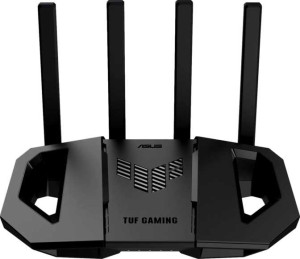
The Asus TUF Gaming BE3600 features four LAN ports and one WAN port for wired connectivity, alongside a single USB port for peripheral or storage attachment. Its four external antennas are fixed and non-removable, with no internal antennas present. The unit does not include outdoor capability and is intended for indoor use. Physically, it measures 274mm wide, 205mm tall, and 168mm thick, with a volume of 9436.56 cm³ and a weight of 561 grams.
The router supports Wi-Fi 7 (802.11be) alongside Wi-Fi 6, Wi-Fi 5, and Wi-Fi 4, operating across a dual-band configuration with a combined wireless speed of 2882 Mb/s. Processing is handled by a quad-core CPU running at 4 x 2 GHz, backed by 1GB of RAM and 0.256GB of internal storage, with an external memory slot available for additional capacity. DNS relay is also supported, contributing to smoother network name resolution for connected devices.
The router includes a built-in network firewall along with SPI intrusion protection and Network Address Translation, forming a solid baseline of network-level defense, though DoS protection is not present. Wireless connections are secured through WPA, WPA2, WPA3, and WEP protocols, with MAC address filtering available for additional access control. Filtering options extend to URLs, ports, and network services, while parental controls offer a way to manage access at the household level. On the VPN side, the router supports L2TP Passthrough, IPsec Passthrough, PPTP Passthrough, and includes a PPTP server. Both static and automatic IP address assignment are supported, rounding out a broad set of security and connectivity management capabilities.
The router supports mesh Wi-Fi and can function wirelessly, making it adaptable to a range of network layouts, while MU-MIMO and beamforming help distribute wireless connections more efficiently across multiple devices. IPv6 is enabled, and the Matter smart home protocol is supported alongside UPnP for broader device compatibility. Network management is well covered through QoS, dynamic routing, static routing, VLAN tagging, Inter-VLAN routing, and Network Time Protocol, giving administrators meaningful control over traffic handling and segmentation. A WPS button and a dedicated smartphone app simplify setup and day-to-day management, though the router is not DLNA-certified.