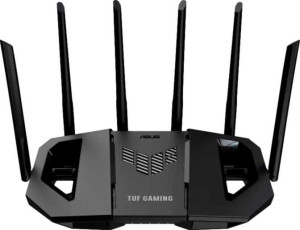
The Asus TUF Gaming BE6500 features three LAN ports and one WAN port, alongside a single USB port for peripheral or storage connections. Its six external antennas are fixed and non-removable, with no internal antennas included. The router is intended for indoor use only, as it does not carry outdoor capability. Physically, it measures 304 × 214 × 174 mm and has a volume of 11319.744 cm³, with a weight of 772 g.
The Asus TUF Gaming BE6500 operates as a dual-band router with support for Wi-Fi 7 (802.11be), along with backwards compatibility for Wi-Fi 6 (802.11ax), Wi-Fi 5 (802.11ac), and Wi-Fi 4 (802.11n). Its combined wireless speed reaches 5764 Mb/s, underpinned by a quad-core CPU running at 4 × 1.5 GHz. The router comes with 1 GB of RAM and 0.256 GB of internal storage, and it includes an external memory slot for additional capacity. DNS relay is also supported, aiding in local network name resolution.
The Asus TUF Gaming BE6500 includes a built-in network firewall backed by SPI intrusion protection and Network Address Translation, forming a solid baseline for traffic control and network boundary enforcement. Wireless connections are covered by WPA3, WPA2, WPA, and WEP security protocols, and MAC address filtering adds an extra layer of access control. The router supports URL filtering, port filtering, and a Network Services Filter, giving administrators granular control over what traffic is permitted on the network. VPN passthrough is available for L2TP, IPsec, and PPTP, and a PPTP server is also built in. Both static and automatic IP address assignment are supported, and parental controls are included for managing access at the user level. DoS protection, however, is not available on this model.
The Asus TUF Gaming BE6500 carries a broad set of networking features, including mesh Wi-Fi support, beamforming, and MU-MIMO for more flexible and efficient wireless coverage across multiple devices. It supports both dynamic and static routing, Inter-VLAN routing, and VLAN tagging, making it suitable for more structured network configurations. QoS is available for traffic prioritization, while UPnP and DLNA certification extend compatibility with media and networked devices. IPv6 is enabled, and Network Time Protocol support is included for time synchronization across the network. The router also supports the Matter smart home protocol, has a WPS button for quick device pairing, and comes with a dedicated smartphone app for management. It can operate wirelessly and is confirmed to work in a wireless deployment mode.