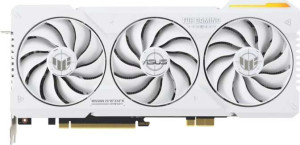
Asus TUF Gaming GeForce RTX 4070 Ti Super BTF White OC Edition specifications and in-depth review

Asus TUF Gaming GeForce RTX 4070 Ti Super BTF White OC Edition

Manufacturer: Asus

The Asus TUF Gaming GeForce RTX 4070 Ti Super BTF White OC Edition is a graphics card built on the Ada Lovelace architecture, manufactured on a 5 nm process with 45,900 million transistors. It carries 16GB of GDDR6X memory across a 256-bit bus at an effective speed of 21,000 MHz, yielding up to 672.3 GB/s of memory bandwidth, and connects to the host system via PCIe 4. Display output is handled through two HDMI 2.1a ports and three DisplayPort connections, supporting up to four screens simultaneously.

The GPU operates at a base clock of 2340 MHz with a boost up to 2640 MHz, backed by 8,448 shading units, 264 texture mapping units, and 96 render output units, producing a texture rate of 697 GTexels/s and a pixel rate of 253.4 GPixel/s. Ray tracing, DLSS, and DirectX 12 Ultimate are all supported, alongside OpenGL 4.6, OpenCL 3, Intel Resizable BAR, ECC memory, DPFP, stereoscopic 3D, RGB lighting, and multi-display technology. The card has a TDP of 285W, relies on air cooling only, and measures 305 mm in width by 138 mm in height.

Pros
  • 16GB of GDDR6X memory on a 256-bit bus provides a substantial framebuffer supported by up to 672.3 GB/s of memory bandwidth, accommodating memory-intensive graphics and compute workloads
  • Two HDMI 2.1a ports alongside three DisplayPort outputs give more flexibility for multi-device or mixed-display configurations than the single HDMI port found on many similar cards
  • Ray tracing and DLSS are both supported, broadening rendering options for compatible workloads without requiring additional hardware
  • ECC memory and DPFP support extend the card's usefulness beyond graphics into compute tasks where data accuracy and numerical precision matter
  • Intel Resizable BAR is included, allowing the CPU broader access to GPU memory during operation
  • RGB lighting is present, offering visual customization within a system build
Cons
  • A 285W TDP places a meaningful demand on system power delivery and requires adequate case ventilation to manage heat output effectively
  • At 305 mm wide and 138 mm tall, the card has a considerable physical footprint that requires careful case clearance verification before installation
  • Air cooling only is supported, with no option for liquid or hybrid cooling, which may be a limitation in thermally constrained or high-ambient-temperature environments
  • XeSS (XMX) upscaling is not available on this model, limiting compatibility with that specific upscaling technology
Who is this for?

This card is well-suited to users who need a generous framebuffer for demanding graphics or compute tasks — the 16GB of GDDR6X memory with 672.3 GB/s of bandwidth handles texture-heavy rendering, high-resolution workloads, and scenarios where VRAM capacity would otherwise become a constraint. The combination of DPFP support and ECC memory also makes it a practical choice for users who move between visual work and compute-intensive tasks requiring numerical precision and reliable data integrity. Those running multi-display setups will benefit from the five physical outputs — two HDMI 2.1a ports and three DisplayPort connections — which offer more configuration flexibility than a single-HDMI arrangement, all within a system that supports up to four simultaneous screens.

Who is this NOT for?

At 305 mm in width and 138 mm in height, this card is not a practical fit for compact or small-form-factor cases where physical clearance is limited, and its 285W TDP demands a power supply and ventilation arrangement that not all builds can comfortably accommodate. Since liquid or hybrid cooling is not supported, users in thermally demanding environments or those who prefer water-cooled setups will need to look elsewhere. Additionally, workflows or display chains that depend on USB-C output or XeSS-based upscaling will find neither available on this model.

Performance:

GPU clock speed 2340 MHz
GPU turbo 2640 MHz
pixel rate 253.4 GPixel/s
floating-point performance 44.61 TFLOPS
texture rate 697 GTexels/s
GPU memory speed 1313 MHz
shading units 8448
texture mapping units (TMUs) 264
render output units (ROPs) 96
Has Double Precision Floating Point (DPFP)

The GPU runs at a base clock of 2340 MHz, with a boost reaching 2640 MHz, supported by 8,448 shading units, 264 texture mapping units, and 96 render output units. GPU memory operates at 1313 MHz, and the combined configuration delivers a texture rate of 697 GTexels/s and a pixel rate of 253.4 GPixel/s. Total floating-point throughput comes to 44.61 TFLOPS, and Double Precision Floating Point (DPFP) support is included, making the card capable of handling compute tasks that demand higher numerical precision in addition to standard graphics workloads.

Memory:

effective memory speed 21000 MHz
maximum memory bandwidth 672.3 GB/s
VRAM 16GB
GDDR version GDDR6X
memory bus width 256-bit
Supports ECC memory

The card carries 16GB of GDDR6X VRAM operating at an effective speed of 21,000 MHz through a 256-bit memory bus, delivering a maximum memory bandwidth of 672.3 GB/s. ECC memory support is included, providing error detection and correction functionality that is particularly relevant for compute-oriented use alongside graphics workloads.

Features:

DirectX version DirectX 12 Ultimate
OpenGL version 4.6
OpenCL version 3
Supports multi-display technology
supports ray tracing
Supports 3D
supports DLSS
has XeSS (XMX)
AMD SAM / Intel Resizable BAR Intel Resizable BAR
has LHR
has RGB lighting
supported displays 4

The card supports DirectX 12 Ultimate, OpenGL 4.6, and OpenCL 3, covering a broad range of graphics and compute APIs. Ray tracing and DLSS are both enabled, with stereoscopic 3D and multi-display technology also present, allowing the card to drive up to four screens simultaneously. Intel Resizable BAR is included to facilitate broader CPU access to GPU memory, and RGB lighting is featured on the card. XeSS (XMX) and LHR are not supported on this model.

Ports:

has an HDMI output
HDMI ports 2
HDMI version HDMI 2.1a
DisplayPort outputs 3
USB-C ports 0
DVI outputs 0
mini DisplayPort outputs 0

This card offers a notably flexible output arrangement with two HDMI 2.1a ports and three DisplayPort outputs, totalling five physical connectors across a maximum of four simultaneous displays. USB-C, DVI, and mini DisplayPort outputs are not included on this model.

General info:

GPU architecture Ada Lovelace
Thermal Design Power (TDP) 285W
PCI Express (PCIe) version 4
semiconductor size 5 nm
number of transistors 45900 million
Has air-water cooling
width 305 mm
height 138 mm

Underpinned by the Ada Lovelace architecture on a 5 nm process, the card integrates 45,900 million transistors and uses a PCIe 4 interface for host system connectivity. It carries a Thermal Design Power of 285W and depends entirely on air cooling, as liquid or hybrid air-water cooling is not available on this model. Its physical dimensions of 305 mm in width and 138 mm in height mean case clearance should be confirmed before installation.

Final Verdict

The Asus TUF Gaming GeForce RTX 4070 Ti Super BTF White OC Edition is a well-appointed graphics card that covers a broad range of use cases through a combination of 16GB of GDDR6X memory on a 256-bit bus, a 2640 MHz boost clock, and a feature set that includes ray tracing, DLSS, ECC memory, DPFP, and five physical display outputs. Its specification profile makes it a capable option for users who need both strong graphics performance and some degree of compute versatility, though the 285W TDP, air-only cooling, and 305 mm footprint mean it requires a well-equipped case and power setup to run effectively. For users whose systems can accommodate it, this card offers a thorough and balanced specification sheet with few meaningful omissions.