Asus TUF Gaming GeForce RTX 5070 Ti BTF White Edition specifications and in-depth review

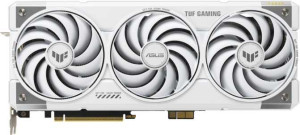
Asus TUF Gaming GeForce RTX 5070 Ti BTF White Edition

Manufacturer: Asus

The Asus TUF Gaming GeForce RTX 5070 Ti BTF White Edition is a graphics card from Asus sitting within their TUF Gaming lineup, built around Nvidia's Blackwell GPU architecture. It carries a base clock of 2295 MHz with a boost frequency reaching 2452 MHz, and its white aesthetic makes it a visually distinct option for builds where appearance matters alongside raw specification depth.

On the memory side, the card is equipped with 16GB of GDDR7 VRAM running across a 256-bit bus at an effective speed of 28000 MHz, delivering up to 896 GB/s of bandwidth. The GPU houses 8960 shading units, 280 texture mapping units, and 96 render output units, translating into a texture rate of 686.6 GTexels/s and floating-point performance of 43.94 TFLOPS. Connectivity is handled through two HDMI 2.1b ports and three DisplayPort outputs, supporting up to four displays simultaneously. The card uses PCIe 5.0, is manufactured on a 5 nm process with 45.6 billion transistors, and includes support for ray tracing, DLSS, DirectX 12 Ultimate, and Intel Resizable BAR.

Pros
  • Supports up to four displays simultaneously through five total video outputs, including two HDMI 2.1b ports and three DisplayPort connections
  • 16GB of GDDR7 VRAM running across a 256-bit bus delivers 896 GB/s of memory bandwidth, suitable for demanding graphical workloads
  • Ray tracing and DLSS support are both present, enabling access to modern rendering and upscaling capabilities
  • ECC memory support adds a degree of data integrity useful for workloads where memory accuracy matters
  • The white aesthetic with RGB lighting offers visual flexibility for builds where appearance is a deliberate consideration
  • Built on a 5 nm process with 45,600 million transistors and the Blackwell architecture, reflecting a modern silicon foundation
Cons
  • A 300W TDP places notable demands on system power delivery and case airflow, requiring careful build planning
  • No USB-C video output is available, limiting compatibility with certain modern monitors and displays that rely on that connection
  • Air-water cooling is not supported, restricting cooling options to air-based solutions only
  • At 329 mm in length, the card may not fit in smaller or compact cases without careful clearance checks
Who is this for?

This card is well-suited to users running graphically intensive workloads who need substantial headroom in memory and throughput. With 16GB of GDDR7 VRAM and 896 GB/s of bandwidth, it handles large textures and high-resolution rendering without memory becoming a bottleneck. The support for ray tracing, DLSS, DirectX 12 Ultimate, and up to four simultaneous displays makes it a practical fit for those working across multi-monitor setups or engaging with modern rendering pipelines. ECC memory support also means it can serve users with compute or data-integrity requirements beyond standard gaming.

Who is this NOT for?

Users working within space-constrained builds will find this card difficult to accommodate, as its 329 mm length demands generous case clearance that compact or mid-tower enclosures may not provide. The 300W TDP also makes it a poor match for systems with modest power supplies or limited airflow, as thermal and power demands are considerable. Additionally, those who rely on USB-C video output for display connectivity — whether for newer monitors or specific professional peripherals — will find no such port available on this card, requiring alternative display solutions.

Performance:

GPU clock speed 2295 MHz
GPU turbo 2452 MHz
pixel rate 235.4 GPixel/s
floating-point performance 43.94 TFLOPS
texture rate 686.6 GTexels/s
GPU memory speed 1750 MHz
shading units 8960
texture mapping units (TMUs) 280
render output units (ROPs) 96
Has Double Precision Floating Point (DPFP)

The Performance section of this card centers on a base GPU clock of 2295 MHz that boosts up to 2452 MHz, supporting a pixel rate of 235.4 GPixel/s and a texture rate of 686.6 GTexels/s. Floating-point throughput sits at 43.94 TFLOPS, backed by 8960 shading units, 280 texture mapping units (TMUs), and 96 render output units (ROPs). GPU memory operates at 1750 MHz, and the card includes support for Double Precision Floating Point (DPFP), rounding out a specification set oriented toward compute-intensive and graphically demanding workloads.

Memory:

effective memory speed 28000 MHz
maximum memory bandwidth 896 GB/s
VRAM 16GB
GDDR version GDDR7
memory bus width 256-bit
Supports ECC memory

This card carries 16GB of GDDR7 VRAM operating across a 256-bit memory bus, with an effective memory speed of 28000 MHz that translates into a maximum memory bandwidth of 896 GB/s. ECC memory support is also included, adding a layer of data integrity for workloads where memory accuracy is a consideration.

Features:

DirectX version DirectX 12 Ultimate
OpenGL version 4.6
OpenCL version 3
Supports multi-display technology
supports ray tracing
Supports 3D
supports DLSS
has XeSS (XMX)
AMD SAM / Intel Resizable BAR Intel Resizable BAR
has LHR
has RGB lighting
supported displays 4

On the features side, this card supports DirectX 12 Ultimate, OpenGL 4.6, and OpenCL 3, covering a broad range of graphics and compute APIs. Ray tracing and DLSS are both supported, alongside stereoscopic 3D and multi-display technology spanning up to four displays simultaneously. Intel Resizable BAR is included for improved CPU-to-GPU data throughput, and RGB lighting is present for those building with aesthetics in mind. XeSS (XMX) and LHR are not featured on this card.

Ports:

has an HDMI output
HDMI ports 2
HDMI version HDMI 2.1b
DisplayPort outputs 3
USB-C ports 0
DVI outputs 0
mini DisplayPort outputs 0

The card's output configuration consists of two HDMI 2.1b ports and three DisplayPort outputs, offering a total of five video connections for multi-monitor setups. There are no USB-C, DVI, or mini DisplayPort outputs present on this model.

General info:

GPU architecture Blackwell
Thermal Design Power (TDP) 300W
PCI Express (PCIe) version 5
semiconductor size 5 nm
number of transistors 45600 million
Has air-water cooling
width 329 mm
height 140 mm

This card is built on the Blackwell GPU architecture, fabricated using a 5 nm process and integrating 45,600 million transistors, with a Thermal Design Power (TDP) of 300W. It uses a PCIe 5.0 interface and does not include air-water cooling. Physically, the card measures 329 mm in width and 140 mm in height.
Final Verdict

The Asus TUF Gaming GeForce RTX 5070 Ti BTF White Edition brings together a well-rounded specification set built around Nvidia's Blackwell architecture, with 16GB of GDDR7 VRAM and 896 GB/s of memory bandwidth forming the core of its appeal for users who demand sustained throughput across demanding workloads. Ray tracing, DLSS, DirectX 12 Ultimate, and broad multi-display support round out a feature list that covers modern rendering requirements thoroughly. That said, its 300W TDP and 329 mm length mean it is best suited to full-sized builds with adequate power and thermal headroom — and those needing USB-C display connectivity will need to plan accordingly. For users whose systems meet these requirements, this card represents a technically complete and visually distinctive option within the RTX 5070 Ti tier.