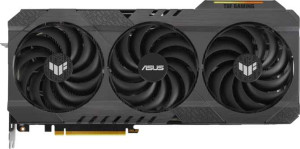
The GPU runs at a base clock of 2,340 MHz and boosts to 2,610 MHz, drawing on 8,448 shading units, 264 texture mapping units, and 96 render output units to deliver a texture rate of 689 GTexels/s and a pixel rate of 250.6 GPixel/s. Overall compute throughput reaches 44.1 TFLOPS of floating-point performance, while GPU memory operates at 1,313 MHz. Double Precision Floating Point (DPFP) is also supported, adding numerical precision capability for workloads that go beyond standard graphics rendering.
Memory configuration consists of 16 GB of GDDR6X VRAM on a 256-bit bus, with an effective speed of 21,000 MHz translating to a maximum bandwidth of 672.3 GB/s. ECC memory support is included, providing error-correction capability that broadens the card's suitability for compute tasks where data integrity is a priority.
The card supports DirectX 12 Ultimate, OpenGL 4.6, and OpenCL 3, providing solid API coverage across graphics and compute workloads. Ray tracing and DLSS are both enabled, alongside stereoscopic 3D and multi-display support for up to four simultaneous screens. Intel Resizable BAR is included for more efficient CPU access to GPU memory, while XeSS (XMX) and LHR are absent from this card's feature set. RGB lighting is present, and no hash rate limiter is applied.
This card offers a notably flexible output arrangement, with three DisplayPort outputs and two HDMI 2.1a ports providing five physical connections in total, though the maximum simultaneous display count is four. DVI, mini DisplayPort, and USB-C outputs are not present on this model.
The card is based on the Ada Lovelace architecture and manufactured on a 5 nm process node, with 45,900 million transistors packed into a body measuring 325.9 mm wide and 140.2 mm tall. It connects via PCIe 4.0 and carries a 285W TDP, which should factor into power supply planning for any intended build. Air-water cooling integration is not supported, meaning thermal management is handled entirely by the card's own cooling assembly.