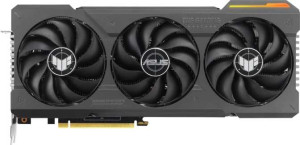
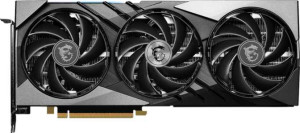
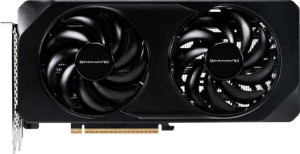
The Performance section of the Asus TUF Gaming GeForce RTX 4070 Ti Super reflects a GPU running at a base clock of 2340 MHz with a turbo boost reaching 2610 MHz, backed by 8448 shading units, 264 texture mapping units, and 96 render output units. Floating-point throughput is rated at 44.1 TFLOPS, accompanied by a texture rate of 689 GTexels/s and a pixel rate of 250.6 GPixel/s. GPU memory operates at 1313 MHz, and the card includes support for Double Precision Floating Point (DPFP), rounding out a specification set oriented toward compute-intensive and graphics-demanding tasks.
The Asus TUF Gaming GeForce RTX 4070 Ti Super is equipped with 16GB of GDDR6X VRAM running across a 256-bit memory bus, achieving an effective memory speed of 21000 MHz and a maximum bandwidth of 672.3 GB/s. ECC memory support is also included, adding a layer of data integrity for workloads where memory accuracy is a consideration.
The Asus TUF Gaming GeForce RTX 4070 Ti Super supports DirectX 12 Ultimate, OpenGL 4.6, and OpenCL 3, covering a broad range of graphics and compute API requirements. It includes ray tracing, DLSS, and stereoscopic 3D support, while XeSS (XMX) and LHR are not present on this card. Multi-display technology is supported with a maximum of four simultaneous displays, and Intel Resizable BAR is available for improved CPU-to-GPU data transfer. RGB lighting is built in, rounding out the feature set on the hardware side.
The Asus TUF Gaming GeForce RTX 4070 Ti Super offers a total of five video outputs, consisting of two HDMI 2.1a ports and three DisplayPort outputs. There are no USB-C, DVI, or mini DisplayPort connections on this card, keeping the output configuration straightforward and focused on the two most widely used modern display interfaces.
The Asus TUF Gaming GeForce RTX 4070 Ti Super is built on the Ada Lovelace architecture, using a 5nm manufacturing process with 45,900 million transistors, and connects via PCIe 4.0. It carries a Thermal Design Power of 285W and does not include air-water cooling. Physically, the card measures 305mm in width and 138mm in height, giving a clear sense of its footprint inside a system build.