Asus TUF Gaming GeForce RTX 4070 Ti Super BTF White Edition specifications and in-depth review

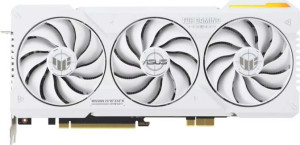
Asus TUF Gaming GeForce RTX 4070 Ti Super BTF White Edition

Manufacturer: Asus

The Asus TUF Gaming GeForce RTX 4070 Ti Super BTF White Edition is a graphics card based on the Ada Lovelace architecture, built on a 5 nm process and integrating 45,900 million transistors. It operates at a base clock of 2340 MHz and boosts up to 2610 MHz, delivering 44.1 TFLOPS of floating-point performance, a texture rate of 689 GTexels/s, and a pixel rate of 250.6 GPixel/s through 8,448 shading units, 264 texture mapping units, and 96 render output units.

The card is equipped with 16GB of GDDR6X memory at an effective speed of 21,000 MHz across a 256-bit bus, producing up to 672.3 GB/s of bandwidth, with ECC memory support also present. It supports DirectX 12 Ultimate, OpenGL 4.6, OpenCL 3, ray tracing, DLSS, stereoscopic 3D, and Intel Resizable BAR, while display output is handled through two HDMI 2.1a ports and three DisplayPort outputs, supporting up to four simultaneous displays. RGB lighting is included, the card carries a TDP of 285W, connects via PCIe 4, and measures 305 mm in width and 138 mm in height.

Pros
  • Two HDMI 2.1a ports alongside three DisplayPort outputs provide more display connection flexibility than most cards in this category, accommodating up to four simultaneous monitors
  • The 16GB of GDDR6X memory at 21,000 MHz effective speed and 672.3 GB/s of bandwidth gives the card solid headroom for memory-intensive rendering and compute tasks
  • Ray tracing, DLSS, and DirectX 12 Ultimate are all supported, enabling access to a broad set of modern rendering capabilities
  • ECC memory support adds data integrity protection, extending the card's suitability to professional and compute-oriented workloads
  • At 305 mm in length and a 285W TDP, the card is more manageable in terms of both physical size and power draw than larger models in its tier
  • RGB lighting is included, which suits users building systems with coordinated visual aesthetics
Cons
  • Air cooling is the only available thermal option, with no water-cooling support, which may limit sustained performance in enclosures with restricted airflow
  • There are no USB-C outputs on this model, which restricts connectivity with monitors and peripherals that rely on that interface
  • XeSS (XMX) upscaling is not supported, meaning hardware-accelerated upscaling is limited to DLSS only
  • No DVI or mini DisplayPort outputs are present, which rules out compatibility with older or less common display interfaces
Who is this for?

This card is a practical fit for users engaged in graphics-intensive rendering and compute workloads that benefit from 16GB of GDDR6X memory, 44.1 TFLOPS of floating-point throughput, and 672.3 GB/s of memory bandwidth. Its support for ray tracing, DLSS, and DirectX 12 Ultimate makes it well-suited for those working within modern real-time graphics pipelines, while ECC memory support adds relevance for professional environments where memory reliability matters. The two HDMI 2.1a ports and three DisplayPort outputs also make it a strong candidate for users running multi-monitor setups who need flexible display connectivity options.

Who is this NOT for?

Users with space-constrained or thermally limited systems should approach with care — while the card's 305 mm length and 285W TDP are relatively manageable, it still requires a case and power supply capable of supporting those demands. Those who depend on USB-C display outputs will find no such port available, which may limit compatibility with certain monitors and peripherals. Additionally, users who want water-cooling support for more aggressive thermal management will need to look elsewhere, as this model is limited to air cooling only.

Performance:

GPU clock speed 2340 MHz
GPU turbo 2610 MHz
pixel rate 250.6 GPixel/s
floating-point performance 44.1 TFLOPS
texture rate 689 GTexels/s
GPU memory speed 1313 MHz
shading units 8448
texture mapping units (TMUs) 264
render output units (ROPs) 96
Has Double Precision Floating Point (DPFP)

The card clocks in at 2340 MHz base and ramps up to a 2610 MHz turbo, backing that up with 44.1 TFLOPS of floating-point performance, a texture rate of 689 GTexels/s, and a pixel rate of 250.6 GPixel/s. The shader pipeline comprises 8,448 shading units, 264 texture mapping units, and 96 render output units, while the GPU memory operates at 1313 MHz. Double Precision Floating Point support is confirmed.

Memory:

effective memory speed 21000 MHz
maximum memory bandwidth 672.3 GB/s
VRAM 16GB
GDDR version GDDR6X
memory bus width 256-bit
Supports ECC memory

Memory comes in the form of 16GB of GDDR6X running at an effective speed of 21,000 MHz across a 256-bit bus, translating to a maximum bandwidth of 672.3 GB/s. ECC memory support is also present, providing a degree of data integrity assurance for workloads that require it.

Features:

DirectX version DirectX 12 Ultimate
OpenGL version 4.6
OpenCL version 3
Supports multi-display technology
supports ray tracing
Supports 3D
supports DLSS
has XeSS (XMX)
AMD SAM / Intel Resizable BAR Intel Resizable BAR
has LHR
has RGB lighting
supported displays 4

Feature support covers DirectX 12 Ultimate, OpenGL 4.6, and OpenCL 3, with ray tracing, DLSS, stereoscopic 3D, and multi-display technology all included. Up to four displays can be connected simultaneously, and Intel Resizable BAR is present to allow the CPU full access to the GPU frame buffer. XeSS (XMX) is not supported, LHR is absent, and RGB lighting is built into this model.

Ports:

has an HDMI output
HDMI ports 2
HDMI version HDMI 2.1a
DisplayPort outputs 3
USB-C ports 0
DVI outputs 0
mini DisplayPort outputs 0

The card offers a notably generous output layout, featuring two HDMI 2.1a ports alongside three DisplayPort outputs, giving users more HDMI connectivity options than is typical for this product category. There are no USB-C, DVI, or mini DisplayPort outputs present on this model.

General info:

GPU architecture Ada Lovelace
Thermal Design Power (TDP) 285W
PCI Express (PCIe) version 4
semiconductor size 5 nm
number of transistors 45900 million
Has air-water cooling
width 305 mm
height 138 mm

Grounded in the Ada Lovelace architecture, the card is manufactured on a 5 nm process and incorporates 45,900 million transistors, connecting to the host system via PCIe 4. It has a rated TDP of 285W and relies on air cooling only, with no water-cooling support available. The card's physical footprint comes in at 305 mm in width and 138 mm in height.
Final Verdict

The Asus TUF Gaming GeForce RTX 4070 Ti Super BTF White Edition brings together a well-rounded specification set under the Ada Lovelace architecture, with 16GB of GDDR6X memory, 44.1 TFLOPS of compute throughput, and a notably versatile port layout headlined by two HDMI 2.1a outputs alongside three DisplayPort connections. Support for ray tracing, DLSS, DirectX 12 Ultimate, and ECC memory gives it genuine breadth across both creative and professional workloads, while its 305 mm length and 285W TDP make it more accommodating for a range of system configurations than bulkier alternatives in its tier. Users should still verify enclosure compatibility and ensure adequate power delivery, and those requiring USB-C outputs or water-cooling options will need to factor in those absences. For builders with compatible systems, this card represents a feature-complete and practically sized option that covers the essentials without unnecessary compromise.