Asus TUF Gaming Radeon RX 7600 XT OC Edition specifications and in-depth review

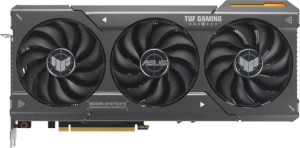
Asus TUF Gaming Radeon RX 7600 XT OC Edition

Manufacturer: Asus

The Asus TUF Gaming Radeon RX 7600 XT OC Edition is a graphics card built on AMD's RDNA 3.0 architecture, manufactured using a 6 nm process with 13,300 million transistors. It features a base clock of 1720 MHz and a boost clock of 2810 MHz, delivering 23.02 TFLOPS of floating-point performance, a pixel rate of 179.8 GPixel/s, and a texture rate of 359.7 GTexels/s. RGB lighting is included, and the card supports up to four displays simultaneously.

On the memory side, the card carries 16GB of GDDR6 running across a 128-bit bus at an effective speed of 18,000 MHz, resulting in a maximum bandwidth of 288 GB/s, with ECC memory support also present. It is compatible with DirectX 12, OpenGL 4.6, and OpenCL 2.2, and supports ray tracing, stereoscopic 3D, AMD SAM, and multi-display output — though DLSS and XeSS are not included. Connectivity consists of one HDMI 2.1 port and three DisplayPort outputs, with no USB-C, DVI, or mini DisplayPort options. The card has a TDP of 190W, uses PCIe 4.0, relies on air cooling, and measures 300.2 mm in width by 142.8 mm in height.

Pros
  • 16GB of GDDR6 VRAM is a notable amount for this class of card, providing headroom for texture-heavy and high-resolution workloads
  • A boost clock of 2810 MHz gives the GPU substantial frequency headroom for demanding rendering tasks
  • Ray tracing support extends compatibility with modern rendering pipelines
  • AMD SAM support enables full GPU frame buffer access from the CPU, which can benefit frame delivery in supported scenarios
  • Support for up to four simultaneous displays makes this card suitable for multi-monitor setups
  • A 190W TDP keeps power demands relatively contained, making system power planning more straightforward
Cons
  • The 128-bit memory bus width limits maximum bandwidth to 288 GB/s, which may become a bottleneck in sustained memory-intensive workloads
  • Neither DLSS nor XeSS upscaling is supported, reducing options for users who rely on these technologies
  • At 300.2 mm in length and 142.8 mm in height, the card has a larger physical footprint that may not fit all chassis
  • Water cooling is not supported, limiting thermal management flexibility for users in high-temperature or compact environments
  • OpenCL support is limited to version 2.2, which may fall short for compute workloads requiring newer API features
Who is this for?

This card is well-suited to users who prioritize a large VRAM buffer for texture-intensive or high-resolution workloads, as the 16GB of GDDR6 provides meaningful headroom within an air-cooled, moderate-power envelope of 190W. The 2810 MHz boost clock and ray tracing support make it a practical fit for those engaged in modern rendering pipelines that leverage hardware-accelerated ray tracing. Users running multi-monitor configurations of up to four displays will also find the output setup accommodating, and AMD SAM support adds further utility for compatible system configurations.

Who is this NOT for?

Users relying on DLSS or XeSS upscaling in their gaming or creative workflows will find neither technology available here, which limits upscaling flexibility considerably. Those handling sustained, bandwidth-sensitive compute tasks may run into constraints from the 128-bit bus and 288 GB/s memory bandwidth ceiling, particularly in workloads that push memory throughput continuously. Additionally, users building into compact enclosures should take note of the card's 300.2 mm length and 142.8 mm height, as physical fitment may be a concern in smaller chassis.

Performance:

GPU clock speed 1720 MHz
GPU turbo 2810 MHz
pixel rate 179.8 GPixel/s
floating-point performance 23.02 TFLOPS
texture rate 359.7 GTexels/s
GPU memory speed 2250 MHz
shading units 2048
texture mapping units (TMUs) 128
render output units (ROPs) 64
Has Double Precision Floating Point (DPFP)

The GPU runs at a base clock of 1720 MHz and scales up to a boost clock of 2810 MHz, with floating-point throughput of 23.02 TFLOPS, a pixel rate of 179.8 GPixel/s, and a texture rate of 359.7 GTexels/s. The underlying hardware consists of 2,048 shading units, 128 texture mapping units, and 64 render output units, with GPU memory operating at 2250 MHz. Double Precision Floating Point is supported on this card.

Memory:

effective memory speed 18000 MHz
maximum memory bandwidth 288 GB/s
VRAM 16GB
GDDR version GDDR6
memory bus width 128-bit
Supports ECC memory

The card is equipped with 16GB of GDDR6 memory running across a 128-bit bus at an effective speed of 18,000 MHz, with a maximum bandwidth of 288 GB/s. ECC memory support is included, providing an added degree of data integrity for workloads where memory accuracy matters.

Features:

DirectX version DirectX 12
OpenGL version 4.6
OpenCL version 2.2
Supports multi-display technology
supports ray tracing
Supports 3D
supports DLSS
has XeSS (XMX)
AMD SAM / Intel Resizable BAR AMD SAM
has LHR
has RGB lighting
supported displays 4

Feature support includes DirectX 12, OpenGL 4.6, and OpenCL 2.2, along with ray tracing, stereoscopic 3D, and multi-display output for up to four screens simultaneously. AMD SAM is supported, and RGB lighting is present on the card. DLSS, XeSS, and LHR are all absent from this model.

Ports:

has an HDMI output
HDMI ports 1
HDMI version HDMI 2.1
DisplayPort outputs 3
USB-C ports 0
DVI outputs 0
mini DisplayPort outputs 0

Output options consist of one HDMI 2.1 port and three DisplayPort outputs, covering all four supported display connections. USB-C, DVI, and mini DisplayPort are not available on this card.

General info:

GPU architecture RDNA 3.0
Thermal Design Power (TDP) 190W
PCI Express (PCIe) version 4
semiconductor size 6 nm
number of transistors 13300 million
Has air-water cooling
width 300.2 mm
height 142.8 mm

The card is based on the RDNA 3.0 architecture, built on a 6 nm process with 13,300 million transistors, and connects to the host system via PCIe 4.0. It carries a TDP of 190W and is cooled exclusively by air, with no water cooling option available. Physically, the card spans 300.2 mm in width and 142.8 mm in height.
Final Verdict

The Asus TUF Gaming Radeon RX 7600 XT OC Edition is a graphics card that makes a clear case for users who need a generous 16GB GDDR6 framebuffer paired with a high boost clock of 2810 MHz and ray tracing support, all within a manageable 190W power envelope. Its RDNA 3.0 foundation, AMD SAM compatibility, and four-display output capability round out a feature set that suits modern rendering and multi-monitor use cases well. Users who depend on DLSS or XeSS upscaling, or who need higher memory bandwidth than the 128-bit bus allows, should weigh those gaps carefully — but for those whose workloads align with what it offers, the TUF Gaming RX 7600 XT OC Edition is a capable and well-specified choice in the graphics card category.