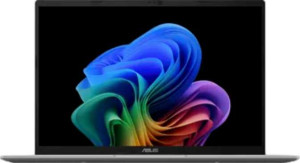
Asus VivoBook 14 (X1407QA) 14" Qualcomm Snapdragon X (X1-26-100) 2.9GHz / 16GB RAM / 512GB SSD specifications and in-depth review

Asus VivoBook 14 (X1407QA) 14" Qualcomm Snapdragon X (X1-26-100) 2.9GHz / 16GB RAM / 512GB SSD

Manufacturer: Asus

The Asus VivoBook 14 (X1407QA) is a compact 14-inch laptop built around Qualcomm's Snapdragon X (X1-26-100) platform, targeting users who need a thin, lightweight machine for everyday computing. Weighing in at 1,490 grams with a slim 17mm profile, it balances portability with a reasonably spacious footprint. The chassis includes a backlit keyboard and supports 3D facial recognition for login, along with a front-facing camera and a 3.5mm headphone jack for day-to-day convenience.

On the performance side, the Snapdragon X chip pairs an 8-core CPU running at up to 2.98 GHz with an Adreno X1 integrated GPU clocked at 500 MHz and boosting to 1,107 MHz, built on a 4nm process and supporting DirectX 12. The 16GB of DDR5 memory operates across 8 channels with a maximum bandwidth of 135 GB/s, while the 512GB NVMe SSD connects over PCIe 4.0. Connectivity is well-equipped, with two USB 4.0 40Gbps ports, two USB 3.2 Gen 1 Type-A ports, HDMI 2.1 output, Wi-Fi 6E, Bluetooth 5.3, and integrated LTE support. The 14-inch display resolves at 1920x1200 pixels at 161 ppi with a 60Hz refresh rate and 300 nits of typical brightness, and the system is capable of driving up to three external displays simultaneously.

Pros
  • The two USB 4.0 40Gbps ports, which also function as Thunderbolt 4 connections, offer fast data transfer and flexible display output in a compact port footprint
  • Wi-Fi 6E support ensures access to the latest wireless standard, with backwards compatibility covering Wi-Fi 4 through 6
  • 3D facial recognition provides a convenient and password-free login method without relying on a fingerprint scanner
  • The 8-channel DDR5 memory configuration delivers a maximum bandwidth of 135 GB/s, which benefits memory-intensive workloads
  • At 17mm thick and 1,490 grams, the chassis is slim and light enough for regular transport
  • The NVMe SSD connected over PCIe 4.0 provides fast flash storage access for everyday tasks and file operations
Cons
  • The 60Hz refresh rate and lack of an anti-reflection coating limit the display's suitability for use in bright environments or for motion-heavy content
  • There are no memory slots available, making RAM upgrades impossible after purchase
  • The 50 Wh battery capacity is modest for a laptop with an always-connected platform, and there are no sleep-and-charge ports for charging peripherals when the system is off
  • A single microphone and no Dolby Atmos support keep the audio input and output capabilities fairly basic
  • The absence of an RJ45 Ethernet port and an external memory card slot reduces flexibility for users who rely on wired networking or memory card-based workflows
  • With only 300 nits of typical brightness and no touchscreen, the display offers limited versatility compared to what the form factor might otherwise support
Who is this for?

This laptop is a solid fit for users who need a portable, everyday computing device that handles productivity tasks, web browsing, and light creative work without demanding desk-bound use. The slim 17mm profile and 1,490g weight make it manageable for commuters and students who carry their machine regularly. The inclusion of USB 4.0 40Gbps and Thunderbolt 4 ports, combined with support for up to three simultaneous displays, also makes it a practical choice for professionals who occasionally connect to external monitors or docking stations. Integrated LTE and 5G support further suit users who work across different locations and need reliable connectivity without relying on Wi-Fi.

Who is this NOT for?

Users who rely on high-refresh-rate or touch-enabled displays for creative, gaming, or interactive workflows will find the 60Hz, non-touch panel limiting. The absence of user-accessible memory slots means the 16GB of onboard RAM cannot be expanded, which may frustrate those whose workloads grow over time or who regularly run memory-intensive applications such as virtual machines or large dataset processing. The modest 50 Wh battery and lack of a wired Ethernet port also make this a poor fit for users in environments where power access is limited or stable, high-throughput network connections are required.

Design:

weight 1490 g
Uses a fanless design
Has a backlit keyboard
volume 1194.165 cm³
width 315 mm
height 223 mm
thickness 17 mm
is weather-sealed (splashproof)

The Asus VivoBook 14 (X1407QA) has a compact physical footprint of 315 mm wide by 223 mm deep, with a slim 17mm thickness and a total volume of 1,194.165 cm³. At 1,490 grams, it sits in a reasonable weight range for a 14-inch laptop, making it manageable for daily transport. The keyboard includes backlighting for use in low-light conditions, while the machine relies on an active cooling system rather than a fanless design. It is not weather-sealed, so it offers no splash or moisture resistance.

Display:

screen size 14"
resolution 1920 x 1200 px
pixel density 161 ppi
has a touch screen
brightness (typical) 300 nits
refresh rate 60Hz
has anti-reflection coating
supported displays 3

The VivoBook 14 features a 14-inch screen with a 1920 x 1200 pixel resolution, yielding a pixel density of 161 ppi for reasonably crisp image rendering across everyday tasks. Typical brightness is rated at 300 nits, and the panel operates at a 60Hz refresh rate. The display does not include a touchscreen or an anti-reflection coating, so it may be susceptible to glare in brightly lit environments. On the output side, the system can drive up to three displays simultaneously, including the built-in panel.

Performance:

RAM 16GB
Uses flash storage
internal storage 512GB
CPU speed 8 x 2.98 GHz
CPU threads 8 threads
Is an NVMe SSD
DirectX version DirectX 12
GPU clock speed 500 MHz
uses multithreading
maximum memory amount 64GB
DDR memory version 5
GPU turbo 1107 MHz
memory slots 0
PCI Express (PCIe) version 4
semiconductor size 4 nm
Supports 64-bit

The VivoBook 14 is powered by an 8-core, 8-thread CPU running at 2.98 GHz per core, built on a 4nm semiconductor process and supporting 64-bit operations with multithreading enabled. It comes with 16GB of DDR5 memory, with the platform supporting a maximum of 64GB, though there are no user-accessible memory slots for upgrades. Storage is handled by a 512GB NVMe SSD connected over PCIe 4.0, offering fast flash-based read and write performance. The integrated GPU runs at a base clock of 500 MHz and boosts up to 1,107 MHz, with support for DirectX 12 rounding out the graphics capabilities.

Benchmarks:

Connectivity:

USB 3.2 Gen 2 ports (USB-C) 0
USB 3.2 Gen 2 ports (USB-A) 0
USB 4 20Gbps ports 0
USB 4 40Gbps ports 2
Thunderbolt 4 ports 2
USB 3.2 Gen 1 ports (USB-C) 0
USB 3.2 Gen 1 ports (USB-A) 2
Thunderbolt 3 ports 0
has an HDMI output
Has USB Type-C
supports Wi-Fi
Wi-Fi version Wi-Fi 6E (802.11ax), Wi-Fi 6 (802.11ax), Wi-Fi 5 (802.11ac), Wi-Fi 4 (802.11n)
has an external memory slot
Bluetooth version 5.3
RJ45 ports 0
HDMI ports 1
HDMI version HDMI 2.1
DisplayPort outputs 0
has AirPlay
mini DisplayPort outputs 0
has a VGA connector

The VivoBook 14 offers a well-rounded port selection, led by two USB 4.0 40Gbps ports that also double as Thunderbolt 4 connections, alongside two USB 3.2 Gen 1 Type-A ports for standard peripherals. Video output is handled by a single HDMI 2.1 port, while DisplayPort, mini DisplayPort, and VGA outputs are absent. There is no RJ45 Ethernet port and no external memory card slot. Wireless connectivity covers Wi-Fi 6E (with backwards compatibility down to Wi-Fi 4) and Bluetooth 5.3, and the device also supports AirPlay.

Battery:

battery size 50 Wh
Has sleep-and-charge USB ports
Has a MagSafe power adapter

The VivoBook 14 is equipped with a 50 Wh battery, providing the onboard energy capacity for day-to-day use. The device does not include sleep-and-charge USB ports, meaning connected devices cannot be charged when the laptop is powered off or in sleep mode. It also does not use a MagSafe power adapter for charging.

Features:

has stereo speakers
has a socket for a 3.5 mm audio jack
has Dolby Atmos
Stylus included
Has a fingerprint scanner
number of microphones 1
Uses 3D facial recognition
has voice commands
has a front camera
Has S/PDIF Out port
has a gyroscope
has GPS
has an accelerometer
has a compass
Has an optical disc drive

The VivoBook 14 includes stereo speakers and a 3.5mm headphone jack for audio output, though it does not support Dolby Atmos or an S/PDIF digital output port. For communication, it features a front-facing camera paired with a single microphone, and authentication is handled through 3D facial recognition rather than a fingerprint scanner — no voice command support is present. A stylus is not included, and the laptop lacks motion and location sensing hardware, with no gyroscope, accelerometer, compass, or GPS on board. There is also no optical disc drive.

Miscellaneous:

clock multiplier 32
upload speed 3500 MBits/s
download speed 10000 MBits/s
GPU name Adreno X1
has 5G support
Has TrustZone
Has NX bit
Has integrated LTE
maximum memory bandwidth 135 GB/s
memory channels 8
Uses big.LITTLE technology
render output units (ROPs) 6
shading units 1536
Has integrated graphics

The integrated Adreno X1 GPU features 1,536 shading units and 6 render output units (ROPs), with the CPU carrying a clock multiplier of 32. The memory subsystem operates across 8 channels, delivering a maximum bandwidth of 135 GB/s, and the CPU does not use a big.LITTLE heterogeneous core arrangement. On the connectivity side, the platform includes integrated LTE directly on the SoC along with 5G support, with upload speeds reaching 3,500 Mbits/s and download speeds up to 10,000 Mbits/s. Security is reinforced through both TrustZone and NX bit support, providing hardware-level protections at the processor level.

Final Verdict

The Asus VivoBook 14 (X1407QA) presents a coherent package for users seeking a lightweight, always-connected laptop built around the Snapdragon X (X1-26-100) platform. Its USB 4.0 40Gbps and Thunderbolt 4 connectivity, paired with integrated 5G and LTE support, give it genuine flexibility across varied work environments, while the PCIe 4.0 NVMe storage and 8-channel DDR5 memory architecture ensure the internals are well-matched to productivity-oriented workloads. That said, the non-expandable RAM, 60Hz non-touch display, and modest battery capacity mean it is best suited for users with straightforward, day-to-day computing needs rather than demanding or specialized workflows. Taken as a whole, it is a capable and portable everyday machine that delivers where its design priorities are clear, but leaves little room for users whose needs may evolve beyond those boundaries.