Design:
| weight |
1700 g |
| Uses a fanless design |
✕ |
| Has a backlit keyboard |
✓ |
| volume |
1415.896 cm³ |
| width |
359 mm |
| height |
232 mm |
| thickness |
17 mm |
| is weather-sealed (splashproof) |
✕ |
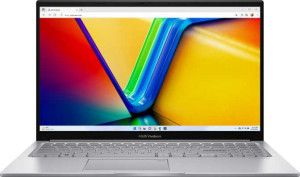
The Asus VivoBook 15 X1504 has a footprint of 359 mm wide by 232 mm deep, with a 17 mm thickness that keeps the chassis reasonably slim for a 15.6″ laptop. It weighs 1,700 g and occupies a total volume of roughly 1,415.9 cm³. The laptop includes a backlit keyboard for low-light usability, while its active cooling setup means it does not use a fanless design. It is worth noting that the device is neither weather-sealed nor splashproof, so exposure to moisture should be avoided.
Display:
| screen size |
15.6" |
| resolution |
1920 x 1080 px |
| pixel density |
141 ppi |
| has a touch screen |
✕ |
| has anti-reflection coating |
✕ |
| supported displays |
4 |
The VivoBook 15 X1504 features a 15.6″ panel with a 1920 x 1080 resolution, delivering a pixel density of 141 ppi. The display does not include a touchscreen or an anti-reflection coating. Through its GPU, the system can support up to four connected displays simultaneously.
Performance:
| RAM |
8GB |
| Uses flash storage |
✓ |
| internal storage |
512GB |
| CPU speed |
2 x 1.7 & 8 x 1.2 GHz |
| CPU threads |
12 threads |
| Is an NVMe SSD |
✓ |
| DirectX version |
DirectX 12 |
| uses multithreading |
✓ |
| maximum memory amount |
64GB |
| DDR memory version |
4 |
| turbo clock speed |
4.7GHz |
| GPU turbo |
1250 MHz |
| PCI Express (PCIe) version |
4 |
| semiconductor size |
10 nm |
| Supports 64-bit |
✓ |
The processor runs two performance cores at 1.7 GHz and eight efficiency cores at 1.2 GHz across 12 threads with multithreading enabled, reaching a turbo clock speed of 4.7 GHz, and is built on a 10 nm process node with 64-bit support. The system comes with 8 GB of DDR4 RAM, expandable up to 64 GB, paired with a 512 GB NVMe SSD over PCIe 4 using flash storage for fast data access. The integrated GPU boosts up to 1,250 MHz and supports DirectX 12, rounding out a performance profile suited to everyday computing workloads.
Benchmarks:
| PassMark result |
13586 |
| PassMark result (single) |
3262 |
| Cinebench R20 (multi) result |
3009 |
| Cinebench R20 (single) result |
649 |
In benchmark testing, the VivoBook 15 X1504 records a PassMark multi-core score of 13,586 alongside a single-core result of 3,262, reflecting the processor's threading capability relative to its per-core throughput. Cinebench R20 results follow a similar pattern, with a multi-core score of 3,009 and a single-core score of 649, giving a consistent picture of the CPU's performance across both sustained multi-threaded workloads and lighter single-threaded tasks.
Connectivity:
| Thunderbolt 4 ports |
0 |
| Thunderbolt 3 ports |
0 |
| has an HDMI output |
✓ |
| Has USB Type-C |
✕ |
| supports Wi-Fi |
✓ |
| Wi-Fi version |
Wi-Fi 6E (802.11ax), Wi-Fi 6 (802.11ax), Wi-Fi 5 (802.11ac), Wi-Fi 4 (802.11n) |
| has an external memory slot |
✕ |
| RJ45 ports |
0 |
| HDMI ports |
1 |
| DisplayPort outputs |
0 |
| USB 2.0 ports |
2 |
| has AirPlay |
✓ |
| mini DisplayPort outputs |
0 |
| has a VGA connector |
✕ |
Wireless connectivity on the VivoBook 15 X1504 covers Wi-Fi 6E (802.11ax) along with backward-compatible support for Wi-Fi 6, Wi-Fi 5, and Wi-Fi 4, and the laptop also supports AirPlay. For wired and display output, it offers one HDMI port and two USB 2.0 ports, while Thunderbolt 3, Thunderbolt 4, USB Type-C, DisplayPort, mini DisplayPort, and VGA outputs are all absent. There is no RJ45 Ethernet port and no external memory card slot.
Battery:
| Battery life |
8 hours |
| battery size |
42 Wh |
| Has sleep-and-charge USB ports |
✕ |
| Has a MagSafe power adapter |
✕ |
The VivoBook 15 X1504 is equipped with a 42 Wh battery rated for up to 8 hours of use on a charge. The laptop does not include sleep-and-charge USB ports, nor does it use a MagSafe power adapter.
Features:
| has stereo speakers |
✓ |
| has a socket for a 3.5 mm audio jack |
✓ |
| has Dolby Atmos |
✕ |
| Stylus included |
✕ |
| Has a fingerprint scanner |
✓ |
| number of microphones |
2 |
| Uses 3D facial recognition |
✕ |
| has voice commands |
✓ |
| has a front camera |
✓ |
| Has S/PDIF Out port |
✕ |
| has a gyroscope |
✕ |
| has GPS |
✕ |
| has an accelerometer |
✕ |
| has a compass |
✕ |
| Has an optical disc drive |
✕ |
The VivoBook 15 X1504 includes stereo speakers, a 3.5 mm headset jack, and a dual-microphone setup, though it does not feature Dolby Atmos or an S/PDIF output. A fingerprint scanner handles biometric authentication, while 3D facial recognition is not supported. The laptop has a front camera and supports voice commands, but does not come with a stylus. Motion and location sensors — including a gyroscope, accelerometer, compass, and GPS — are absent, and there is no optical disc drive.
Miscellaneous:
| clock multiplier |
17 |
| GPU name |
Iris Xe Graphics 96EU |
| L2 cache |
9.5 MB |
| L1 cache |
928 KB |
| L3 cache |
12 MB |
| Has an unlocked multiplier |
✕ |
| Has NX bit |
✓ |
| CPU temperature |
100 °C |
| OpenCL version |
3 |
| OpenGL version |
4.6 |
| GPU execution units |
96 |
| Has integrated graphics |
✓ |
| Supports ECC memory |
✕ |
| memory channels |
2 |
| Thermal Design Power (TDP) |
15W |
| Type |
Laptop |
| instruction sets |
SSE 4.2, SSE 4.1, AVX, AES, FMA3, F16C, MMX |
| RAM speed (max) |
5200 MHz |
The CPU carries a clock multiplier of 17 and operates within a 15 W TDP, with a maximum rated temperature of 100 °C; the multiplier is locked. Cache memory is arranged across three levels — 928 KB of L1, 9.5 MB of L2, and 12 MB of L3 — and the processor supports a range of instruction sets including SSE 4.1, SSE 4.2, AVX, AES, FMA3, F16C, and MMX, along with NX bit for hardware-level security. Graphics are handled by the integrated Intel Iris Xe with 96 execution units, supporting OpenCL 3 and OpenGL 4.6, while ECC memory is not supported. The two memory channels can accommodate RAM speeds of up to 5,200 MHz, and the platform is classified as a laptop-category processor.