Asus Zenbook 14 Oled UX3405 14" Intel Core Ultra 7 155H 1.4GHz / 16GB RAM / 1TB SSD specifications and in-depth review

Asus Zenbook 14 Oled UX3405 14" Intel Core Ultra 7 155H 1.4GHz / 16GB RAM / 1TB SSD

Manufacturer: Asus

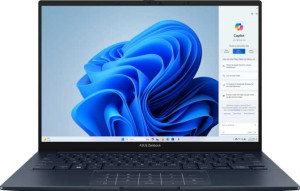
The Asus Zenbook 14 OLED UX3405 is a 14-inch productivity laptop built around Intel's Core Ultra 7 155H processor, a hybrid chip running six performance cores at 1.4GHz alongside eight efficiency cores at 0.9GHz. Weighing in at 1,279g and measuring just 14mm thick, the machine occupies a relatively compact footprint while still accommodating a 75Wh battery and a full suite of modern connectivity options. The chassis includes a backlit keyboard and supports 3D facial recognition for login, rounding out a feature set oriented toward daily professional use.

The display is a 14-inch OLED panel running at 1920x1200 resolution with a pixel density of 161 ppi, a peak brightness of 500 nits, and a contrast ratio of 1,000,000:1 — figures typical of OLED technology. Graphics are handled by the integrated Intel Arc Xe-LPG 128EU GPU, which boosts up to 2,250MHz and supports DirectX 12 Ultimate and OpenCL 3. On the connectivity side, the laptop provides two Thunderbolt 4 ports, one USB 3.2 Gen 1 Type-A port, HDMI 2.1 output, and Wi-Fi 6E wireless networking. System memory sits at 16GB of DDR5 running at 8,400MHz, paired with a 1TB NVMe SSD over a PCIe 4 interface.

Pros
  • The OLED panel delivers a contrast ratio of 1,000,000:1, making dark scenes and shadow detail visually distinct in a way that non-OLED displays cannot match
  • Two Thunderbolt 4 ports provide high-bandwidth connectivity for external devices, fast data transfer, and the ability to drive up to four displays simultaneously
  • At 14mm thick and 1,279g, the chassis is slim and light enough for daily commuting without adding significant bulk to a bag
  • The 75Wh battery paired with sleep-and-charge USB ports means connected devices can keep charging even when the laptop is powered down
  • 3D facial recognition offers a hands-free login method that does not rely on a fingerprint scanner, keeping the workflow uninterrupted
  • Wi-Fi 6E support enables access to the 6GHz band where available, reducing interference in congested wireless environments
Cons
  • The display is capped at a 60Hz refresh rate, which limits smoothness for users who work with fast-moving content or animations
  • There is only one memory slot, so the installed 16GB of RAM cannot be expanded by adding a second module — an upgrade requires replacing the existing one
  • No RJ45 ethernet port is included, meaning wired network connections require an adapter
  • The lack of an anti-reflection coating on the OLED panel may cause glare issues in brightly lit environments
  • No external memory card slot is available, which can be inconvenient for users who regularly transfer files from cameras or other devices
  • There are no USB-A ports beyond a single USB 3.2 Gen 1 connection, limiting compatibility with older peripherals that require higher-speed Type-A ports
Who is this for?

This laptop is well suited to professionals who spend most of their day on productivity tasks such as writing, coding, data work, or video conferencing. The hybrid CPU architecture with 22 threads handles sustained multitasking efficiently, while the OLED display with its 1,000,000:1 contrast ratio makes it a solid choice for anyone who works with visual content and needs accurate, high-contrast rendering. Its slim 14mm profile and 1,279g weight make it genuinely portable, and the inclusion of two Thunderbolt 4 ports means users who connect to docking stations, external monitors, or fast storage drives will find the connectivity more than adequate for a structured desk setup.

Who is this NOT for?

Users looking for a capable gaming machine will find this laptop lacking, as the integrated Intel Arc Xe-LPG GPU is not designed for demanding 3D titles and the 60Hz display refresh rate falls short of what competitive gaming typically requires. Creative professionals who work with large media projects or run memory-intensive applications may also be constrained by the single memory slot, which limits upgrade flexibility and means the 16GB configuration cannot be expanded without a full module replacement. Additionally, users who frequently transfer files from cameras or SD cards will be inconvenienced by the absence of an external memory card reader, and those who work in bright, sunlit environments may struggle with the display due to the lack of an anti-reflection coating.

Design:

Type Productivity
weight 1279 g
Uses a fanless design
Has a backlit keyboard
volume 960.96 cm³
width 312 mm
height 220 mm
thickness 14 mm
is weather-sealed (splashproof)

The Asus Zenbook 14 OLED UX3405 is classified as a productivity laptop and keeps a notably slim profile at just 14mm thick, with a footprint of 312mm wide by 220mm deep and a total volume of 960.96cm³. It weighs 1,279g, making it relatively light for its class. The machine includes a backlit keyboard to support use in low-light environments, but does not feature a fanless design or any weather sealing.

Display:

screen size 14"
resolution 1920 x 1200 px
pixel density 161 ppi
Display type OLED/AMOLED
has a touch screen
brightness (typical) 500 nits
refresh rate 60Hz
contrast ratio 1000000:1
has anti-reflection coating
supported displays 4

The laptop features a 14-inch OLED/AMOLED panel running at a resolution of 1920x1200 pixels, which works out to a pixel density of 161 ppi. Brightness is rated at a typical 500 nits, and the contrast ratio reaches 1,000,000:1, a characteristic inherent to OLED technology. The display refreshes at 60Hz and can drive up to four external screens simultaneously. It does not include a touchscreen or an anti-reflection coating.

Performance:

RAM 16GB
RAM speed 8400 MHz
Uses flash storage
internal storage 1024GB
CPU speed 6 x 1.4 & 8 x 0.9 GHz
CPU threads 22 threads
Is an NVMe SSD
DirectX version DirectX 12 Ultimate
GPU clock speed 300 MHz
uses multithreading
maximum memory amount 96GB
DDR memory version 5
turbo clock speed 4.8GHz
GPU turbo 2250 MHz
memory slots 1
PCI Express (PCIe) version 4
semiconductor size 7 nm
Supports 64-bit

The processor runs across 14 cores — six performance cores at 1.4GHz and eight efficiency cores at 0.9GHz — with a turbo ceiling of 4.8GHz and support for 22 threads through multithreading. The chip is built on a 7nm process and supports 64-bit operation. Paired with 16GB of DDR5 RAM running at 8,400MHz across a single memory slot, the system can be configured with up to 96GB. Storage comes in the form of a 1TB NVMe SSD connected over a PCIe 4 interface using flash-based memory. The integrated GPU has a base clock of 300MHz and boosts up to 2,250MHz, with support for DirectX 12 Ultimate.

Benchmarks:

PassMark result 24879
PassMark result (single) 3468

In PassMark testing, the system scores 24,879 in the multi-core benchmark, while the single-core result comes in at 3,468, reflecting the per-core processing capability of the Intel Core Ultra 7 155H processor.

Connectivity:

USB 3.2 Gen 2 ports (USB-C) 0
USB 3.2 Gen 2 ports (USB-A) 0
USB 4 20Gbps ports 0
USB 4 40Gbps ports 2
Thunderbolt 4 ports 2
USB 3.2 Gen 1 ports (USB-C) 0
USB 3.2 Gen 1 ports (USB-A) 1
Thunderbolt 3 ports 0
has an HDMI output
Has USB Type-C
supports Wi-Fi
Wi-Fi version Wi-Fi 6E (802.11ax), Wi-Fi 6 (802.11ax), Wi-Fi 5 (802.11ac), Wi-Fi 4 (802.11n)
has an external memory slot
Bluetooth version 5
RJ45 ports 0
HDMI ports 1
HDMI version HDMI 2.1
DisplayPort outputs 0
has AirPlay
mini DisplayPort outputs 0
has a VGA connector

The laptop's port selection centers on two Thunderbolt 4 ports, which also function as USB 4 40Gbps connections, alongside a single USB 3.2 Gen 1 Type-A port. Video output is handled by one HDMI 2.1 port, while DisplayPort, mini DisplayPort, and VGA outputs are absent. There is no RJ45 ethernet port and no external memory card slot. Wireless connectivity covers Wi-Fi 6E (802.11ax) along with backward-compatible Wi-Fi 6, 5, and 4 standards, and Bluetooth 5. AirPlay is also supported.

Battery:

battery size 75 Wh
Has sleep-and-charge USB ports
Has a MagSafe power adapter

The Zenbook 14 OLED UX3405 is equipped with a 75Wh battery and supports sleep-and-charge functionality, allowing connected devices to be charged through the laptop's USB ports even when the system is asleep. It does not use a MagSafe power adapter.

Features:

has stereo speakers
has a socket for a 3.5 mm audio jack
has Dolby Atmos
Stylus included
Has a fingerprint scanner
number of microphones 2
Uses 3D facial recognition
has voice commands
has a front camera
Has S/PDIF Out port
has a gyroscope
has GPS
has an accelerometer
has a compass
Has an optical disc drive

For audio, the laptop includes stereo speakers and a 3.5mm headset jack, though it does not support Dolby Atmos or an S/PDIF output. A front-facing camera is present alongside dual microphones, and the system uses 3D facial recognition for biometric login rather than a fingerprint scanner. Voice commands are not supported. There is no stylus included, and the device lacks motion and location sensors such as a gyroscope, accelerometer, compass, and GPS. An optical disc drive is also absent.

Miscellaneous:

clock multiplier 38
PassMark result (overclocked) 24880
shading units 1024
render output units (ROPs) 32
texture mapping units (TMUs) 64
GPU name Arc Xe-LPG 128EU
CPU socket BGA 2049
Type Laptop
Has an unlocked multiplier
instruction sets MMX, F16C, FMA3, AES, AVX, AVX2, SSE 4.1, SSE 4.2
L3 cache 24 MB
Has NX bit
CPU temperature 110 °C
OpenCL version 3
OpenGL version 4.6
GPU execution units 8
Has integrated graphics
Supports ECC memory
memory channels 2
RAM speed (max) 7467 MHz
Thermal Design Power (TDP) 28W
Uses big.LITTLE technology

The processor uses a BGA 2049 socket, a clock multiplier of 38, and a thermal design power (TDP) of 28W, with a maximum operating temperature of 110°C. It employs big.LITTLE technology to balance performance and efficiency cores, supports the NX bit for hardware-level security, and carries a 24MB L3 cache across two memory channels with a maximum RAM speed of 7,467MHz. ECC memory is not supported, and the multiplier is locked. Supported instruction sets include MMX, F16C, FMA3, AES, AVX, AVX2, SSE 4.1, and SSE 4.2. Graphics are handled by the integrated Intel Arc Xe-LPG 128EU, which features 1,024 shading units, 64 texture mapping units, 32 render output units, and 8 execution units, with support for OpenCL 3 and OpenGL 4.6. The overclocked PassMark result stands at 24,880.
Final Verdict

The Asus Zenbook 14 OLED UX3405 presents a well-rounded package for professionals who prioritize portability and display quality in a productivity-oriented machine. Its most compelling attribute is the OLED panel with a 1,000,000:1 contrast ratio, which sets it apart from many laptops in its category and makes it a particularly strong fit for users who spend long hours in front of the screen. Backed by a capable hybrid processor, fast DDR5 memory, and a Thunderbolt 4-equipped port selection, it handles everyday professional workflows without compromise. The trade-offs — a 60Hz refresh rate, a single memory slot, and the absence of an ethernet port or card reader — are worth noting, but they reflect deliberate design choices aimed at keeping the chassis thin and light rather than oversights. For the right user, this is a focused, capable productivity laptop that delivers where it matters most.

Popular Comparisons

Asus Zenbook 14 Oled UX3405 14" Intel Core Ultra 7 155H 1.4GHz / 16GB RAM / 1TB SSD
VS
Asus ZenBook S 14 UX5406 14"