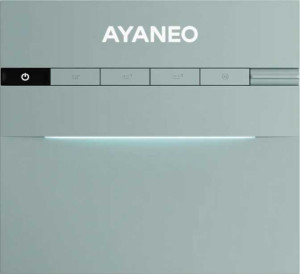
The Ayaneo AM03 adopts a Micro-ATX form factor, positioning it as a compact desktop solution. Storage is handled by a 1000GB NVMe SSD, which uses flash-based technology connected over a high-speed NVMe interface for faster data access compared to conventional drives.
The processor runs a 14-core configuration split between six cores at 2.5 GHz and eight cores at 1.8 GHz, with a turbo clock speed reaching 5 GHz and a total of 20 threads supported through multithreading. It operates within a 45W TDP envelope and has a maximum rated temperature of 100°C, with a fixed clock multiplier of 25 that cannot be unlocked. The CPU includes integrated graphics, supports 64-bit processing, and carries a three-tier cache structure consisting of 1200 KB of L1, 11.5 MB of L2, and 24 MB of L3 cache.
The integrated GPU runs at a turbo clock of 1450 MHz and is built on a 10 nm semiconductor process, featuring 768 shading units, 48 texture mapping units, and 24 render output units. It connects via PCIe 4 and can drive up to 4 displays simultaneously. API support covers DirectX 12, OpenGL 4.6, and OpenCL 3, making it compatible with a broad range of graphics and compute workloads.
The Ayaneo AM03 comes equipped with 64GB of DDR5 RAM, placing it at the higher end of typical Mini PC memory configurations. The use of fifth-generation DDR memory brings higher bandwidth and improved efficiency compared to earlier DDR standards, suiting the system for memory-intensive tasks.
Wireless connectivity is handled by Wi-Fi 6 (802.11ax) with backwards compatibility for Wi-Fi 5 and Wi-Fi 4, alongside Bluetooth 5.2 for peripheral pairing. Wired networking is covered by two RJ45 Ethernet ports, while the USB layout includes two USB 3.2 Gen 2 Type-A ports, one USB 3.2 Gen 2 Type-C port, and one USB 2.0 Type-A port; there are no USB 4, Thunderbolt 3, or Thunderbolt 4 ports. Display output is provided through one HDMI 2.1 port and one DisplayPort output, and audio connectivity includes a 3.5mm headset jack, though neither a VGA connector nor an S/PDIF output is present.
In multi-threaded workloads, the processor achieves a PassMark score of 26,897 alongside a Geekbench 6 multi-core result of 11,894 and a Cinebench R20 multi-core result of 6,371. Single-core performance is reflected in a PassMark single-thread score of 3,675, a Geekbench 6 single-core result of 2,426, and a Cinebench R20 single-core score of 734, giving a clear picture of both sustained parallel throughput and per-core responsiveness.
The system uses a laptop-class processor that employs big.LITTLE technology to balance performance and efficiency cores, and the integrated GPU is the Iris Xe Graphics 96EU, featuring 96 execution units. Memory support tops out at 64GB across two channels, with a maximum RAM speed of 5200 MHz, though ECC memory is not supported and flash storage is not used. The CPU includes the NX bit for hardware-level security and supports a range of instruction sets — SSE 4.1, SSE 4.2, AVX, AES, FMA3, F16C, and MMX — broadening compatibility with modern software and compute tasks.