Beastcom Q5 Pro (R7 8700F / RTX 5060 / 32GB RAM / 1TB SSD) specifications and in-depth review

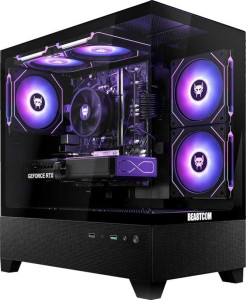
Beastcom Q5 Pro (R7 8700F / RTX 5060 / 32GB RAM / 1TB SSD)

Manufacturer: Beastcom

The Beastcom Q5 Pro (R7 8700F / RTX 5060 / 32GB RAM / 1TB SSD) is an ATX-form-factor desktop gaming PC built around AMD and NVIDIA components. It ships with an AMD Ryzen 7 8700F running eight cores at a base clock of 4.1 GHz and a turbo frequency of 5 GHz, paired with 32GB of DDR5 RAM at 5600 MHz. Storage is handled by a 1TB NVMe SSD, and the system carries a one-year warranty.

On the graphics side, the RTX 5060 is based on the Blackwell architecture and delivers 19.2 TFLOPS of floating-point performance alongside 8GB of GDDR7 VRAM across a 128-bit memory bus, with a maximum memory bandwidth of 448 GB/s. The GPU supports DirectX 12 Ultimate, ray tracing, and DLSS, and can drive up to four displays through a combination of three DisplayPort outputs and one HDMI 2.1 port. Connectivity includes Wi-Fi 5, Bluetooth, four USB 2.0 ports, two USB 3.2 Gen 1 Type-A ports, a 3.5mm audio jack, and an S/PDIF output, with Intel Resizable BAR support also confirmed.

Pros
  • The RTX 5060 GPU delivers 19.2 TFLOPS of floating-point performance and supports ray tracing and DLSS, making it well-suited for demanding gaming workloads
  • The 8-core CPU reaches a turbo frequency of 5 GHz, features an unlocked multiplier, and scores 32,348 in overclocked PassMark testing, indicating meaningful headroom for tuning
  • 32GB of DDR5 RAM running at 5600 MHz provides ample capacity and fast throughput for memory-intensive tasks
  • The NVMe SSD with 1TB of storage ensures fast system responsiveness and generous space for games and applications
  • Support for up to four simultaneous displays through three DisplayPort outputs and one HDMI 2.1 port gives flexibility for multi-monitor setups
  • ECC memory support adds a layer of data reliability that is uncommon in standard gaming desktop configurations
Cons
  • Wi-Fi is limited to Wi-Fi 5 (802.11ac) with no support for newer Wi-Fi 6 or Wi-Fi 7 standards, which may be a bottleneck on faster home networks
  • There are no USB-C ports of any kind, including no USB 3.2 Gen 2 Type-C, USB 4, or Thunderbolt connections, limiting compatibility with modern peripherals
  • The GPU uses a 128-bit memory bus, which constrains memory bandwidth headroom relative to wider bus configurations
  • Air-water cooling is not included, leaving thermal management dependent on whatever cooling solution is fitted
  • The warranty period covers only one year
  • The four USB ports available beyond the two USB 3.2 Gen 1 slots are all USB 2.0, which offers limited transfer speeds for connected storage or devices
Who is this for?

This gaming PC is a solid fit for users who engage in graphically demanding gaming, given the RTX 5060's ray tracing and DLSS support, 19.2 TFLOPS of floating-point performance, and GDDR7 memory. The 8-core CPU with a 5 GHz turbo frequency and an unlocked multiplier also makes it appealing to enthusiasts interested in overclocking and CPU tuning, particularly those comfortable working within the AM5 platform and compatible chipsets. With 32GB of DDR5 RAM, a 1TB NVMe SSD, and support for up to four displays, it also suits users who need a capable multi-monitor desktop workstation that can handle gaming alongside content consumption or productivity tasks.

Who is this NOT for?

Users who rely heavily on high-speed USB connectivity will find this system limiting, as there are no USB-C ports of any generation, no Thunderbolt support, and the majority of USB ports run at USB 2.0 speeds. The Wi-Fi 5 wireless adapter makes it a poor fit for anyone on a fast modern wireless network that benefits from Wi-Fi 6 or Wi-Fi 7 standards. Additionally, the 128-bit memory bus on the GPU and the absence of any built-in air-water cooling solution mean it is not the most appropriate choice for users planning extended high-load or thermally intensive workloads without supplementary cooling considerations.

General info:

SSD storage capacity 1000GB
form factor ATX
Is an NVMe SSD
height 111 mm
width 241 mm

The Beastcom Q5 Pro uses an ATX form factor and measures 111 mm in height and 241 mm in width. It comes equipped with a 1TB NVMe SSD, offering fast storage access through the NVMe interface.

Graphics card:

VRAM 8GB
floating-point performance 19.2 TFLOPS
effective memory speed 28000 MHz
GPU clock speed 2280 MHz
GPU memory speed 1750 MHz
GPU turbo 2500 MHz
GDDR version GDDR7
DirectX version DirectX 12 Ultimate
PCI Express (PCIe) version 5
supports ray tracing
texture rate 300 GTexels/s
pixel rate 120 GPixel/s
maximum memory bandwidth 448 GB/s
memory bus width 128-bit
supports DLSS
supported displays 4
semiconductor size 5 nm
texture mapping units (TMUs) 120
shading units 3840
render output units (ROPs) 48
OpenGL version 4.6
OpenCL version 3
has LHR
Supports multi-display technology
Has Double Precision Floating Point (DPFP)
Supports 3D
has RGB lighting
number of transistors 21900 million

The graphics card features 8GB of GDDR7 VRAM across a 128-bit memory bus, with an effective memory speed of 28000 MHz, a memory bandwidth of 448 GB/s, and a GPU memory speed of 1750 MHz. The core runs at a base clock of 2280 MHz and boosts up to 2500 MHz, delivering 19.2 TFLOPS of floating-point performance alongside a texture rate of 300 GTexels/s and a pixel rate of 120 GPixel/s. It is built on a 5 nm process and integrates 21,900 million transistors, 3840 shading units, 120 texture mapping units, and 48 render output units. The card supports DirectX 12 Ultimate, ray tracing, DLSS, OpenGL 4.6, OpenCL 3, double precision floating point, stereoscopic 3D, and multi-display output across up to four screens, and connects via PCIe 5. It does not include LHR or RGB lighting.

CPU:

CPU speed 8 x 4.1 GHz
Has integrated graphics
Has an unlocked multiplier
L1 cache 512 KB
L2 cache 8 MB
L3 cache 16 MB
turbo clock speed 5GHz
CPU threads 16 threads
uses multithreading
clock multiplier 41
L2 core 1 MB/core
L3 core 2 MB/core
Supports 64-bit
CPU temperature 95 °C

The CPU runs eight cores at a base speed of 4.1 GHz per core, with a turbo clock of 5 GHz and a clock multiplier of 41. It supports 16 threads through multithreading and is 64-bit compatible, while offering an unlocked multiplier for manual frequency adjustments. Cache memory is distributed across 512 KB of L1, 8 MB of L2 (1 MB per core), and 16 MB of L3 cache (2 MB per core). The processor does not include integrated graphics, and its maximum rated operating temperature is 95 °C.

Benchmarks:

PassMark result 31349
PassMark result (single) 3897
PassMark result (overclocked) 32348
Cinebench R20 (single) result 707
Cinebench R20 (multi) result 7061

In benchmark testing, the CPU achieves a PassMark multi-core score of 31,349 and a single-core score of 3,897, rising to 32,348 when overclocked. Cinebench R20 results stand at 707 for the single-core run and 7,061 in the multi-core test.

Memory:

RAM 32GB
RAM speed 5600 MHz
DDR memory version 5

The system is equipped with 32GB of DDR5 RAM running at a speed of 5600 MHz, providing a solid foundation for memory-intensive workloads and multitasking.

Connectivity:

Wi-Fi version Wi-Fi 5 (802.11ac), Wi-Fi 4 (802.11n)
supports Wi-Fi
USB 2.0 ports 4
USB 3.2 Gen 2 ports (USB-A) 0
USB 3.2 Gen 1 ports (USB-A) 2
USB 3.2 Gen 2 ports (USB-C) 0
USB 4 40Gbps ports 0
USB 4 20Gbps ports 0
USB 3.2 Gen 2x2 ports 0
USB 3.2 Gen 1 ports (USB-C) 0
RJ45 ports 1
Thunderbolt 4 ports 0
Thunderbolt 3 ports 0
DisplayPort outputs 3
HDMI version HDMI 2.1
HDMI ports 1
Has Bluetooth
DVI outputs 0
Has S/PDIF Out port
has a socket for a 3.5 mm audio jack
has a VGA connector

Wireless connectivity is handled by Wi-Fi 5 (802.11ac) and Wi-Fi 4 (802.11n), complemented by built-in Bluetooth and a single RJ45 port for wired networking. USB options include four USB 2.0 ports and two USB 3.2 Gen 1 Type-A ports, with no USB-C, USB 4, or Thunderbolt ports present. Display outputs consist of three DisplayPort connections and one HDMI 2.1 port, while DVI and VGA outputs are absent. Audio connectivity covers a 3.5mm headset jack and an S/PDIF output.

Miscellaneous:

has an HDMI output
AMD SAM / Intel Resizable BAR Intel Resizable BAR
GPU architecture Blackwell
USB-C ports 0
Has air-water cooling
Thermal Design Power (TDP) 145W
mini DisplayPort outputs 0
Supports ECC memory
Type Desktop
CPU socket AM5
chipset X670, B650, X870
instruction sets MMX, F16C, FMA3, AES, AVX, AVX2, SSE 4.1, SSE 4.2
Uses big.LITTLE technology
memory channels 2
RAM speed (max) 5200 MHz
maximum memory amount 256GB
Has NX bit
warranty period 1 years

The desktop CPU sits in an AM5 socket and is compatible with X670, B650, and X870 chipsets, carrying a thermal design power of 145W. It does not use big.LITTLE technology and supports instruction sets including MMX, F16C, FMA3, AES, AVX, AVX2, SSE 4.1, and SSE 4.2, along with an NX bit for hardware-level security. Memory support extends to a maximum of 256GB across two channels, with a peak RAM speed of 5200 MHz and ECC memory compatibility. The GPU is based on the Blackwell architecture and benefits from Intel Resizable BAR support, while the system includes an HDMI output but no USB-C or mini DisplayPort connections and no air-water cooling. Air-water cooling is not included, and the unit is covered by a one-year warranty.
Final Verdict

The Beastcom Q5 Pro (R7 8700F / RTX 5060 / 32GB RAM / 1TB SSD) is a well-specified ATX desktop that brings together a capable eight-core processor with overclocking headroom and an RTX 5060 GPU built on the Blackwell architecture, making it a competent machine for gaming and multi-display desktop use. Its 32GB of DDR5 RAM paired with a 1TB NVMe SSD ensures the system handles both storage and memory demands without compromise, while ECC memory support and AM5 platform compatibility add a degree of longevity to the build. That said, the absence of USB-C ports, limited wireless standards, and a relatively narrow GPU memory bus are factors that more demanding or connectivity-focused users will need to weigh carefully. On balance, the Q5 Pro represents a straightforward, gaming-oriented desktop configuration that will serve its intended audience well, provided their workflow aligns with its connectivity and thermal boundaries.