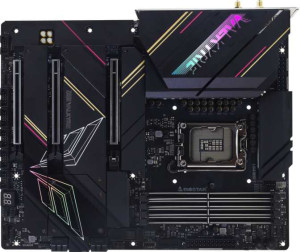
The Biostar Z890 Valkyrie uses the LGA 1851 socket and is compatible with the Z890 chipset, arriving in the standard ATX form factor at 305 mm wide and 244 mm tall. It accommodates a single CPU and carries no integrated processor or integrated graphics of its own. The board supports easy overclocking and features a dual BIOS setup alongside a straightforward BIOS reset mechanism, which adds a layer of resilience during tuning. RGB lighting is present, while Wi-Fi and Bluetooth are not included. There is an HDMI 2.1 output available for display connectivity, and the board is backed by a three-year warranty.
The board uses DDR5 memory across four slots arranged in a dual-channel configuration, supporting up to 192GB total capacity. Standard rated speeds top out at 5600 MHz, while overclocking headroom extends that figure to 8000 MHz for those willing to push beyond stock settings. ECC memory is not supported.
The rear I/O panel is built around nine USB 3.2 Gen 2 Type-A ports, making it well-suited for connecting multiple high-speed peripherals without relying on a hub. Beyond that, there is one USB 4 40Gbps port and a Thunderbolt 4 port, both of which support USB Type-C connections, while USB 3.2 Gen 1, USB 2.0, Gen 2x2, eSATA, and PS/2 ports are absent. Display output options include one HDMI and one DisplayPort, with no DVI or VGA connectors present. Networking is handled by two RJ45 ports for wired connectivity.
Internal connectivity is a strong point of this board, with six M.2 sockets available for NVMe or SATA-based drives, complemented by four SATA 3 connectors for traditional storage devices; SATA 2, U.2, and mSATA are not present. Expansion USB headers allow for two USB 3.2 Gen 2 ports, one USB 3.2 Gen 2x2 port, two USB 3.0 ports, and four USB 2.0 ports to be added via the chassis. Five fan headers provide cooling control across the system, and a TPM connector is included for security module support.
The expansion slot configuration is built entirely around three PCIe 5.0 x16 slots, with no PCIe 4.0, 3.0, or 2.0 x16 slots present. There are also no PCIe x8, x4, or x1 slots, and no legacy PCI slots of any kind, making the layout straightforward and focused solely on the latest PCIe generation at full x16 width.
The onboard audio solution supports 7.1-channel output and achieves a signal-to-noise ratio of 120 dB on the DAC, indicating a reasonably clean audio signal for a motherboard implementation. Two audio connectors are available on the rear panel, and an S/PDIF output is included for those who prefer to route audio digitally to an external receiver or DAC.
The board supports RAID 0, 1, 5, and 10 configurations, covering the most commonly used modes for performance, redundancy, and a combination of both. RAID 0+1 is not supported, though the inclusion of RAID 10 addresses similar use cases for those needing striped mirroring across multiple drives.