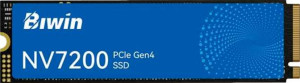
Biwin NV7200 4TB specifications and in-depth review

Biwin NV7200 4TB

Manufacturer: Biwin

Biwin's NV7200 4TB sits in the upper tier of consumer M.2 NVMe storage, built around the Maxio MAP1602 controller and targeting workloads that demand consistent throughput across large file transfers. With a sequential read speed of 7200 MB/s, it covers the practical ceiling of the PCIe 4.0 interface, making it a straightforward option for users who need fast sustained reads without moving to a PCIe 5.0 platform.

On the technical side, the drive uses TLC NAND paired with an HMB (Host Memory Buffer) caching scheme in place of dedicated DRAM, running through a four-channel Maxio MAP1602 controller over a PCIe 4.0 x4 connection with NVMe 2.0. Sequential write speed reaches 6200 MB/s, while random performance is rated at 1,000,000 read IOPS and 800,000 write IOPS. The drive carries a 1,600 TBW endurance rating, an MTBF figure of 1.5 million hours, a maximum operating temperature of 70°C, and ships with a five-year warranty. It does not include an integrated heatsink or hardware AES encryption support.

Pros
  • Sequential read speed of 7200 MB/s and write speed of 6200 MB/s reflect strong sustained throughput for large file transfers
  • Random read performance rated at 1,000,000 IOPS and random write at 800,000 IOPS indicate capable handling of scattered, small-block workloads
  • A 1600 TBW endurance rating is substantial for a 4TB TLC-based drive, supporting heavy write workloads over time
  • The five-year warranty provides a meaningful coverage period for long-term use
  • NVMe 2.0 over PCIe 4.0 ensures compatibility with a wide range of current motherboard platforms
  • An MTBF of 1.5 million hours reflects a solid reliability specification for day-to-day operation
Cons
  • No integrated heatsink means thermal management depends entirely on the host system or a separately purchased cooler
  • HMB caching relies on system RAM rather than dedicated DRAM on the drive, which can affect consistent random performance under sustained mixed workloads
  • The four-channel controller configuration is narrower than eight-channel designs, which may limit parallelism at the hardware level
  • No hardware AES encryption support limits options for users who require drive-level data security
Who is this for?

This drive is a practical fit for users who regularly work with large sequential workloads — such as video editing, content creation, or transferring substantial data sets — where its 7200 MB/s read and 6200 MB/s write speeds translate directly into faster load and save times. The 1600 TBW endurance rating and 1.5 million hour MTBF also make it a reasonable choice for workstation environments where the drive sees consistent daily use over several years. Users building or upgrading a PCIe 4.0 system who need a high-capacity M.2 NVMe drive with reliable longevity and a five-year warranty will find the specification set well aligned with those requirements.

Who is this NOT for?

Users who require hardware-level AES encryption for data security compliance or sensitive storage will find this drive unsuitable, as it carries no encryption support. Systems without adequate airflow or a dedicated M.2 heatsink may also struggle, since the drive lacks an integrated heatsink and tops out at a maximum operating temperature of 70°C, leaving thermal management entirely to the host platform. Additionally, users on platforms that do not support PCIe 4.0 will not be able to take advantage of the drive's rated speeds, as the interface is a hard requirement for the performance figures to be realized.

Read speed:

sequential read speed 7200 MB/s
random read speed 1000000 IOPS

The Biwin NV7200 4TB delivers a sequential read speed of 7200 MB/s, allowing large files to be read at a pace that fully utilizes the PCIe 4.0 bandwidth available to this drive class. For workloads involving many small, scattered data requests, it is rated at 1,000,000 random read IOPS, indicating strong throughput even under conditions where data is not laid out contiguously on the drive.

Write speed:

sequential write speed 6200 MB/s
random write speed 800000 IOPS

The NV7200 4TB is rated for a sequential write speed of 6200 MB/s, supporting sustained data writing at a pace well suited to transferring large files or moving bulk data onto the drive. Alongside that, its random write performance reaches 800,000 IOPS, reflecting solid handling of fragmented write operations where data is being written to multiple scattered locations simultaneously.

Benchmarks:

General info:

type M2
SSD cache HMB (Host Memory Buffer)
Is an NVMe SSD
NVMe version 2
internal storage 4000GB
controller Maxio MAP1602
SSD storage type TLC
PCI Express (PCIe) version 4
Controller channels 4
Terabytes Written (TBW) 1600
MTBF 1.5million hours
warranty period 5 years
Has an integrated heatsink
maximum operating temperature 70 °C
bits of encryption supported 0
has RGB lighting

The NV7200 4TB is an M.2 NVMe SSD running NVMe version 2 over a PCIe 4.0 interface, with 4000GB of TLC NAND storage managed by a Maxio MAP1602 controller operating across four channels. It uses HMB (Host Memory Buffer) in place of dedicated DRAM for caching, and carries an endurance rating of 1600 TBW alongside an MTBF figure of 1.5 million hours, with a maximum operating temperature of 70°C. The drive ships with a five-year warranty and does not include an integrated heatsink, RGB lighting, or hardware AES encryption support.

Final Verdict

The Biwin NV7200 4TB presents a well-rounded specification sheet for a PCIe 4.0 M.2 NVMe drive, anchored by its 7200 MB/s sequential read speed and a 1600 TBW endurance rating that supports sustained, heavy use over the long term. Backed by a five-year warranty and a 1.5 million hour MTBF, it is built for users who prioritize throughput and reliability in a high-capacity M.2 package. The absence of hardware encryption and an integrated heatsink are practical constraints worth factoring in depending on the deployment environment, but for PCIe 4.0 systems where those features are not a requirement, the NV7200 4TB delivers a solid and coherent set of specifications for demanding storage workloads.