Bmax B11 Power specifications and in-depth review

Bmax B11 Power

Manufacturer: Bmax

The Bmax B11 Power is a compact mini PC built around a mobile-class processor that brings together a capable feature set within a Micro-ATX chassis measuring just 126 × 52 × 112 mm. With a volume of under 734 cm³, it occupies minimal desk space while housing 1000GB of NVMe SSD storage and 24GB of DDR5 memory, making it a reasonably well-equipped machine for everyday computing tasks. The unit ships with a one-year warranty and uses a BGA 2049 socket, meaning the CPU is soldered directly to the board.

On the processing side, the CPU operates across 22 threads using big.LITTLE architecture, combining six cores at 1.4 GHz with eight cores at 0.9 GHz and a turbo ceiling of 4.8 GHz, backed by a 24 MB L3 cache and a 28W TDP. Graphics are handled by the Intel Arc Xe-LPG 128EU, which supports up to four simultaneous displays via two HDMI 2.1 outputs and one DisplayPort, alongside DirectX 12 Ultimate and OpenGL 4.6. Connectivity includes Wi-Fi 6, Bluetooth 5.2, two USB 3.2 Gen 2 Type-A ports, one USB 3.2 Gen 2 Type-C port, two USB 2.0 ports, and a single RJ45 Ethernet port. The system recorded a PassMark score of 24,673 and supports up to 96GB of RAM at speeds reaching 7,467 MHz across two memory channels.

Pros
  • Supports up to four simultaneous display outputs, making it suitable for multi-monitor setups without additional hardware
  • Wi-Fi 6 support ensures faster wireless throughput and better performance in congested network environments
  • The 1000GB NVMe SSD provides substantial storage capacity with faster read and write speeds than a standard SATA drive
  • 24GB of DDR5 RAM offers a generous amount of memory for a mini PC, with headroom up to 96GB if expansion is needed
  • A broad set of USB ports covers multiple generations, including two USB 3.2 Gen 2 Type-A, one USB 3.2 Gen 2 Type-C, and two USB 2.0 ports, accommodating a wide range of peripherals
  • The compact Micro-ATX chassis with a volume under 734 cm³ keeps desk space usage to a minimum
Cons
  • The CPU multiplier is locked, removing any possibility of performance tuning through overclocking
  • ECC memory is not supported, which limits reliability options for error-sensitive workloads
  • No Thunderbolt 3 or Thunderbolt 4 ports are present, restricting high-bandwidth peripheral and daisy-chaining options
  • The BGA 2049 socket means the CPU is soldered to the board and cannot be upgraded or replaced
  • The warranty period covers only one year, which is relatively short for a desktop computing device
  • There is no S/PDIF output or VGA connector, limiting compatibility with certain legacy audio and display equipment
Who is this for?

This mini PC suits users who need a space-efficient desktop solution for everyday computing tasks such as web browsing, office work, and media consumption, particularly those who want to connect multiple monitors simultaneously — the four-display output capability makes it a practical fit for productivity setups or digital signage environments. The combination of 24GB of DDR5 RAM and a 1000GB NVMe SSD also makes it a reasonable choice for users handling moderate multitasking or local file-heavy workflows, while Wi-Fi 6 and Bluetooth 5.2 cater well to those who prefer a clean, cable-reduced desk arrangement with modern wireless peripherals.

Who is this NOT for?

Users with demanding workloads such as video editing, 3D rendering, or computationally intensive tasks are likely to find the locked CPU multiplier and soldered BGA socket limiting, as there is no path to upgrading or overclocking the processor as needs grow. The integrated GPU, while capable of driving multiple displays, lacks the dedicated memory and raw rendering power required for gaming at meaningful resolutions or GPU-accelerated professional applications, making this a poor fit for those use cases. Additionally, the absence of Thunderbolt support and ECC memory rules it out for users who rely on high-bandwidth external devices or require error-correcting memory for data-sensitive or mission-critical environments.

General info:

SSD storage capacity 1000GB
form factor Micro-ATX
release date November 2025
Is an NVMe SSD
thickness 112 mm
height 52 mm
width 126 mm
volume 733.824 cm³

The Bmax B11 Power follows a Micro-ATX form factor and occupies a notably small footprint, measuring 126 mm wide, 52 mm tall, and 112 mm thick, which works out to a total volume of 733.824 cm³. Storage is handled by a 1000GB NVMe SSD, offering both generous capacity and the faster data transfer speeds that come with the NVMe interface rather than a conventional SATA drive.

CPU:

Thermal Design Power (TDP) 28W
CPU speed 6 x 1.4 & 8 x 0.9 GHz
turbo clock speed 4.8GHz
CPU threads 22 threads
Has integrated graphics
uses multithreading
L3 cache 24 MB
clock multiplier 38
Has an unlocked multiplier
Supports 64-bit
CPU temperature 110 °C

The processor uses a hybrid core layout with six cores running at 1.4 GHz and eight cores at 0.9 GHz, reaching a turbo clock speed of 4.8 GHz when conditions allow, and spreads its workload across 22 threads thanks to multithreading support. It carries a 24 MB L3 cache, a clock multiplier of 38, and a 28W TDP, with a maximum operating temperature of 110 °C. The CPU supports 64-bit processing and includes integrated graphics, though the multiplier is locked, ruling out any overclocking through that route.

Graphics card:

GPU clock speed 300 MHz
GPU turbo 2250 MHz
PCI Express (PCIe) version 5
texture mapping units (TMUs) 64
shading units 1024
render output units (ROPs) 32
DirectX version DirectX 12 Ultimate
OpenGL version 4.6
OpenCL version 3
semiconductor size 7 nm
supported displays 4

The integrated GPU has a base clock of 300 MHz and a turbo clock of 2250 MHz, built on a 7 nm process and connected via PCIe 5. Its rendering pipeline includes 1024 shading units, 64 texture mapping units, and 32 render output units, giving it a reasonably detailed hardware configuration for an integrated solution. It supports DirectX 12 Ultimate, OpenGL 4.6, and OpenCL 3, and can drive up to four displays simultaneously.

Memory:

RAM 24GB
DDR memory version 5

The system comes equipped with 24GB of DDR5 RAM, placing it on the newer fifth generation of DDR memory technology, which brings higher bandwidth and improved efficiency compared to its predecessors.

Connectivity:

Wi-Fi version Wi-Fi 6 (802.11ax), Wi-Fi 5 (802.11ac), Wi-Fi 4 (802.11n)
supports Wi-Fi
Has Bluetooth
Bluetooth version 5.2
USB 2.0 ports 2
USB 3.2 Gen 2 ports (USB-A) 2
USB 3.2 Gen 1 ports (USB-A) 0
USB 3.2 Gen 2 ports (USB-C) 1
USB 4 40Gbps ports 0
USB 4 20Gbps ports 0
USB 3.2 Gen 2x2 ports 0
USB 3.2 Gen 1 ports (USB-C) 0
Thunderbolt 4 ports 0
Thunderbolt 3 ports 0
DisplayPort outputs 1
HDMI version HDMI 2.1
HDMI ports 2
RJ45 ports 1
has a socket for a 3.5 mm audio jack
has a VGA connector
Has S/PDIF Out port

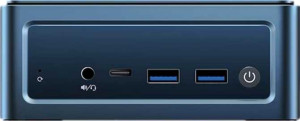
Wireless connectivity covers Wi-Fi 6 (802.11ax) along with backwards-compatible Wi-Fi 5 and Wi-Fi 4, paired with Bluetooth 5.2 for peripheral connections. On the wired side, the unit provides two USB 3.2 Gen 2 Type-A ports and one USB 3.2 Gen 2 Type-C port for faster data transfer, complemented by two USB 2.0 Type-A ports for standard devices; there are no USB 3.2 Gen 1, USB 4, Thunderbolt 3, or Thunderbolt 4 ports. Display output is handled by two HDMI 2.1 ports and one DisplayPort, while a single RJ45 port provides wired network access. Audio connectivity includes a 3.5 mm headset jack, though there is no VGA connector or S/PDIF output.

Benchmarks:

PassMark result 24673
PassMark result (single) 3438
PassMark result (overclocked) 24674

In PassMark testing, the system achieved a multi-threaded score of 24,673 and a single-threaded score of 3,438, with the overclocked result coming in at 24,674 — virtually identical to the standard multi-threaded figure, reflecting the locked multiplier noted in the CPU specifications.

Miscellaneous:

maximum memory amount 96GB
GPU name Arc Xe-LPG 128EU
CPU socket BGA 2049
Type Laptop
instruction sets MMX, F16C, FMA3, AES, AVX, AVX2, SSE 4.1, SSE 4.2
Has NX bit
GPU execution units 8
Supports ECC memory
memory channels 2
RAM speed (max) 7467 MHz
Uses big.LITTLE technology
warranty period 1 years

The processor is a laptop-type chip mounted via a BGA 2049 socket, meaning it is soldered directly to the board, and it employs big.LITTLE technology for its hybrid core arrangement. It supports NX bit for hardware-level security and carries a broad set of instruction sets including MMX, F16C, FMA3, AES, AVX, AVX2, SSE 4.1, and SSE 4.2. Memory can be expanded to a maximum of 96GB across two channels, with RAM speeds reaching up to 7,467 MHz, though ECC memory is not supported. The integrated GPU is the Arc Xe-LPG 128EU, featuring 8 execution units, and the system comes with a one-year warranty.
Final Verdict

The Bmax B11 Power is a compact mini PC that delivers a well-rounded specification sheet for its form factor, with its 1000GB NVMe SSD, 24GB of DDR5 RAM, and four-display output capability standing out as genuine practical strengths for users building a space-efficient, multi-monitor workstation. Its Wi-Fi 6 support and broad USB port selection add to its appeal for everyday productivity environments. That said, the soldered CPU, locked multiplier, and integrated-only graphics draw a clear boundary around its capabilities, making it best suited to light-to-moderate workloads rather than demanding creative or compute-intensive tasks. For users whose needs align with that profile, the Bmax B11 Power represents a capable and feature-complete compact desktop that covers the essentials without unnecessary bulk.