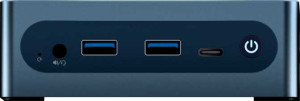
The Bmax B4 Ultra follows a Micro-ATX form factor and occupies a total volume of just 408.24 cm³, with dimensions of 108 mm in thickness, 105 mm in width, and 36 mm in height — a notably compact footprint for a desktop unit. Storage is handled by a 512GB NVMe SSD, which uses the faster NVMe interface rather than a conventional SATA connection, contributing to quicker boot times and file access speeds.
The processor in this unit is a 4-core, 4-thread chip with a TDP of just 6W, reflecting its low-power design intended for energy-efficient operation. Base clock speed sits at 4 × 0.1 GHz, but the CPU can reach a turbo clock speed of 3.6 GHz when the workload demands it. It does not support multithreading and comes with a locked clock multiplier, meaning there is no overclocking headroom. The processor includes 6 MB of L3 cache, or 1.5 MB per core, and has a maximum rated temperature of 105 °C. It supports 64-bit computing and includes integrated graphics, while the clock multiplier value of 1 confirms it runs at its rated frequency without any built-in boost to the base ratio.
The integrated graphics solution runs at a turbo clock of 1000 MHz and is built on a 10 nm semiconductor process, connecting to the system via PCIe 3. It supports up to three displays simultaneously and handles modern graphics APIs without issue, including DirectX 12 Ultimate, OpenGL 4.6, and OpenCL 3, making it capable of handling a reasonable range of general-purpose and lightly accelerated workloads.
The Bmax B4 Ultra comes equipped with 12GB of DDR4 RAM, providing a reasonable amount of system memory for everyday multitasking and general use workloads.
Wireless connectivity is covered by built-in Wi-Fi and Bluetooth 5.0. On the wired side, the unit provides two USB 2.0 ports, two USB 3.2 Gen 1 Type-A ports, and one USB 3.2 Gen 1 Type-C port; there are no USB 3.2 Gen 2, USB 4, or Thunderbolt ports of any kind. Display output options include two HDMI 2.1 ports and one DisplayPort, while a single RJ45 port handles wired networking. Audio is supported via a 3.5 mm headset jack, though there is no VGA connector and no S/PDIF output.
In PassMark testing, the system achieves a multi-threaded score of 5408 and a single-core score of 1904, giving a reasonable indication of both parallel and single-threaded processing capability. Under overclocked conditions, the PassMark result rises modestly to 5706, suggesting limited but measurable headroom beyond the default configuration.
The processor is classified as a laptop-type CPU and does not use big.LITTLE technology. It supports a broad set of instruction sets — MMX, F16C, FMA3, AES, AVX, AVX2, SSE 4.1, and SSE 4.2 — and includes NX bit support for hardware-level security. Memory can be configured up to a maximum of 16GB, running through a single memory channel at speeds of up to 4800 MHz, though ECC memory is not supported and there is no external memory slot. The GPU features 24 execution units, and the unit ships with a one-year warranty.