General info:
| SSD storage capacity |
1000GB |
| form factor |
Micro-ATX |
| release date |
June 2025 |
| Is an NVMe SSD |
✓ |
| thickness |
112 mm |
| height |
52 mm |
| width |
126 mm |
| volume |
733.824 cm³ |
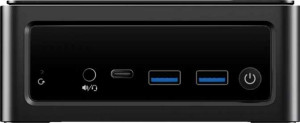
The Bmax B9 Power adopts a Micro-ATX form factor with dimensions of 126 mm wide, 52 mm tall, and 112 mm thick, resulting in a total volume of 733.824 cm³. Storage is handled by a 1TB NVMe SSD, offering fast read and write speeds through the NVMe interface. Despite its compact footprint, the chassis manages to accommodate these components in a reasonably dense but well-defined physical envelope.
CPU:
| Thermal Design Power (TDP) |
45W |
| CPU speed |
6 x 2.5 & 8 x 1.8 GHz |
| turbo clock speed |
5GHz |
| CPU threads |
20 threads |
| Has integrated graphics |
✓ |
| uses multithreading |
✓ |
| L3 cache |
24 MB |
| L2 cache |
11.5 MB |
| L1 cache |
1200 KB |
| clock multiplier |
25 |
| Has an unlocked multiplier |
✕ |
| Supports 64-bit |
✓ |
| CPU temperature |
100 °C |
The processor operates with a 45W TDP and features a hybrid core configuration running six cores at 2.5 GHz and eight cores at 1.8 GHz, with a turbo clock speed reaching up to 5 GHz across 20 threads via multithreading support. Cache memory is layered at 1200 KB L1, 11.5 MB L2, and 24 MB L3, while the clock multiplier is set at 25 and the multiplier is locked. The CPU supports 64-bit processing, includes integrated graphics, and has a maximum rated temperature of 100 °C.
Graphics card:
| GPU turbo |
1450 MHz |
| PCI Express (PCIe) version |
4 |
| texture mapping units (TMUs) |
48 |
| shading units |
768 |
| render output units (ROPs) |
24 |
| DirectX version |
DirectX 12 |
| OpenGL version |
4.6 |
| OpenCL version |
3 |
| semiconductor size |
10 nm |
| supported displays |
4 |
The integrated graphics solution runs at a turbo clock of 1450 MHz and is built on a 10 nm semiconductor process, featuring 768 shading units, 48 texture mapping units, and 24 render output units. It connects via PCIe 4 and can drive up to four displays simultaneously. API support covers DirectX 12, OpenGL 4.6, and OpenCL 3, making it compatible with a broad range of modern software and compute workloads.
Memory:
| RAM |
24GB |
| RAM speed |
4400 MHz |
| DDR memory version |
5 |
The Bmax B9 Power is equipped with 24GB of DDR5 RAM running at 4400 MHz, providing a solid foundation for multitasking and memory-intensive tasks. DDR5 is the latest generation of double data rate memory, and at this speed and capacity it offers meaningful bandwidth for both system and integrated graphics workloads.
Connectivity:
| Wi-Fi version |
Wi-Fi 6 (802.11ax), Wi-Fi 5 (802.11ac), Wi-Fi 4 (802.11n) |
| supports Wi-Fi |
✓ |
| Has Bluetooth |
✓ |
| Bluetooth version |
5.2 |
| USB 2.0 ports |
2 |
| USB 3.2 Gen 2 ports (USB-A) |
2 |
| USB 3.2 Gen 1 ports (USB-A) |
0 |
| USB 3.2 Gen 2 ports (USB-C) |
1 |
| USB 4 40Gbps ports |
0 |
| USB 4 20Gbps ports |
0 |
| USB 3.2 Gen 2x2 ports |
0 |
| USB 3.2 Gen 1 ports (USB-C) |
0 |
| Thunderbolt 4 ports |
0 |
| Thunderbolt 3 ports |
0 |
| DisplayPort outputs |
1 |
| HDMI version |
HDMI 2.1 |
| HDMI ports |
2 |
| RJ45 ports |
0 |
| has a socket for a 3.5 mm audio jack |
✓ |
| has a VGA connector |
✕ |
| Has S/PDIF Out port |
✕ |
Wireless connectivity is covered by Wi-Fi 6 (802.11ax) with backward compatibility for Wi-Fi 5 and Wi-Fi 4, alongside Bluetooth 5.2 for short-range peripherals. On the wired side, the unit provides two USB 3.2 Gen 2 Type-A ports, two USB 2.0 ports, and one USB 3.2 Gen 2 Type-C port; there are no USB 3.2 Gen 1, USB 4, Thunderbolt, or RJ45 ports. Display output is handled by two HDMI 2.1 ports and one DisplayPort, while a 3.5 mm audio jack is also present. VGA and S/PDIF outputs are not included.
Benchmarks:
| PassMark result |
26897 |
| PassMark result (single) |
3675 |
| Geekbench 6 result (multi) |
11894 |
| Geekbench 6 result (single) |
2426 |
| Cinebench R20 (multi) result |
6371 |
| Cinebench R20 (single) result |
734 |
In multi-core testing, the processor scores 26,897 in PassMark and 11,894 in Geekbench 6, with a Cinebench R20 multi-core result of 6,371. Single-core performance is reflected in a PassMark score of 3,675, a Geekbench 6 single-core result of 2,426, and a Cinebench R20 single-core score of 734, giving a clear picture of both sustained multi-threaded throughput and per-core responsiveness.
Miscellaneous:
| maximum memory amount |
64GB |
| Uses big.LITTLE technology |
✓ |
| GPU name |
Iris Xe Graphics 96EU |
| Has NX bit |
✓ |
| GPU execution units |
96 |
| Supports ECC memory |
✕ |
| memory channels |
2 |
| Type |
Laptop |
| instruction sets |
SSE 4.2, SSE 4.1, AVX, AES, FMA3, F16C, MMX |
| RAM speed (max) |
5200 MHz |
| warranty period |
1 years |
| Uses flash storage |
✕ |
The system uses a laptop-class processor built on big.LITTLE architecture and features the Iris Xe Graphics 96EU with 96 execution units. Memory can be expanded up to 64GB across two channels, with a maximum supported RAM speed of 5200 MHz, though ECC memory is not supported and flash storage is not used. The CPU includes NX bit support and is compatible with instruction sets covering SSE 4.1, SSE 4.2, AVX, AES, FMA3, F16C, and MMX. Flash storage is not used, and the unit comes with a one-year warranty.