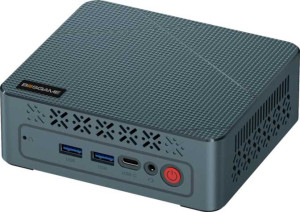
The Bosgame E2 follows a Micro-ATX form factor and is built around a compact physical footprint, measuring 126 mm wide, 41 mm tall, and 112 mm thick, with a total volume of 578.592 cm³ and a weight of 910 g. Storage is handled by a 512GB NVMe SSD, offering faster data access compared to traditional SATA drives thanks to the NVMe interface.
The CPU runs at a base speed of 4 x 2.1 GHz with a turbo clock of 3.7 GHz, and supports multithreading across 8 threads, making it capable of handling multiple tasks concurrently. It has a TDP of 35W and a maximum operating temperature of 105 °C, with a fixed clock multiplier of 21 and no unlocked multiplier. Cache memory is organized across three levels — 384 KB L1, 2 MB L2 at 0.5 MB per core, and 4 MB L3 at 1 MB per core — and the processor supports 64-bit computing as well as integrated graphics.
The integrated GPU operates at a base clock of 300 MHz with a turbo frequency of 1200 MHz, and is built on a 12 nm semiconductor process containing 4,940 million transistors. It features 512 shading units and a maximum memory bandwidth of 35.76 GB/s, with PCIe 3 connectivity. API support covers DirectX 12, OpenGL 4.6, and OpenCL 2.2, and the GPU is capable of driving up to 4 displays simultaneously.
The Bosgame E2 comes with 16GB of DDR4 RAM running at a speed of 3200 MHz, providing a solid memory configuration for everyday multitasking and general computing workloads.
The Bosgame E2 supports wireless connectivity through Wi-Fi 5 (802.11ac) and Wi-Fi 4 (802.11n), alongside Bluetooth 5.0 for peripheral connections. On the wired side, the unit provides two USB 2.0 ports, two USB 3.2 Gen 1 Type-A ports, and one USB 3.2 Gen 1 Type-C port, while higher-speed options such as USB 3.2 Gen 2, USB 4, and Thunderbolt are not included. Display output is handled by two HDMI 2.0 ports, with no DisplayPort or VGA connector present. Audio connectivity is covered by a 3.5 mm headset jack, though there is no S/PDIF output, and there is no RJ45 port for wired networking.
In benchmark testing, the Bosgame E2 achieves a PassMark score of 7722 in the multi-core test and 2019 in the single-core test. Geekbench 6 results come in at 2879 for multi-core and 948 for single-core performance. Cinebench R20 records 1660 in the multi-core run and 360 in the single-core run. Blender render times are measured at 498.39 seconds for the bmw27 scene and 1548.58 seconds for the classroom scene.
The system uses a laptop-type CPU paired with the Radeon Vega 8 GPU, which features 8 execution units. Memory can be expanded up to 32GB across two channels, with a maximum supported RAM speed of 2400 MHz, and the system is compatible with ECC memory. The processor supports NX bit for hardware-level security and does not use big.LITTLE technology. Compatible chipsets include X570, B550, A520, X470, and B450, and the supported instruction sets cover SSE 4.1, SSE 4.2, AVX, AES, FMA3, F16C, and MMX.