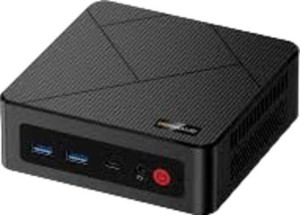
The Bosgame E4 follows a Micro-ATX form factor and is notably compact, measuring 128 mm wide, 42.8 mm tall, and 127.1 mm thick, which translates to a total volume of roughly 696.3 cm³. Storage is handled by a 512GB NVMe SSD, offering faster read and write performance compared to traditional SATA-based drives thanks to the NVMe interface.
The CPU in the Bosgame E4 is a quad-core processor running at 4 x 2.1 GHz with a turbo clock speed of 3.7 GHz, supported by 8 threads through multithreading. It carries a 35W TDP and has a maximum operating temperature of 105 °C, with a fixed clock multiplier of 21 and no unlocked multiplier available. The chip includes integrated graphics and fully supports 64-bit computing. Cache memory is distributed across three levels: 384 KB of L1, 2 MB of L2 at 0.5 MB per core, and 4 MB of L3 cache at 1 MB per core.
The integrated GPU in the Bosgame E4 runs at a base clock of 300 MHz with a turbo frequency of 1200 MHz, and is built on a 12 nm semiconductor process housing 4,940 million transistors. It features 512 shading units and delivers a maximum memory bandwidth of 35.76 GB/s, while supporting up to four displays simultaneously. API support covers DirectX 12, OpenGL 4.6, and OpenCL 2.2, with the GPU connected via PCIe 3.
The Bosgame E4 is equipped with 16GB of DDR4 RAM running at a speed of 2400 MHz, covering the memory needs of standard multitasking and everyday workloads within a compact system.
The Bosgame E4 offers a well-rounded set of connectivity options, including Wi-Fi and Bluetooth 5.0 for wireless communication. On the wired side, it provides two RJ45 Ethernet ports for network redundancy or dual-network setups. USB ports consist of three USB 3.2 Gen 2 Type-A ports, one USB 3.2 Gen 2 Type-C port, and one USB 2.0 port; there are no USB 3.2 Gen 1, USB 4, Thunderbolt 3, or Thunderbolt 4 ports. Display output is handled by two HDMI 2.0 ports and one DisplayPort, while VGA and S/PDIF outputs are absent. A 3.5 mm audio jack is also present for headset or audio connectivity.
In benchmark testing, the Bosgame E4 achieves a PassMark score of 7722 in multi-core and 2019 in single-core workloads. Geekbench 6 results come in at 2879 for multi-core and 948 for single-core performance. Cinebench R20 records 1660 in the multi-core test and 360 in the single-core run. For rendering workloads, Blender completed the bmw27 scene in 498.39 seconds and the more demanding classroom scene in 1548.58 seconds.
The Bosgame E4 uses a laptop-class CPU paired with a Radeon Vega 8 GPU featuring 8 execution units. System memory can be expanded up to 32GB across two channels, with a maximum supported RAM speed of 2400 MHz, and ECC memory is supported; there is no external memory slot nor does the unit use flash storage. The processor supports a range of instruction sets including SSE 4.1, SSE 4.2, AVX, AES, FMA3, F16C, and MMX, and includes NX bit support for hardware-level memory protection. It does not use big.LITTLE technology. Compatible chipsets include X570, B550, A520, X470, and B450, and the unit comes with a one-year warranty.