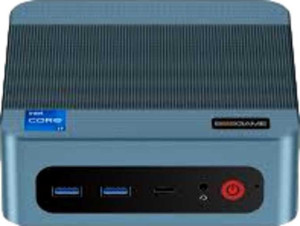
The Bosgame P2 Plus follows a Micro-ATX form factor and occupies a very compact footprint, measuring 130 mm wide, 46 mm tall, and 129 mm thick, which results in a total volume of just 771.42 cm³. Storage is handled by a 512GB NVMe SSD, offering faster read and write performance compared to traditional SATA-based drives thanks to the NVMe interface.
The processor in the Bosgame P2 Plus is a 14-core design with a hybrid configuration, running six cores at 2.3 GHz and eight cores at 1.7 GHz, and it supports multithreading across 20 threads in total. It operates under a 45W TDP with a maximum junction temperature of 100°C, and can reach a turbo clock speed of 4.7 GHz via Turbo Boost version 3, though the clock multiplier is locked at 23. The cache hierarchy consists of 1200 KB of L1, 11.5 MB of L2, and 24 MB of L3 cache, and the CPU supports both 64-bit computing and integrated graphics.
The integrated graphics solution runs at a turbo frequency of 1400 MHz and is built on a 10 nm semiconductor process, connecting to the system via PCIe 4. It supports up to four displays simultaneously and is compatible with DirectX 12, OpenGL 4.6, and OpenCL 3, covering a broad range of graphical and compute workloads.
The Bosgame P2 Plus comes equipped with 32GB of DDR5 RAM running at a base speed of 4800 MHz, providing a solid foundation for multitasking and memory-intensive workloads within its compact form factor.
Wireless connectivity covers Wi-Fi 6E, Wi-Fi 6, Wi-Fi 5, and Wi-Fi 4 standards alongside Bluetooth 5.2, while wired networking is provided through a single RJ45 Ethernet port. On the USB front, the unit offers four USB 3.2 Gen 2 Type-A ports and one USB 4 40Gbps port, which also functions as a Thunderbolt 4 output; there are no USB 2.0, USB 3.2 Gen 1, or USB 3.2 Gen 2x2 ports present. Display output options include one HDMI 2.0 port and one DisplayPort, and audio is covered by a 3.5 mm headset jack, though there is no VGA connector or S/PDIF output.
In benchmark testing, the Bosgame P2 Plus records a PassMark multi-thread score of 25,260 alongside a single-thread score of 3,505, reflecting the processor's threading capability relative to its per-core throughput. The Cinebench R20 results follow a similar pattern, with a multi-core score of 7,170 and a single-core result of 694.
The processor is a laptop-class chip that employs big.LITTLE technology and carries NX bit support, while the Iris Xe Graphics 96EU handles integrated graphics duties with 96 execution units. Memory can be expanded up to 64GB across two channels, with a maximum supported RAM speed of 5200 MHz, though ECC memory is not supported and flash storage is not used. The supported instruction sets include SSE 4.1, SSE 4.2, AVX, AES, FMA3, F16C, and MMX, and the unit comes with a one-year warranty.