Canon EOS R5 II specifications and in-depth review

Canon EOS R5 II

Manufacturer: Canon

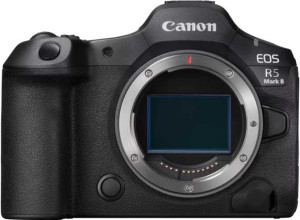
The Canon EOS R5 II is a full-frame mirrorless camera built around the Canon RF lens mount, combining high-resolution stills with advanced video capabilities in a weather-sealed body. It runs on a Digic X with Digic Accelerator processor and offers a broad feature set covering both photography and videography, housed in a chassis measuring 138.5 mm wide, 101.2 mm tall, and 93.5 mm thick, with a total weight of 746 g. A 3.2″ flip-out touchscreen and a 100% coverage electronic viewfinder provide flexible shooting and composition options.

On the imaging side, the R5 II uses a 45 MP back-illuminated stacked CMOS sensor with a native maximum ISO of 51200, expandable to 102400, and delivers in-body stabilization rated at 8.5 stops under CIPA standards. Continuous mechanical shooting reaches 12 fps, backed by phase-detection autofocus for both stills and video. Video recording tops out at 4320p 60fps with a maximum bitrate of 2600 Mbps, and the camera includes a 3.5 mm microphone input, stereo built-in microphones, and a headphone jack. Connectivity covers Wi-Fi 6 (802.11ax), Bluetooth 5.3, USB 3.2 Type-C, HDMI output, dual card slots, and remote smartphone control.

Pros
  • The full-frame stacked BSI CMOS sensor delivers 45 MP resolution with a native ISO range up to 51200, expandable to 102400, offering broad light sensitivity for stills
  • In-body sensor-shift stabilization rated at 8.5 stops (CIPA) can be combined with lens-based stabilization, reducing the impact of camera movement during handheld shooting
  • 5,850 phase-detection autofocus points with AF tracking and touch autofocus provide extensive coverage across the frame for both photos and videos
  • The flip-out 3.2-inch touchscreen paired with a 100% coverage electronic viewfinder gives flexible framing options across a wide range of shooting angles
  • Video recording reaches 4320p at 60 fps with a maximum bitrate of 2600 Mbps, and includes phase-detection and continuous autofocus during recording alongside a 24p cinema mode and slow-motion support
  • Dual card slots, USB 3.2 Type-C, Wi-Fi 6, and Bluetooth 5.3 provide versatile options for storage and fast data transfer or wireless connectivity
Cons
  • CIPA-rated battery life of 340 shots per charge is relatively modest given the demands of high-resolution capture and video recording
  • The camera has no built-in GPS, requiring an external solution for geotagging images
  • NFC is absent, limiting quick one-tap pairing options with compatible devices
  • At 746 g, the body adds considerable weight for extended handheld use
  • No built-in flash is included, making an external unit necessary for flash photography
Who is this for?

This camera is well-matched to professional and advanced photographers who demand high-resolution stills and high-frame-rate video in a single body. The 45 MP full-frame sensor with 8.5-stop in-body stabilization makes it a strong choice for demanding genres like wildlife, sports, and documentary work, where resolving fine detail and shooting handheld in variable conditions are both priorities. Videographers who need 8K recording at up to 60 fps with a 2600 Mbps bitrate alongside phase-detection autofocus and continuous AF will find the feature set well-suited to high-end production work. The weather-sealed build, flip-out touchscreen, dual card slots, and broad wireless connectivity further support professionals working in the field or on set.

Who is this NOT for?

Users prioritizing a lightweight, portable kit may find the 746 g body weight a limiting factor during extended handheld sessions or travel. The CIPA-rated battery life of 340 shots per charge is unlikely to satisfy shooters who cover long events or all-day sessions without access to spare batteries or charging facilities. Additionally, those who rely on built-in GPS for automatic geotagging or NFC for quick device pairing will need to seek external workarounds, making this a less convenient option for travel photographers or journalists who depend on streamlined location-aware workflows.

Design:

Type Mirrorless
viewfinder Electronic viewfinder (EVF)
is weather-sealed (splashproof)
screen resolution 2100k dots
Has a flip-out screen
viewfinder coverage 100%
screen size 3.2"
weight 746 g
has a touch screen
Has a hot shoe
volume 1310.5147 cm³
is a system camera
has a flash
lowest potential operating temperature 1 °C
maximum operating temperature 40 °C
Has a tilting viewfinder
width 138.5 mm
height 101.2 mm
thickness 93.5 mm

The Canon EOS R5 II is a mirrorless system camera with a body measuring 138.5 mm wide, 101.2 mm tall, and 93.5 mm thick, weighing 746 g at a total volume of 1310.5147 cm³. It features a weather-sealed construction rated for operating temperatures between 1 °C and 40 °C, making it suitable for a range of shooting conditions. The camera includes a 3.2″ flip-out touchscreen with a resolution of 2100k dots, complemented by a 100% coverage electronic viewfinder (EVF) that does not tilt. A hot shoe is present for attaching external flash units, while a built-in flash is not included. As a system camera, it accepts interchangeable lenses and supports the full Canon RF ecosystem.

Optics:

sensor size Full frame
lens mount Canon RF
focus points 5850
megapixels (main camera) 45 MP
maximum ISO 51200 ISO
maximum expanded ISO 102400 ISO
has sensor shift stabilization
continuous shooting (mechanical) 12 fps
has AF tracking
Has phase-detection autofocus for photos
fastest shutter speed 0.000125 s
has manual focus
has touch autofocus
has manual shutter speed
has a built-in HDR mode
has a BSI sensor
has manual exposure
has a two-stage shutter
has a serial shot mode
has a CMOS sensor
has manual ISO
flash sync speed 0.004 s
has manual white balance
exposure time 30 s
Maximum electronic shutter speed 3.125E-5 s
has a stacked CMOS sensor
image stabilization rating (CIPA) 8.5 stops
can combine image stabilization

The Canon EOS R5 II uses a full-frame back-illuminated stacked CMOS sensor with a resolution of 45 MP, mounted via the Canon RF lens mount and supported by 5,850 focus points with phase-detection autofocus, AF tracking, and touch autofocus for stills. Native ISO reaches 51200, expandable to 102400, with full manual control over ISO, exposure, shutter speed, and white balance also available. The mechanical shutter reaches a top speed of 0.000125 s, while the electronic shutter goes as fast as 3.125E-5 s, and the flash sync speed sits at 0.004 s; maximum exposure time extends to 30 s. Continuous mechanical shooting is supported at 12 fps alongside a burst mode and a two-stage shutter. In-body sensor-shift stabilization is rated at 8.5 stops (CIPA) and can be combined with lens-based stabilization for a coordinated approach. A built-in HDR mode rounds out the imaging feature set.

Videography:

video recording (main camera) 4320 x 60 fps
Has phase-detection autofocus for videos
has continuous autofocus when recording movies
has a microphone input
has a socket for a 3.5 mm audio jack
has a stereo microphone
Has timelapse function
movie bitrate 2600 Mbps
number of microphones 2
has a 24p cinema mode
supports slow-motion video recording

The Canon EOS R5 II records video at up to 4320p at 60 fps with a maximum bitrate of 2600 Mbps, and supports phase-detection autofocus as well as continuous autofocus during recording. A 24p cinema mode, slow-motion video recording, and a timelapse function are all included. Audio handling is covered by two built-in stereo microphones, a dedicated microphone input, and a 3.5 mm headphone jack for monitoring.

Battery:

Battery life (CIPA) 340 shots
has a removable battery
has a rechargeable battery
has a battery level indicator
battery power 2130 mAh

The Canon EOS R5 II is powered by a removable, rechargeable battery with a capacity of 2130 mAh, delivering a CIPA-rated battery life of 340 shots per charge. A battery level indicator is built in, allowing the remaining charge to be monitored during use.

Features:

processor Digic X with Digic Accelerator
supports Wi-Fi
Has Bluetooth
Has dual card slots
has pixel shift shot
shoots raw
supports lossless compressed raw
Wi-Fi version Wi-Fi 5 (802.11ac), Wi-Fi 4 (802.11n), Wi-Fi 6 (802.11ax)
supports a remote smartphone
has an HDMI output
has GPS
has an advanced hot shoe
has NFC
has an external memory slot
Has USB Type-C
Bluetooth version 5.3

The Canon EOS R5 II runs on a Digic X with Digic Accelerator processor and supports RAW capture including lossless compressed RAW, while pixel shift shot is not available. Wireless connectivity covers Wi-Fi 6 (802.11ax), Wi-Fi 5 (802.11ac), and Wi-Fi 4 (802.11n), alongside Bluetooth 5.3 and remote smartphone control; NFC and GPS are not included. The camera offers dual card slots and an external memory slot for flexible storage, plus a USB Type-C port, HDMI output, and an advanced hot shoe for external accessories.

Miscellaneous:

USB version 3.2

The Canon EOS R5 II features a USB 3.2 interface for data transfer and connectivity.
Final Verdict

The Canon EOS R5 II stands as a technically comprehensive mirrorless camera aimed squarely at professionals who need both high-resolution imaging and capable video in one body. Its 45 MP full-frame stacked BSI CMOS sensor combined with 8.5-stop in-body stabilization and 8K/60fps video recording at 2600 Mbps reflects a specification set built for demanding real-world use across photography and cinematography alike. While the battery life and body weight will require planning for extended shoots, and the absence of GPS and NFC may inconvenience some workflows, these are reasonable trade-offs within the context of what the camera delivers overall. For professionals seeking a single, well-connected, weather-sealed system body capable of handling high-resolution stills and high-bitrate video with robust autofocus, the Canon EOS R5 II presents a well-rounded and credible option.

Popular Comparisons

Canon EOS R5 II
Canon EOS R5 II
VS
Canon EOS R6 Mark III
Canon EOS R5 II
Canon EOS R5 II
VS
Hasselblad X2D II 100C
Canon EOS R5 II
Canon EOS R5 II
VS
Sony Alpha 1 II
Sony Alpha 1 II
Canon EOS R5 II
Canon EOS R5 II
VS
Leica Q3 43
Leica Q3 43
Canon EOS R5 II
Canon EOS R5 II
VS
Nikon Z6 III
Nikon Z6 III
Canon EOS R5 II
Canon EOS R5 II
VS
Nikon Zf
Nikon Zf
Canon EOS R5 II
Canon EOS R5 II
VS
Leica SL3
Leica SL3
Canon EOS R5 II
Canon EOS R5 II
VS
Fujifilm X-E5 + Fujifilm XF 23mm f/2.8 R WR