Colorful Battle-AX B860M-GHA Wi-Fi V20 specifications and in-depth review

Colorful Battle-AX B860M-GHA Wi-Fi V20

Manufacturer: Colorful

The Colorful Battle-AX B860M-GHA Wi-Fi V20 is a Micro-ATX motherboard based on Intel's B860 chipset, designed for LGA 1851 processors. It includes built-in wireless connectivity through Wi-Fi 6 (802.11ax) and Bluetooth 5.2, along with RGB lighting and a straightforward BIOS reset mechanism. The board carries a 3-year warranty and measures 245 mm by 210 mm, fitting comfortably into compact mid-tower and Micro-ATX cases.

Memory support extends to 96 GB of DDR5 across two slots in a dual-channel configuration, with a rated maximum of 6400 MHz and overclocked headroom reaching 7600 MHz. Storage options include three M.2 sockets and four SATA 3 connectors, with full support for RAID 0, 1, 5, and 10. Expansion is handled by a single PCIe 5.0 x16 slot alongside a PCIe x4 slot. The rear I/O provides four USB 3.2 Gen 1 Type-A ports, two USB 2.0 ports, one USB Type-C, HDMI 2.0, DisplayPort, and a single RJ45 Ethernet port, while 5.1-channel audio is delivered through three analog connectors.

Pros
  • Supports Wi-Fi 6 (802.11ax) alongside Wi-Fi 4 and Wi-Fi 5, covering a broad range of wireless standards without needing a separate adapter
  • Three M.2 sockets provide ample high-speed storage expansion for a Micro-ATX board
  • DDR5 memory with overclocked speeds up to 7600 MHz offers meaningful headroom for memory-sensitive workloads
  • RAID 0, 1, 5, and 10 support gives flexibility for both performance-oriented and redundancy-focused storage configurations
  • Built-in BIOS reset and overclock-friendly design simplify system tuning without requiring advanced technical steps
  • Three-year warranty provides solid long-term coverage for a motherboard in this category
Cons
  • Only two memory slots limits future upgrade flexibility, as the maximum of 96 GB cannot be expanded by adding more modules
  • No USB 3.2 Gen 2 ports on the rear I/O, limiting transfer speeds for compatible devices to Gen 1 rates
  • No TPM connector, which can be a drawback for users requiring hardware-based security features
  • Dual BIOS is absent, meaning there is no automatic fallback if the primary BIOS becomes corrupted
  • No S/PDIF digital audio output, restricting connectivity options for certain audio receivers or external DACs
Who is this for?

This board is a solid fit for users building a compact desktop system around an LGA 1851 processor who want a capable feature set within a Micro-ATX footprint. The three M.2 sockets and broad RAID support (0, 1, 5, and 10) make it well-suited for home office or small workstation builds where storage flexibility matters. Built-in Wi-Fi 6 and Bluetooth 5.2 are practical for setups where running Ethernet cables is not feasible, and the DDR5 support with overclocked speeds up to 7600 MHz appeals to users who want to push memory performance without investing in a higher-tier chipset board.

Who is this NOT for?

Users who need extensive rear USB connectivity will find this board limiting, as it offers no USB 3.2 Gen 2 ports and only a modest total of six rear USB ports, which may not satisfy content creators or users with many high-speed peripherals. The absence of a TPM connector makes it a poor match for environments where hardware-level security compliance is required, such as managed enterprise or regulated professional settings. Additionally, with only two memory slots, users planning to scale memory capacity incrementally over time will hit an upgrade ceiling sooner than they might with a four-slot alternative.

General info:

CPU socket LGA 1851
chipset B860
form factor Micro-ATX
supports Wi-Fi
Wi-Fi version Wi-Fi 4 (802.11n), Wi-Fi 5 (802.11ac), Wi-Fi 6 (802.11ax)
Has Bluetooth
Bluetooth version 5.2
HDMI version HDMI 2.0
Easy to overclock
has RGB lighting
Easy to reset BIOS
Has dual BIOS
has aptX
CPU sockets 1
Has integrated graphics
warranty period 3 years
height 210 mm
width 245 mm
Has integrated CPU

The Colorful Battle-AX B860M-GHA Wi-Fi V20 uses an LGA 1851 socket paired with the B860 chipset and comes in the Micro-ATX form factor, measuring 245 mm by 210 mm. It accommodates a single CPU and does not include an integrated processor or integrated graphics. Wireless connectivity is built in, covering Wi-Fi 4, Wi-Fi 5, and Wi-Fi 6 (802.11ax) alongside Bluetooth 5.2, though aptX audio codec support is absent. The board features RGB lighting, an easy BIOS reset via a dedicated clear CMOS function, and supports overclocking, while dual BIOS is not present. Video output is available through HDMI 2.0, and the board is backed by a 3-year warranty.

Memory:

maximum memory amount 96GB
RAM speed (max) 6400 MHz
overclocked RAM speed 7600 MHz
memory slots 2
DDR memory version 5
memory channels 2
Supports ECC memory

This motherboard supports DDR5 memory across two slots in a dual-channel configuration, with a maximum capacity of 96 GB. Standard RAM speeds top out at 6400 MHz, while overclocked operation can reach 7600 MHz. ECC memory is not supported.

Ports:

USB 3.2 Gen 2 ports (USB-A) 0
USB 3.2 Gen 1 ports (USB-A) 4
USB 3.2 Gen 2 ports (USB-C) 0
USB 3.2 Gen 1 ports (USB-C) 0
USB 2.0 ports 2
USB 3.2 Gen 2x2 ports 0
USB 4 40Gbps ports 0
USB 4 20Gbps ports 0
Thunderbolt 4 ports 0
Thunderbolt 3 ports 0
has an HDMI output
DisplayPort outputs 1
RJ45 ports 1
Has USB Type-C
eSATA ports 0
DVI outputs 0
has a VGA connector
PS/2 ports 1

The rear I/O panel provides four USB 3.2 Gen 1 Type-A ports and two USB 2.0 ports for peripheral connectivity, along with a single USB Type-C port; USB 3.2 Gen 2, Gen 2x2, USB 4, Thunderbolt 3, and Thunderbolt 4 are not present. Display output is handled by one HDMI port and one DisplayPort output, while DVI and VGA connectors are absent. Networking is covered by a single RJ45 Ethernet port, and legacy input device support is available through one PS/2 port. There are no eSATA ports on this board.

Connectors:

USB 3.2 Gen 1 ports (through expansion) 2
USB 2.0 ports (through expansion) 2
SATA 3 connectors 4
fan headers 3
USB 3.0 ports (through expansion) 2
M.2 sockets 3
Has TPM connector
U.2 sockets 0
Has mSATA connector
SATA 2 connectors 0

For storage, the board offers three M.2 sockets and four SATA 3 connectors, with no SATA 2, U.2, or mSATA options present. Internal USB expansion is supported through two USB 3.2 Gen 1 headers and two additional USB 2.0 headers, as well as two USB 3.0 expansion ports. Cooling is managed via three fan headers, and there is no TPM connector on this board.

Expansion slots:

PCIe 4.0 x16 slots 0
PCIe 5.0 x16 slots 1
PCIe 3.0 x16 slots 0
PCIe x1 slots 0
PCI slots 0
PCIe 2.0 x16 slots 0
PCIe x4 slots 1
PCIe x8 slots 0

The board's expansion slot configuration centers on a single PCIe 5.0 x16 slot as the primary option for discrete add-in cards, complemented by one PCIe x4 slot. No PCIe 2.0, 3.0, or 4.0 x16 slots are present, and there are no PCIe x1, PCIe x8, or legacy PCI slots on this board.

Audio:

audio channels 5.1
Has S/PDIF Out port
audio connectors 3

Audio output is handled through three analog connectors supporting a 5.1-channel configuration. There is no S/PDIF digital output port on this board.

Storage:

Supports RAID 1
Supports RAID 10 (1+0)
Supports RAID 5
Supports RAID 0
Supports RAID 0+1

The board supports RAID 0, 1, 5, and 10 (1+0) configurations, covering a practical range of performance and redundancy setups. RAID 0+1 is not supported.
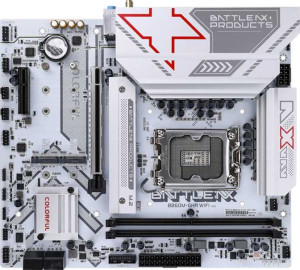
Final Verdict

The Colorful Battle-AX B860M-GHA Wi-Fi V20 is a well-rounded Micro-ATX motherboard that delivers a meaningful feature set within a compact form factor, making it a practical choice for LGA 1851 builds where space and wireless connectivity are priorities. Its three M.2 sockets combined with DDR5 support and Wi-Fi 6 give it genuine versatility for home workstation and enthusiast desktop use cases, while the broad RAID support adds value for users with specific storage needs. That said, the two-slot memory configuration and absence of USB 3.2 Gen 2 rear ports do place real ceilings on long-term expandability and high-speed peripheral connectivity. Overall, this board suits builders who want a modern, wireless-ready platform with solid storage options but should be approached with realistic expectations around future scalability.