Colorful Colorfire GeForce RTX 5060 Meow-Org Duo specifications and in-depth review

Colorful Colorfire GeForce RTX 5060 Meow-Org Duo

Manufacturer: Colorful

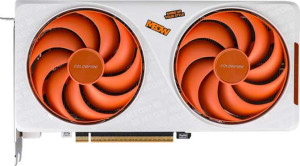
The Colorful Colorfire GeForce RTX 5060 Meow-Org Duo is a graphics card from Colorful based on NVIDIA's Blackwell architecture, manufactured on a 5 nm process with 21.9 billion transistors. It operates at a base clock of 2280 MHz and reaches a turbo frequency of 2497 MHz, positioning it within the RTX 5060 product line. The card includes RGB lighting and supports up to four simultaneous displays, making it a versatile option for multi-monitor setups.

On the memory side, the card is equipped with 8GB of GDDR7 VRAM running across a 128-bit bus at an effective speed of 28000 MHz, delivering up to 448 GB/s of bandwidth. It achieves 19.18 TFLOPS of floating-point performance, a pixel rate of 119.9 GPixel/s, and a texture rate of 299.6 GTexels/s, backed by 3840 shading units, 120 TMUs, and 48 ROPs. The card supports DirectX 12 Ultimate, OpenGL 4.6, OpenCL 3, ray tracing, DLSS, and Intel Resizable BAR, with connectivity provided through one HDMI 2.1b port and three DisplayPort outputs. Its thermal design power is rated at 145W, and it connects via a PCIe 5 interface.

Pros
  • Supports DLSS and ray tracing, enabling hardware-accelerated lighting and upscaling features in compatible applications
  • GDDR7 memory with an effective speed of 28000 MHz and 448 GB/s of bandwidth provides substantial data throughput for the GPU
  • Can drive up to four displays simultaneously, making it practical for multi-monitor setups
  • Intel Resizable BAR support allows the CPU to access the full VRAM pool at once, which can improve frame delivery in supported titles
  • ECC memory support adds a layer of data integrity for compute workloads where accuracy matters
  • RGB lighting is built in, offering visual customization within a compatible system
Cons
  • The 128-bit memory bus width is relatively narrow for an 8GB card, which may limit sustained throughput in memory-intensive scenarios
  • No USB-C display output is available, which could be a limitation for users with USB-C or Thunderbolt-connected monitors
  • Air-water cooling is not supported, so users are limited to the card's default cooling solution with no hybrid cooling option
  • With only one HDMI port, users needing multiple HDMI connections simultaneously will need adapters or alternate display solutions
Who is this for?

This card is a reasonable fit for users who want to run games or creative applications at moderate to high settings with the benefit of DLSS and ray tracing support, which can extend visual quality without relying solely on raw raster performance. Its support for up to four simultaneous displays makes it a practical choice for multi-monitor productivity setups, and ECC memory support also makes it usable in light compute or data-sensitive workflows where memory reliability matters. The 145W TDP and compact 229.9 x 115.5 mm footprint suit users working within smaller chassis or power-constrained builds.

Who is this NOT for?

Users who regularly work with memory-bandwidth-intensive workloads — such as high-resolution texture rendering, large dataset compute tasks, or professional content creation at scale — may find the 128-bit bus width a limiting factor despite the GDDR7 speed. The card is also not well-suited for those needing high-VRAM capacity, as 8GB can become a constraint in modern AAA titles or AI inference tasks that push beyond that ceiling. Additionally, users who require USB-C display connectivity or a hybrid cooling solution will find neither available on this model, making it a poor match for those specific hardware or thermal requirements.

Performance:

GPU clock speed 2280 MHz
GPU turbo 2497 MHz
pixel rate 119.9 GPixel/s
floating-point performance 19.18 TFLOPS
texture rate 299.6 GTexels/s
GPU memory speed 1750 MHz
shading units 3840
texture mapping units (TMUs) 120
render output units (ROPs) 48
Has Double Precision Floating Point (DPFP)

The Performance section of this card centers on a base GPU clock of 2280 MHz that boosts up to 2497 MHz, supported by 3840 shading units, 120 texture mapping units, and 48 render output units. It delivers 19.18 TFLOPS of floating-point performance alongside a texture rate of 299.6 GTexels/s and a pixel rate of 119.9 GPixel/s, reflecting the throughput capacity of its shader and raster pipeline. GPU memory operates at 1750 MHz, and the card includes support for Double Precision Floating Point (DPFP), which extends its utility to workloads that require higher numerical precision beyond standard single-precision compute tasks.

Memory:

effective memory speed 28000 MHz
maximum memory bandwidth 448 GB/s
VRAM 8GB
GDDR version GDDR7
memory bus width 128-bit
Supports ECC memory

This card is equipped with 8GB of GDDR7 VRAM running across a 128-bit memory bus at an effective speed of 28000 MHz, yielding a maximum memory bandwidth of 448 GB/s. The GDDR7 standard brings notably higher data rates compared to previous generations, and the card also supports ECC memory, which enables error detection and correction for workloads where data integrity is a priority.

Features:

DirectX version DirectX 12 Ultimate
OpenGL version 4.6
OpenCL version 3
Supports multi-display technology
supports ray tracing
Supports 3D
supports DLSS
has XeSS (XMX)
AMD SAM / Intel Resizable BAR Intel Resizable BAR
has LHR
has RGB lighting
supported displays 4

On the software and feature side, this card supports DirectX 12 Ultimate, OpenGL 4.6, and OpenCL 3, covering a broad range of graphics and compute APIs. Ray tracing and DLSS are both supported, while XeSS (XMX) is not present. The card is compatible with Intel Resizable BAR and does not include LHR. It can drive up to four displays simultaneously through its multi-display support, also offering stereoscopic 3D capability. RGB lighting is built in, rounding out a feature set that spans rendering, compute, and visual customization.

Ports:

has an HDMI output
HDMI ports 1
HDMI version HDMI 2.1b
DisplayPort outputs 3
USB-C ports 0
DVI outputs 0
mini DisplayPort outputs 0

The card's output configuration consists of one HDMI 2.1b port and three DisplayPort outputs, providing a total of four physical connections for display use. There are no USB-C, DVI, or mini DisplayPort outputs included on this model, keeping the layout focused on the two most common modern display interfaces.

General info:

GPU architecture Blackwell
Thermal Design Power (TDP) 145W
PCI Express (PCIe) version 5
semiconductor size 5 nm
number of transistors 21900 million
Has air-water cooling
width 229.9 mm
height 115.5 mm

This card is built on the Blackwell architecture, fabricated using a 5 nm process node and integrating 21,900 million transistors. It connects via a PCIe 5 interface and carries a Thermal Design Power rating of 145W. The card does not include air-water cooling. Physically, it measures 229.9 mm in width and 115.5 mm in height, giving a sense of its overall footprint inside a system.
Final Verdict

The Colorful Colorfire GeForce RTX 5060 Meow-Org Duo is a Blackwell-based graphics card that brings together DLSS, ray tracing, and GDDR7 memory with 448 GB/s of bandwidth in a compact, relatively power-efficient package rated at 145W. Its four-display support, ECC memory capability, and Intel Resizable BAR compatibility give it a broader range of use cases than a pure gaming card, while the 128-bit bus width and 8GB VRAM ceiling do set practical boundaries for the most demanding workloads. For users building a multi-monitor system or looking to take advantage of modern rendering features within a modest power envelope, this card presents a well-rounded option — provided its memory configuration aligns with the intended workload.