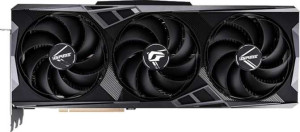
Colorful iGame GeForce RTX 4080 Super Vulcan OC specifications and in-depth review

Colorful iGame GeForce RTX 4080 Super Vulcan OC

Manufacturer: Colorful

The Colorful iGame GeForce RTX 4080 Super Vulcan OC is a high-end graphics card from Colorful's iGame lineup, grounded in Nvidia's Ada Lovelace architecture and produced on a 5 nm fabrication process. It integrates 45,900 million transistors across a card measuring 348.5 mm in width and 159.5 mm in height, placing it firmly in large-format territory. With 54.07 TFLOPS of floating-point performance, the card is built to handle demanding rendering tasks and supports a full suite of modern features including ray tracing, DLSS, and DirectX 12 Ultimate.

On the memory side, the card carries 16 GB of GDDR6X VRAM running on a 256-bit bus at an effective speed of 23,000 MHz, yielding a maximum bandwidth of 736 GB/s. Its 10,240 shading units are paired with 320 texture mapping units and 112 render output units, generating a texture rate of 844.8 GTexels/s and a pixel rate of 295.7 GPixel/s. The GPU operates at a base clock of 2,295 MHz with a turbo frequency of 2,640 MHz, and both Double Precision Floating Point and ECC memory are supported. Display output covers four screens simultaneously via three DisplayPort and one HDMI 2.1 port, Intel Resizable BAR is included, and the card has a rated TDP of 350W over a PCIe 4.0 interface. RGB lighting is not present on this model.

Pros
  • 54.07 TFLOPS of floating-point performance and a 2,640 MHz boost clock position the card for demanding rendering and compute tasks
  • 736 GB/s of memory bandwidth delivered through a 256-bit bus and 23,000 MHz effective memory speed supports sustained throughput in memory-intensive workloads
  • Ray tracing and DLSS are both natively supported, keeping the card aligned with current rendering standards in modern titles and applications
  • ECC memory and Double Precision Floating Point support extend usability to compute workloads where data accuracy is critical
  • Intel Resizable BAR is included, enabling the CPU to access the full 16 GB VRAM pool more efficiently during operation
  • Four display outputs across three DisplayPort and one HDMI 2.1 port provide practical multi-monitor flexibility
Cons
  • A 350W TDP places significant demands on both the power supply and system airflow, requiring careful infrastructure planning before installation
  • At 348.5 mm wide and 159.5 mm tall, the card's large physical footprint will not fit in many mid-tower or compact cases without verification
  • Air-water cooling integration is not supported, making this card incompatible with custom liquid cooling loops that attach directly to the GPU
  • RGB lighting is absent, which may be a drawback for users who want their graphics card to contribute to a lit system aesthetic
  • XeSS (XMX) is not supported, meaning applications that rely on that upscaling technology will not benefit from it on this card
Who is this for?

The Colorful iGame GeForce RTX 4080 Super Vulcan OC is well-matched to users who run demanding rendering, compute, or GPU-accelerated workloads, given its 54.07 TFLOPS of floating-point performance, DPFP support, and ECC memory capability. The 16 GB of GDDR6X VRAM paired with 736 GB/s of bandwidth gives it meaningful headroom for high-resolution texturing, large dataset processing, and memory-intensive applications that would strain cards with narrower memory configurations. It also suits users who want full access to modern graphics features, as ray tracing, DLSS, and DirectX 12 Ultimate are all supported, and those who need multi-monitor setups will find four simultaneous display outputs readily available through its port layout.

Who is this NOT for?

With a 350W TDP, this card is a poor fit for systems equipped with modest power supplies or limited case airflow, as the power and thermal demands require a well-provisioned build to operate reliably. Its physical dimensions of 348.5 mm in width and 159.5 mm in height also make it unsuitable for compact or mid-tower cases where clearance is restricted, ruling it out for smaller form-factor builds entirely. Users who integrate their GPU into a custom liquid cooling loop will find no support for air-water cooling on this card, and those who prioritize RGB lighting in their build aesthetics will need to look elsewhere, as no lighting is present on this model.

Performance:

GPU clock speed 2295 MHz
GPU turbo 2640 MHz
pixel rate 295.7 GPixel/s
floating-point performance 54.07 TFLOPS
texture rate 844.8 GTexels/s
GPU memory speed 1438 MHz
shading units 10240
texture mapping units (TMUs) 320
render output units (ROPs) 112
Has Double Precision Floating Point (DPFP)

The GPU operates at a base clock of 2,295 MHz and scales up to 2,640 MHz under boost, supported by 10,240 shading units, 320 texture mapping units, and 112 render output units. This configuration produces a texture rate of 844.8 GTexels/s and a pixel rate of 295.7 GPixel/s, with total compute throughput reaching 54.07 TFLOPS of floating-point performance. GPU memory runs at 1,438 MHz, and Double Precision Floating Point (DPFP) is supported, making the card capable of handling workloads that demand higher arithmetic precision beyond standard graphics rendering.

Memory:

effective memory speed 23000 MHz
maximum memory bandwidth 736 GB/s
VRAM 16GB
GDDR version GDDR6X
memory bus width 256-bit
Supports ECC memory

The card is equipped with 16 GB of GDDR6X VRAM running across a 256-bit memory bus at an effective speed of 23,000 MHz, resulting in a maximum memory bandwidth of 736 GB/s. ECC memory support is also present, offering error-correction capability that is particularly useful in compute-oriented or data-sensitive workloads.

Features:

DirectX version DirectX 12 Ultimate
OpenGL version 4.6
OpenCL version 3
Supports multi-display technology
supports ray tracing
Supports 3D
supports DLSS
has XeSS (XMX)
AMD SAM / Intel Resizable BAR Intel Resizable BAR
has LHR
has RGB lighting
supported displays 4

The card supports DirectX 12 Ultimate, OpenGL 4.6, and OpenCL 3, covering the principal graphics and compute APIs in active use today. Ray tracing and DLSS are both enabled, and stereoscopic 3D and multi-display technology are also present, with support for up to four simultaneous outputs. Intel Resizable BAR is included to facilitate more efficient CPU-to-GPU memory access, while XeSS (XMX) and LHR are not featured on this card. RGB lighting is absent, giving the card a visually understated appearance.

Ports:

has an HDMI output
HDMI ports 1
HDMI version HDMI 2.1
DisplayPort outputs 3
USB-C ports 0
DVI outputs 0
mini DisplayPort outputs 0

The card provides three DisplayPort outputs and one HDMI 2.1 port, offering four physical display connections in total. USB-C, DVI, and mini DisplayPort outputs are not included on this model.

General info:

GPU architecture Ada Lovelace
Thermal Design Power (TDP) 350W
PCI Express (PCIe) version 4
semiconductor size 5 nm
number of transistors 45900 million
Has air-water cooling
width 348.5 mm
height 159.5 mm

Underpinned by the Ada Lovelace architecture and built on a 5 nm process node, the GPU integrates 45,900 million transistors and uses a PCIe 4.0 interface for system connectivity. Its 350W TDP reflects the card's substantial power requirements, and prospective builders should verify both power supply capacity and case clearance, as the card measures 348.5 mm in width and 159.5 mm in height. Air-water cooling integration is not supported, so the card relies entirely on its own cooling assembly for thermal management.

Final Verdict

The Colorful iGame GeForce RTX 4080 Super Vulcan OC is a specification-dense graphics card that targets users with genuine compute and rendering demands, built around the Ada Lovelace architecture with a clear focus on throughput and feature coverage. Its 54.07 TFLOPS of floating-point performance backed by 736 GB/s of memory bandwidth gives it the headroom to handle sustained workloads across both graphics and compute tasks, and the inclusion of ray tracing, DLSS, ECC memory, and DPFP support rounds out a well-equipped feature set. The 350W TDP and large physical footprint do impose real system requirements that will exclude some builds, and the absence of RGB lighting and liquid cooling integration may matter to certain users. For those with the infrastructure to support it, however, this card represents a thorough and capable option within the RTX 4080 Super tier.

Popular Comparisons

Colorful iGame GeForce RTX 4080 Super Vulcan OC
VS
Intel Arc B570
Intel Arc B570