Colorful iGame GeForce RTX 5060 Ti Mini OC 16GB specifications and in-depth review

Colorful iGame GeForce RTX 5060 Ti Mini OC 16GB

Manufacturer: Colorful

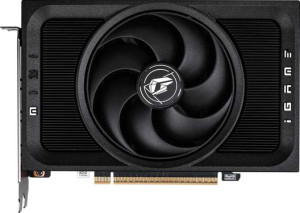
The Colorful iGame GeForce RTX 5060 Ti Mini OC is a compact graphics card from Colorful's iGame lineup, designed around NVIDIA's Blackwell architecture. With a footprint of just 180 mm × 123 mm, it fits into tighter builds without sacrificing the underlying GPU specification. The card operates at a base clock of 2407 MHz and reaches a boost clock of 2632 MHz, delivering 24.26 TFLOPS of floating-point performance through its 4608 shading units.

On the memory side, the card carries 16GB of GDDR7 VRAM across a 128-bit bus, running at an effective speed of 28000 MHz for a maximum bandwidth of 448 GB/s. It supports DirectX 12 Ultimate, OpenGL 4.6, OpenCL 3, ray tracing, and DLSS, alongside Intel Resizable BAR. Display connectivity includes one HDMI 2.1b output and three DisplayPort outputs, supporting up to four monitors simultaneously. The card has a rated TDP of 180W and connects via PCIe 5, with transistor count reported at 21,900 million on a 5 nm process node.

Pros
  • The compact 180 mm × 123 mm footprint makes it well-suited for small form factor builds where space is limited
  • 16GB of GDDR7 VRAM with 448 GB/s bandwidth provides a generous memory allocation for its class
  • Supports ray tracing and DLSS, enabling access to modern rendering techniques
  • Up to four displays can be connected simultaneously via three DisplayPort outputs and one HDMI 2.1b port
  • ECC memory support adds a layer of data integrity useful in compute-oriented workloads
  • PCIe 5 connectivity ensures the interface does not limit data throughput
Cons
  • The 128-bit memory bus width is narrow relative to the 16GB VRAM capacity, which can constrain sustained throughput in bandwidth-heavy scenarios
  • No USB-C output is available, limiting compatibility with certain modern monitors and display adapters
  • Air-water hybrid cooling is not supported, restricting thermal management options for users in thermally constrained environments
  • No RGB lighting is present, which may matter to users building systems with coordinated lighting setups
Who is this for?

This card is a solid fit for users building small form factor systems who still want access to modern GPU features, given its compact 180 mm × 123 mm dimensions and 180W TDP. The combination of ray tracing, DLSS, and DirectX 12 Ultimate support makes it well-matched for gamers targeting current-generation rendering techniques without requiring a full-size chassis. Its 16GB of GDDR7 VRAM and ECC memory support also make it relevant for users running compute or content creation workloads that benefit from larger memory pools and error correction.

Who is this NOT for?

Users who need maximum memory throughput for bandwidth-intensive workloads may find the 128-bit bus width a limiting factor, as it constrains sustained data movement despite the high effective memory speed. The absence of a USB-C display output makes it a poor match for users whose monitor setup depends on that connection type. Additionally, anyone looking to build a system with coordinated RGB lighting or requiring air-water hybrid cooling flexibility will find neither feature available on this card.

Performance:

GPU clock speed 2407 MHz
GPU turbo 2632 MHz
pixel rate 126.3 GPixel/s
floating-point performance 24.26 TFLOPS
texture rate 379 GTexels/s
GPU memory speed 1750 MHz
shading units 4608
texture mapping units (TMUs) 144
render output units (ROPs) 48
Has Double Precision Floating Point (DPFP)

The card runs at a base GPU clock of 2407 MHz, climbing to a boost clock of 2632 MHz under load, and delivers 24.26 TFLOPS of floating-point performance alongside a pixel rate of 126.3 GPixel/s and a texture rate of 379 GTexels/s. Those figures are backed by 4608 shading units, 144 texture mapping units, and 48 render output units, with GPU memory operating at 1750 MHz. The card also supports Double Precision Floating Point (DPFP), broadening its compute capabilities beyond standard graphics workloads.

Memory:

effective memory speed 28000 MHz
maximum memory bandwidth 448 GB/s
VRAM 16GB
GDDR version GDDR7
memory bus width 128-bit
Supports ECC memory

The card is equipped with 16GB of GDDR7 VRAM running at an effective speed of 28000 MHz across a 128-bit memory bus, yielding a maximum memory bandwidth of 448 GB/s. ECC memory support is included, which helps maintain data integrity in workloads where memory error correction is relevant.

Features:

DirectX version DirectX 12 Ultimate
OpenGL version 4.6
OpenCL version 3
Supports multi-display technology
supports ray tracing
Supports 3D
supports DLSS
has XeSS (XMX)
AMD SAM / Intel Resizable BAR Intel Resizable BAR
has LHR
has RGB lighting
supported displays 4

The card supports DirectX 12 Ultimate, OpenGL 4.6, and OpenCL 3, covering a broad range of graphics and compute workloads. Ray tracing and DLSS are both supported, along with stereoscopic 3D and multi-display output across up to four screens simultaneously. Intel Resizable BAR is enabled, while XeSS (XMX) and LHR are not present. The card does not include RGB lighting.

Ports:

has an HDMI output
HDMI ports 1
HDMI version HDMI 2.1b
DisplayPort outputs 3
USB-C ports 0
DVI outputs 0
mini DisplayPort outputs 0

The card's output configuration consists of one HDMI 2.1b port and three DisplayPort outputs, providing four connections in total. There are no USB-C, DVI, or mini DisplayPort outputs available.

General info:

GPU architecture Blackwell
Thermal Design Power (TDP) 180W
PCI Express (PCIe) version 5
semiconductor size 5 nm
number of transistors 21900 million
Has air-water cooling
width 180 mm
height 123 mm

Built on the Blackwell architecture using a 5 nm process node with 21,900 million transistors, the card connects via PCIe 5 and carries a TDP of 180W. Its physical dimensions measure 180 mm wide and 123 mm tall, making it a notably compact design. Cooling is handled without an air-water hybrid solution, and the card does not include that type of cooling system.
Final Verdict

The Colorful iGame GeForce RTX 5060 Ti Mini OC carves out a clear niche as a compact, feature-complete graphics card built on NVIDIA's Blackwell architecture. Its most compelling proposition is the pairing of a small physical footprint with 16GB of GDDR7 VRAM, ray tracing, DLSS, and DirectX 12 Ultimate support — a combination that keeps it relevant for both modern gaming and lighter compute tasks. The 128-bit bus and absence of USB-C output are real constraints that narrow its appeal for certain users, but for those prioritizing a capable GPU that fits within tight spatial and power budgets, the iGame GeForce RTX 5060 Ti Mini OC delivers a well-rounded specification set that few compact cards can match on paper.