Corsair Vengance i7600 (Ultra 7 265K / RTX 4070 Super / 32GB RAM / 1TB SSD) specifications and in-depth review

Corsair Vengance i7600 (Ultra 7 265K / RTX 4070 Super / 32GB RAM / 1TB SSD)

Manufacturer: Corsair

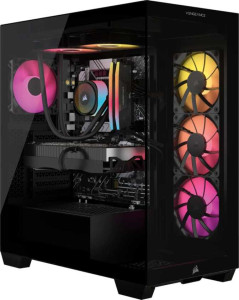
The Corsair Vengeance i7600 is a desktop gaming PC built around Intel's Ultra 7 265K processor and NVIDIA's GeForce RTX 4070 Super graphics card. It ships in an ATX form factor with dimensions of 506 mm × 240 mm × 460 mm and a volume of approximately 55,862 cm³. The system comes equipped with 32GB of DDR5 RAM running at 6400 MHz and a 1TB NVMe SSD for storage, alongside Wi-Fi 6E and Bluetooth 5.4 for wireless connectivity.

On the graphics side, the RTX 4070 Super is based on NVIDIA's Ada Lovelace architecture, delivering 35.48 TFLOPS of floating-point performance through 7,168 shading units and a 192-bit memory bus backed by 12GB of GDDR6X at an effective speed of 21,000 MHz, with a maximum memory bandwidth of 504.2 GB/s. The GPU supports ray tracing, DLSS, DirectX 12 Ultimate, and up to four simultaneous displays via three DisplayPort outputs and one HDMI 2.1 port. The Intel Ultra 7 265K CPU features 20 threads across a hybrid core configuration, a maximum turbo clock of 5.5 GHz, 36MB of L2 cache, 30MB of L3 cache, and a TDP of 220W, with PassMark scores of 58,780 in multi-threaded and 4,925 in single-threaded testing. The system is covered by a 2-year warranty.

Pros
  • The RTX 4070 Super delivers 35.48 TFLOPS of floating-point performance backed by 12GB of GDDR6X VRAM on a 192-bit bus, with a maximum memory bandwidth of 504.2 GB/s — figures that translate to strong frame rates in graphically demanding titles
  • Ray tracing and DLSS support are both present, enabling access to real-time lighting effects and AI-assisted upscaling in compatible games
  • Wi-Fi 6E support ensures low-latency wireless connectivity on the latest router hardware, complemented by Bluetooth 5.4 for peripheral pairing
  • The Intel Ultra 7 265K features an unlocked multiplier, and benchmark results show a PassMark score climbing from 58,780 stock to 61,016 when overclocked, confirming usable headroom
  • 32GB of DDR5 RAM running at 6,400 MHz across two memory channels provides ample bandwidth for simultaneous gaming and background workloads
  • The system supports up to four displays simultaneously via three DisplayPort outputs and one HDMI 2.1 port, making multi-monitor setups straightforward to configure
Cons
  • The CPU has a TDP of 220W yet the system does not include air or water cooling, leaving the thermal solution unspecified in the provided data
  • There are no USB 4 ports, no Thunderbolt 3 or Thunderbolt 4 ports, and no USB 3.2 Gen 2x2 connectivity, which limits high-speed device and dock compatibility
  • With only one USB 3.2 Gen 2 Type-A port and one USB 3.2 Gen 2 Type-C port, faster USB throughput options are relatively limited given the number of total ports
  • The system does not support simultaneous multithreading on the CPU, which may reduce efficiency in heavily threaded non-gaming workloads
  • The enclosure measures 506 mm tall and 460 mm deep with a volume exceeding 55,800 cm3, making it a physically large unit that demands significant desk or floor space
Who is this for?

This desktop gaming PC is well-suited to users who prioritize high-fidelity gaming with ray tracing and DLSS, given the RTX 4070 Super's 35.48 TFLOPS, 12GB of GDDR6X VRAM, and full DirectX 12 Ultimate support. The Intel Ultra 7 265K's unlocked multiplier and overclocking headroom — demonstrated by its PassMark score rising to 61,016 when overclocked — make it a solid fit for enthusiasts who want to push hardware beyond stock settings. Users who rely on multi-monitor workflows or mixed gaming and productivity setups will also find the four-display output capacity, 32GB of DDR5 RAM at 6,400 MHz, and Wi-Fi 6E connectivity well-matched to their needs.

Who is this NOT for?

This system is not well-suited to users who need a compact or space-efficient desktop, as the ATX form factor with a height of 506 mm and depth of 460 mm demands substantial physical space that may not be practical in smaller rooms or tightly configured desk setups. Users who depend on high-speed peripheral and docking station connectivity — such as those relying on Thunderbolt 4 or USB 4 devices — will find the port selection lacking, as neither standard is present. Additionally, the absence of a specified cooling solution alongside the CPU's 220W TDP makes this a less straightforward option for users in thermally constrained environments or those who expect a fully integrated and validated thermal setup out of the box.

General info:

SSD storage capacity 1000GB
form factor ATX
Is an NVMe SSD
volume 55862.4 cm³
thickness 460 mm
height 506 mm
width 240 mm

The Corsair Vengeance i7600 follows an ATX form factor and measures 506 mm in height, 240 mm in width, and 460 mm in depth, giving it a total volume of approximately 55,862 cm³. Storage is handled by a 1TB NVMe SSD, offering faster data access compared to conventional SATA drives thanks to its NVMe interface.

Graphics card:

VRAM 12GB
floating-point performance 35.48 TFLOPS
effective memory speed 21000 MHz
GPU clock speed 1980 MHz
GPU memory speed 1313 MHz
GPU turbo 2480 MHz
GDDR version GDDR6X
DirectX version DirectX 12 Ultimate
PCI Express (PCIe) version 4
supports ray tracing
texture rate 554.4 GTexels/s
pixel rate 198 GPixel/s
maximum memory bandwidth 504.2 GB/s
memory bus width 192-bit
supports DLSS
supported displays 4
semiconductor size 5 nm
texture mapping units (TMUs) 224
shading units 7168
render output units (ROPs) 80
OpenGL version 4.6
OpenCL version 3
has LHR
Supports multi-display technology
Has Double Precision Floating Point (DPFP)
Supports 3D
has RGB lighting
number of transistors 35800 million

The graphics card features 12GB of GDDR6X VRAM across a 192-bit memory bus, with an effective memory speed of 21,000 MHz and a maximum memory bandwidth of 504.2 GB/s. Its 7,168 shading units, 224 texture mapping units, and 80 render output units deliver a floating-point performance of 35.48 TFLOPS, a texture rate of 554.4 GTexels/s, and a pixel rate of 198 GPixel/s. The GPU runs at a base clock of 1,980 MHz with a turbo boost up to 2,480 MHz, and is built on a 5 nm process housing 35,800 million transistors. It connects via PCIe 4.0 and supports DirectX 12 Ultimate, OpenGL 4.6, OpenCL 3, ray tracing, DLSS, double precision floating point, stereoscopic 3D, and multi-display setups of up to four screens simultaneously. The card does not include RGB lighting or LHR (Lite Hash Rate) restrictions.

CPU:

CPU speed 8 x 3.9 & 12 x 3.3 GHz
Has integrated graphics
Has an unlocked multiplier
L2 cache 36 MB
L3 cache 30 MB
turbo clock speed 5.5GHz
CPU threads 20 threads
uses multithreading
Turbo Boost version 2
clock multiplier 39
Supports 64-bit
CPU temperature 105 °C

The Intel Ultra 7 265K processor runs across 20 threads with a hybrid clock configuration of 8 cores at 3.9 GHz and 12 cores at 3.3 GHz, reaching a turbo clock speed of 5.5 GHz via Turbo Boost version 2 and a clock multiplier of 39. It carries 36 MB of L2 cache and 30 MB of L3 cache, supports 64-bit processing, and includes integrated graphics. The CPU features an unlocked multiplier for manual frequency adjustments and has a maximum operating temperature of 105 °C. Note that this processor does not use simultaneous multithreading.

Benchmarks:

PassMark result 58780
PassMark result (single) 4925
PassMark result (overclocked) 61016

In CPU benchmark testing, the system achieves a multi-threaded PassMark score of 58,780 and a single-threaded score of 4,925, reflecting its per-core and overall processing capabilities. When overclocked, the PassMark result rises to 61,016, indicating measurable headroom beyond its stock configuration.

Memory:

RAM 32GB
RAM speed 6400 MHz
DDR memory version 5

The system is equipped with 32GB of DDR5 RAM running at a speed of 6,400 MHz, providing a solid memory foundation for both gaming and general multitasking workloads.

Connectivity:

Wi-Fi version Wi-Fi 6E (802.11ax), Wi-Fi 6 (802.11ax), Wi-Fi 5 (802.11ac), Wi-Fi 4 (802.11n)
supports Wi-Fi
USB 2.0 ports 4
USB 3.2 Gen 2 ports (USB-A) 1
USB 3.2 Gen 1 ports (USB-A) 3
USB 3.2 Gen 2 ports (USB-C) 1
USB 4 40Gbps ports 0
USB 4 20Gbps ports 0
USB 3.2 Gen 2x2 ports 0
USB 3.2 Gen 1 ports (USB-C) 0
RJ45 ports 1
Thunderbolt 4 ports 0
Thunderbolt 3 ports 0
DisplayPort outputs 3
HDMI version HDMI 2.1
HDMI ports 1
Has Bluetooth
Bluetooth version 5.4
DVI outputs 0
Has S/PDIF Out port
has a socket for a 3.5 mm audio jack
has a VGA connector

Wireless connectivity is covered by Wi-Fi 6E (802.11ax) with backward compatibility down to Wi-Fi 4, alongside Bluetooth 5.4. For wired networking, a single RJ45 port is available. The USB port selection includes four USB 2.0 ports, three USB 3.2 Gen 1 Type-A ports, one USB 3.2 Gen 2 Type-A port, and one USB 3.2 Gen 2 Type-C port; there are no USB 4, USB 3.2 Gen 2x2, Thunderbolt 3, or Thunderbolt 4 ports. Display output options consist of three DisplayPort outputs and one HDMI 2.1 port, with no DVI or VGA connectors present. Audio connectivity is handled through a 3.5 mm headset jack and an S/PDIF output port.

Miscellaneous:

has an HDMI output
AMD SAM / Intel Resizable BAR Intel Resizable BAR
USB-C ports 0
Has air-water cooling
Thermal Design Power (TDP) 220W
mini DisplayPort outputs 0
Supports ECC memory
has XeSS (XMX)
GPU architecture Ada Lovelace
chipset B860, Z890
CPU socket LGA 1851
Type Desktop
instruction sets MMX, F16C, FMA3, AES, AVX, AVX2, SSE 4.1, SSE 4.2
Has NX bit
memory channels 2
RAM speed (max) 6400 MHz
maximum memory amount 192GB
Uses big.LITTLE technology
warranty period 2 years

The GPU is built on the Ada Lovelace architecture and includes an HDMI output, while the system supports Intel Resizable BAR but does not feature XeSS (XMX). The CPU sits in an LGA 1851 socket, is classified as a desktop type, employs big.LITTLE hybrid core technology, and carries a TDP of 220W. It supports the instruction sets MMX, F16C, FMA3, AES, AVX, AVX2, SSE 4.1, and SSE 4.2, along with NX bit for hardware-level security. The platform is compatible with B860 and Z890 chipsets, operates across two memory channels, supports ECC memory, and accommodates up to 192GB of RAM at a maximum speed of 6,400 MHz. There are no mini DisplayPort outputs, no USB-C ports, and the system does not include air or water cooling. The unit comes with a 2-year warranty.
Final Verdict

The Corsair Vengeance i7600 configured with the Ultra 7 265K and RTX 4070 Super is a well-specified desktop gaming PC that covers the core demands of modern gaming with genuine depth — from ray tracing and DLSS support through to multi-display output and DDR5 memory running at its rated maximum. Its 35.48 TFLOPS of GPU floating-point performance combined with an overclockable CPU and 32GB of high-speed RAM make it a capable platform for users who want headroom to push both graphical fidelity and processing throughput. The connectivity suite and large ATX chassis impose practical constraints that suit a fixed desk environment rather than a flexible or space-limited setup, and prospective users should account for the thermal demands of a 220W CPU. Taken as a whole, the Vengeance i7600 represents a focused, feature-complete gaming desktop for users who know what they need and are prepared to accommodate its physical footprint.