Crucial P310 (2230) 1TB specifications and in-depth review

Crucial P310 (2230) 1TB

Manufacturer: Crucial

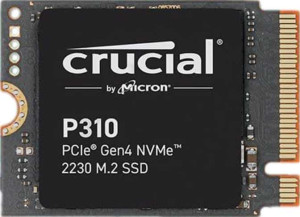
The Crucial P310 (2230) 1TB is a compact M.2 form factor SSD designed for systems that support the shorter 2230 footprint, such as certain laptops and handheld devices. It operates over a PCIe 4.0 interface using the NVMe 2.0 protocol, giving it access to the bandwidth needed to reach its rated sequential read speed of 7100 MB/s and sequential write speed of 6000 MB/s.

On the technical side, the drive is built around a Phison PS5027-E27T controller with four channels and uses QLC NAND flash storage. Rather than a dedicated DRAM cache, it relies on HMB (Host Memory Buffer), which borrows a portion of system RAM for caching tasks. Random performance is rated at 1,000,000 read IOPS and 1,200,000 write IOPS. Endurance is specified at 220 TBW, with a mean time between failures (MTBF) of 1.5 million hours. The drive ships without an integrated heatsink or RGB lighting.

Pros
  • Sequential read speed of 7100 MB/s and write speed of 6000 MB/s indicate strong throughput for data-intensive tasks
  • Random write performance rated at 1,200,000 IOPS suits workloads involving frequent small file operations
  • The 2230 M.2 form factor makes it compatible with compact systems such as mini PCs and certain ultrabooks
  • NVMe 2.0 over PCIe 4.0 ensures the drive takes full advantage of modern interface bandwidth
  • An MTBF of 1.5 million hours reflects a solid reliability specification for everyday use
  • The absence of a heatsink and RGB lighting keeps the physical footprint minimal, which benefits space-constrained builds
Cons
  • QLC NAND flash typically sustains lower endurance per cell compared to TLC or MLC alternatives, and the 220 TBW rating reflects this limitation for write-heavy workloads
  • Relying on HMB rather than dedicated DRAM means caching performance is dependent on available system memory and may be less consistent under heavy sustained loads
  • The four-channel controller configuration may limit parallelism compared to higher-channel designs found in larger form factor drives
  • No integrated heatsink means thermal management relies entirely on the host system, which may be a concern in thermally constrained enclosures
Who is this for?

This drive is a natural fit for users building or upgrading systems with a 2230 M.2 slot, such as compact mini PCs, select ultrabooks, or handheld gaming devices, where physical space is a hard constraint. Its PCIe 4.0 NVMe 2.0 interface with sequential read speeds of 7100 MB/s makes it well suited for users who need fast data throughput in a small footprint — including those transferring large files, loading substantial application assets, or running an operating system that benefits from high sequential access rates. The drive also serves users who prioritize a clean, low-profile install, given its lack of a heatsink or RGB lighting, and who are comfortable with HMB-based caching on a system with adequate available RAM.

Who is this NOT for?

Users running sustained write-heavy workloads — such as continuous video recording, large-scale data logging, or frequent bulk file ingestion — may find the 220 TBW endurance ceiling and QLC NAND architecture limiting over time, as QLC flash is generally less suited to high-volume repeated writes. The drive is also a poor match for systems that lack a 2230 M.2 slot, since its compact form factor serves no advantage in standard desktops or laptops with 2280 slots. Additionally, environments with limited thermal management may present challenges, as the absence of an integrated heatsink means the drive depends entirely on the host system to keep temperatures in check during intensive use.

Read speed:

sequential read speed 7100 MB/s
random read speed 1000000 IOPS

The Crucial P310 (2230) 1TB reaches a sequential read speed of 7100 MB/s, making it capable of handling large file transfers at a steady throughput. For workloads that involve accessing many small files simultaneously, the drive is rated at 1,000,000 random read IOPS, reflecting solid responsiveness under mixed read-heavy conditions.

Write speed:

sequential write speed 6000 MB/s
random write speed 1200000 IOPS

On the write side, the drive is rated for a sequential write speed of 6000 MB/s, allowing large volumes of data to be written at a consistent pace. For random write workloads involving numerous small operations, it is specified at 1,200,000 random write IOPS, indicating strong throughput when handling fragmented or queue-heavy write patterns.

Benchmarks:

General info:

type M2
SSD cache HMB (Host Memory Buffer)
Is an NVMe SSD
NVMe version 2
internal storage 1000GB
controller Phison PS5027-E27T
SSD storage type QLC
PCI Express (PCIe) version 4
Controller channels 4
Terabytes Written (TBW) 220
MTBF 1.5million hours
Has an integrated heatsink
has RGB lighting

This drive uses the M.2 form factor and operates as an NVMe SSD (version 2) over a PCIe 4.0 interface, with 1000GB of internal storage built on QLC NAND flash. It is powered by a Phison PS5027-E27T controller with four channels and relies on HMB (Host Memory Buffer) rather than dedicated DRAM for caching. Endurance is rated at 220 TBW with an MTBF of 1.5 million hours, and the drive ships without an integrated heatsink or RGB lighting.

Final Verdict

The Crucial P310 (2230) 1TB occupies a well-defined niche as a high-throughput storage solution built around the constraints of the compact 2230 form factor. Its PCIe 4.0 NVMe 2.0 interface delivers sequential read speeds of 7100 MB/s and strong random I/O figures that hold up well for everyday computing, OS workloads, and fast file access in space-limited systems. The reliance on HMB caching and QLC NAND does mean it is better matched to read-leaning and moderate write workloads than to sustained, high-volume write environments, and users should ensure their host system provides adequate thermal support given the drive's heatsink-free design. For anyone specifically needing a capable, no-frills M.2 2230 SSD with modern interface support, the P310 1TB delivers a focused and technically coherent package.

Popular Comparisons

Crucial P310 (2230) 1TB
VS
Crucial E100 480GB
Crucial E100 480GB
Crucial P310 (2230) 1TB
VS
Kingston NV3 1TB
Kingston NV3 1TB
Crucial P310 (2230) 1TB
VS
Western Digital WD Black SN770M 1TB
Crucial P310 (2230) 1TB
VS
Western Digital WD Blue SN5100 1TB