Dell Alienware Area-51 (R7 9850X3D / RTX 5090 / 64GB RAM / 2TB SSD) specifications and in-depth review

Dell Alienware Area-51 (R7 9850X3D / RTX 5090 / 64GB RAM / 2TB SSD)

Manufacturer: Dell

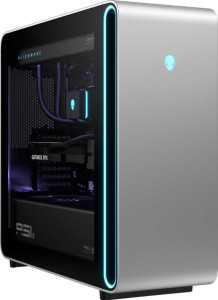
The Dell Alienware Area-51 is a full-size ATX desktop gaming PC built around AMD's Ryzen 9 9850X3D processor and NVIDIA's RTX 5090 graphics card. With 64GB of DDR5 memory running at 6400 MHz and a 4TB NVMe SSD, the system is configured for demanding workloads and high-resolution gaming alike. Its substantial chassis measures 569 mm in height and 231.6 mm in width, reflecting the engineering headroom required to house this level of hardware.

The RTX 5090 at the heart of the graphics subsystem is built on NVIDIA's Blackwell architecture using a 4 nm semiconductor process, delivering 104.9 TFLOPS of floating-point performance alongside a 512-bit memory bus and 1792 GB/s of maximum memory bandwidth. The GPU supports DirectX 12 Ultimate, ray tracing, DLSS, and can drive up to four displays simultaneously. On the connectivity side, the system offers Wi-Fi 7 (802.11be), Bluetooth 5.4, two USB 4 40Gbps ports, four USB 3.2 Gen 2 USB-C ports, two Thunderbolt 4 ports, and a single RJ45 Ethernet port, rounding out a broad and flexible I/O configuration.

Pros
  • The RTX 5090 GPU delivers 104.9 TFLOPS of floating-point performance with 32GB of GDDR7 VRAM across a 512-bit bus, enabling demanding rendering and compute workloads
  • Wi-Fi 7 support alongside Bluetooth 5.4 ensures the system is equipped with current-generation wireless standards
  • The port selection is extensive, covering USB 4 40Gbps, Thunderbolt 4, USB 3.2 Gen 2 Type-C, and legacy USB 2.0 ports, accommodating a wide range of peripherals
  • A 4TB NVMe SSD provides substantial high-speed storage capacity within a single drive
  • 64GB of DDR5 RAM running at 6,400 MHz offers a large and fast memory pool for multitasking and data-heavy applications
  • The GPU supports ray tracing, DLSS, DirectX 12 Ultimate, and multi-display output across up to four screens simultaneously
Cons
  • The chassis volume exceeds 80,000 cm³ with a depth of 610.5 mm, making it physically large and potentially difficult to fit in compact spaces
  • The CPU's maximum supported RAM speed is listed at 5,600 MHz, while the installed RAM runs at 6,400 MHz, indicating the processor spec and installed memory operate at different rated speeds
  • The system does not include air-water cooling as a built-in feature
  • No USB 3.2 Gen 2 Type-A ports are present, which may limit compatibility with certain high-speed Type-A peripherals
Who is this for?

This system is well suited to users who run demanding rendering, simulation, or compute workloads alongside high-resolution gaming, given the RTX 5090's 104.9 TFLOPS of floating-point performance, 32GB of GDDR7 VRAM, and support for ray tracing and DLSS. The 64GB of DDR5 RAM and 4TB NVMe SSD make it equally capable for content creators or technical professionals who work with large datasets or high-bitrate media. Those who rely on a broad peripheral ecosystem will also benefit from the extensive port selection, which includes Thunderbolt 4, USB 4 40Gbps, and multi-display support across up to four outputs.

Who is this NOT for?

The chassis measures over 610 mm in depth with a total volume exceeding 80,000 cm³, making it a poor fit for anyone with limited desk or room space who needs a compact desktop setup. Users who require a self-contained cooling solution may find the absence of a built-in air-water cooling system a limitation. Additionally, those who rely heavily on USB 3.2 Gen 2 Type-A connectivity will find no ports of that type available, which could create friction when using certain high-speed Type-A storage devices or peripherals.

General info:

SSD storage capacity 4000GB
form factor ATX
Is an NVMe SSD
volume 80451.9342 cm³
thickness 610.5 mm
height 569 mm
width 231.6 mm

The Alienware Area-51 uses an ATX form factor and houses a 4TB NVMe SSD for fast, high-capacity storage. The chassis measures 569 mm in height, 231.6 mm in width, and 610.5 mm in depth, resulting in a total volume of roughly 80,451 cm³ — dimensions that reflect the substantial internal space needed to accommodate its hardware configuration.

Graphics card:

VRAM 32GB
floating-point performance 104.9 TFLOPS
effective memory speed 28000 MHz
GPU clock speed 2010 MHz
GPU memory speed 1750 MHz
GPU turbo 2200 MHz
GDDR version GDDR7
DirectX version DirectX 12 Ultimate
PCI Express (PCIe) version 5
supports ray tracing
texture rate 1638.8 GTexels/s
pixel rate 424.2 GPixel/s
maximum memory bandwidth 1792 GB/s
memory bus width 512-bit
supports DLSS
supported displays 4
semiconductor size 4 nm
texture mapping units (TMUs) 680
shading units 21760
render output units (ROPs) 176
OpenGL version 4.6
OpenCL version 3
has LHR
Supports multi-display technology
Has Double Precision Floating Point (DPFP)
Supports 3D
has RGB lighting
number of transistors 92200 million

The graphics card carries 32GB of GDDR7 VRAM across a 512-bit memory bus, reaching an effective memory speed of 28,000 MHz and a maximum memory bandwidth of 1,792 GB/s. Built on a 4 nm process with 92,200 million transistors, it runs a base GPU clock of 2,010 MHz with a turbo of 2,200 MHz, and delivers 104.9 TFLOPS of floating-point performance alongside a texture rate of 1,638.8 GTexels/s and a pixel rate of 424.2 GPixel/s. The card includes 21,760 shading units, 680 texture mapping units, and 176 render output units, and connects via PCIe 5. It supports DirectX 12 Ultimate, OpenGL 4.6, OpenCL 3, ray tracing, DLSS, double precision floating point, stereoscopic 3D, and multi-display output across up to four screens simultaneously. It does not include LHR or RGB lighting.

CPU:

CPU speed 8 x 4.7 GHz
Has integrated graphics
Has an unlocked multiplier
L1 cache 640 KB
L2 cache 8 MB
L3 cache 96 MB
turbo clock speed 5.6GHz
CPU threads 16 threads
uses multithreading
clock multiplier 47
L2 core 1 MB/core
L3 core 12 MB/core
Supports 64-bit
CPU temperature 95 °C

The CPU runs 8 cores at a base speed of 4.7 GHz per core, with a turbo clock reaching 5.6 GHz, and handles 16 threads through multithreading support. It features an unlocked multiplier set at 47, supports 64-bit processing, and includes integrated graphics. Cache is organized across three levels — 640 KB of L1, 8 MB of L2 (1 MB per core), and 96 MB of L3 (12 MB per core) — providing substantial on-chip memory for data-intensive tasks. The processor has a maximum rated temperature of 95 °C.

Benchmarks:

Memory:

RAM 64GB
RAM speed 6400 MHz
DDR memory version 5

The system is equipped with 64GB of DDR5 RAM running at 6,400 MHz, providing a fast and high-capacity memory configuration suited to the demands of its hardware platform.

Connectivity:

Wi-Fi version Wi-Fi 6E (802.11ax), Wi-Fi 6 (802.11ax), Wi-Fi 5 (802.11ac), Wi-Fi 4 (802.11n), Wi-Fi 7 (802.11be)
supports Wi-Fi
USB 2.0 ports 5
USB 3.2 Gen 2 ports (USB-A) 0
USB 3.2 Gen 1 ports (USB-A) 3
USB 3.2 Gen 2 ports (USB-C) 4
USB 4 40Gbps ports 2
USB 4 20Gbps ports 0
USB 3.2 Gen 2x2 ports 0
USB 3.2 Gen 1 ports (USB-C) 0
RJ45 ports 1
Thunderbolt 4 ports 2
Thunderbolt 3 ports 0
DisplayPort outputs 3
HDMI version HDMI 2.1
HDMI ports 1
Has Bluetooth
Bluetooth version 5.4
DVI outputs 0
Has S/PDIF Out port
has a socket for a 3.5 mm audio jack
has a VGA connector

Wireless connectivity covers Wi-Fi 7 (802.11be) along with Wi-Fi 6E, 6, 5, and 4, paired with Bluetooth 5.4. The USB port selection includes five USB 2.0 ports, three USB 3.2 Gen 1 Type-A ports, four USB 3.2 Gen 2 Type-C ports, and two USB 4 40Gbps ports, while there are no USB 3.2 Gen 2 Type-A, Gen 2x2, Gen 1 Type-C, or USB 4 20Gbps ports. Two Thunderbolt 4 ports are also present, with no Thunderbolt 3 support. Video output is handled by three DisplayPort outputs and one HDMI 2.1 port, with no DVI or VGA connectors. A single RJ45 port provides wired networking, and audio connectivity is covered by a 3.5 mm headset jack and an S/PDIF output.

Miscellaneous:

has an HDMI output
Type Desktop
chipset X670, B650, X870, B840, B850
CPU socket AM5
instruction sets MMX, F16C, FMA3, AES, AVX, AVX2, SSE 4.1, SSE 4.2
Has NX bit
Supports ECC memory
memory channels 2
RAM speed (max) 5600 MHz
maximum memory amount 192GB
Thermal Design Power (TDP) 120W
Uses big.LITTLE technology
AMD SAM / Intel Resizable BAR Intel Resizable BAR
GPU architecture Blackwell
USB-C ports 0
Has air-water cooling
mini DisplayPort outputs 0
has XeSS (XMX)

The desktop CPU uses an AM5 socket and is compatible with X670, B650, X870, B840, and B850 chipsets, with a TDP of 120W. It supports a dual-channel memory configuration, ECC memory, and a maximum of 192GB of RAM at up to 5,600 MHz. Supported instruction sets include MMX, F16C, FMA3, AES, AVX, AVX2, SSE 4.1, and SSE 4.2, and the NX bit is present. The system uses Intel Resizable BAR and pairs with a Blackwell-architecture GPU, which includes an HDMI output. It does not use big.LITTLE technology, does not include air-water cooling, has no mini DisplayPort outputs, no additional USB-C ports beyond those listed elsewhere, and does not support XeSS.
Final Verdict

The Dell Alienware Area-51 (R7 9850X3D / RTX 5090) is a purpose-built desktop that leaves little room for compromise at the top end of the gaming PC category. Its RTX 5090 GPU with 32GB of GDDR7 VRAM and 104.9 TFLOPS of floating-point performance is the defining feature, complemented by 64GB of DDR5 RAM, a 4TB NVMe SSD, and a CPU that turbos to 5.6 GHz across 16 threads — a configuration that addresses both high-resolution gaming and professional compute demands in equal measure. The system's size and the absence of a built-in liquid cooling solution mean it demands adequate physical space and some attention to thermal planning, but for users whose workloads justify the hardware, the Alienware Area-51 in this configuration represents a thoroughly specified and capable machine.